

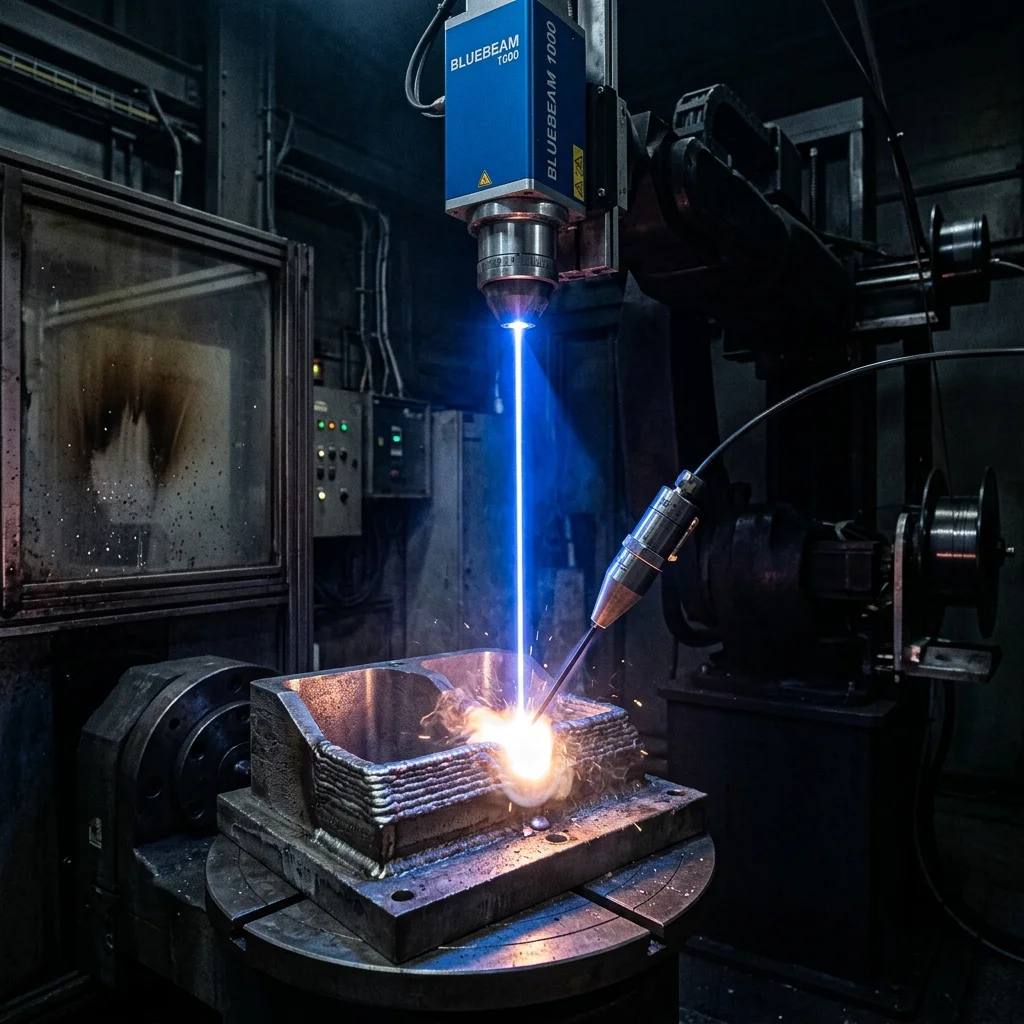
In 2025–2026, Directed Energy Deposition (DED) with blue diode lasers (450 nm) has emerged as a breakthrough for processing highly reflective metals like copper and gold. Standard IR lasers (1064–1070 nm) achieve only 5–15% absorption on copper: 85–95% of energy is reflected. Blue lasers (450 nm) achieve 40–65% absorption: a revolutionary improvement.
Physics: Why Wavelength Matters
| Metal | IR (1064 nm) Absorption | Blue (450 nm) Absorption | Green (532 nm) Absorption |
|---|---|---|---|
| Copper (Cu) | 5% – 15% | 40% – 65% | 35% – 50% |
| Gold (Au) | 5% – 10% | 40% – 55% | 30% – 40% |
| Aluminum (Al) | 5% – 15% | 20% – 35% | 15% – 25% |
| Steel (Fe) | 30% – 40% | 40% – 50% | 35% – 45% |
Key Insight: For copper and gold, blue lasers are 4–6× more efficient than IR, enabling stable melt pools with less porosity and spatter.
Interactive Filament Selector
Answer 3 quick questions and find the optimal material for your project.
1. What are the mechanical requirements for the part?
2. What temperature will the part operate at?
3. Are there any specific environmental requirements?
Our recommendation:
PLA filament
Ideal for easy printing, model visualization and decorative parts.
Pros and Cons
Pros:
- High Absorption for Cu/Au: 40–65% (vs 5–15% for IR).
- Stable Melt Pool: Less spatter and porosity.
- New Niche: Opens AM for copper, gold, and other reflective metals.
Cons:
- Emerging Technology: Limited commercial systems.
- Lower Power: Currently up to 4 kW (IR lasers reach 20+ kW).
- Higher Cost per Watt: Blue diode lasers are more expensive than IR fiber lasers.
FAQ
Interactive Analyzer for Blue Laser Ded (450 Nm): Revolution In Copper And Gold Processing
Select a profile to view detailed analysis.
The full picture
This article is one page from The Big Book of 3D Printing: 704 illustrated pages covering every technology, material and fix in one reference.
Read it on Kindle →Engineer, author of The Big Book of 3D Printing and additive manufacturing expert