

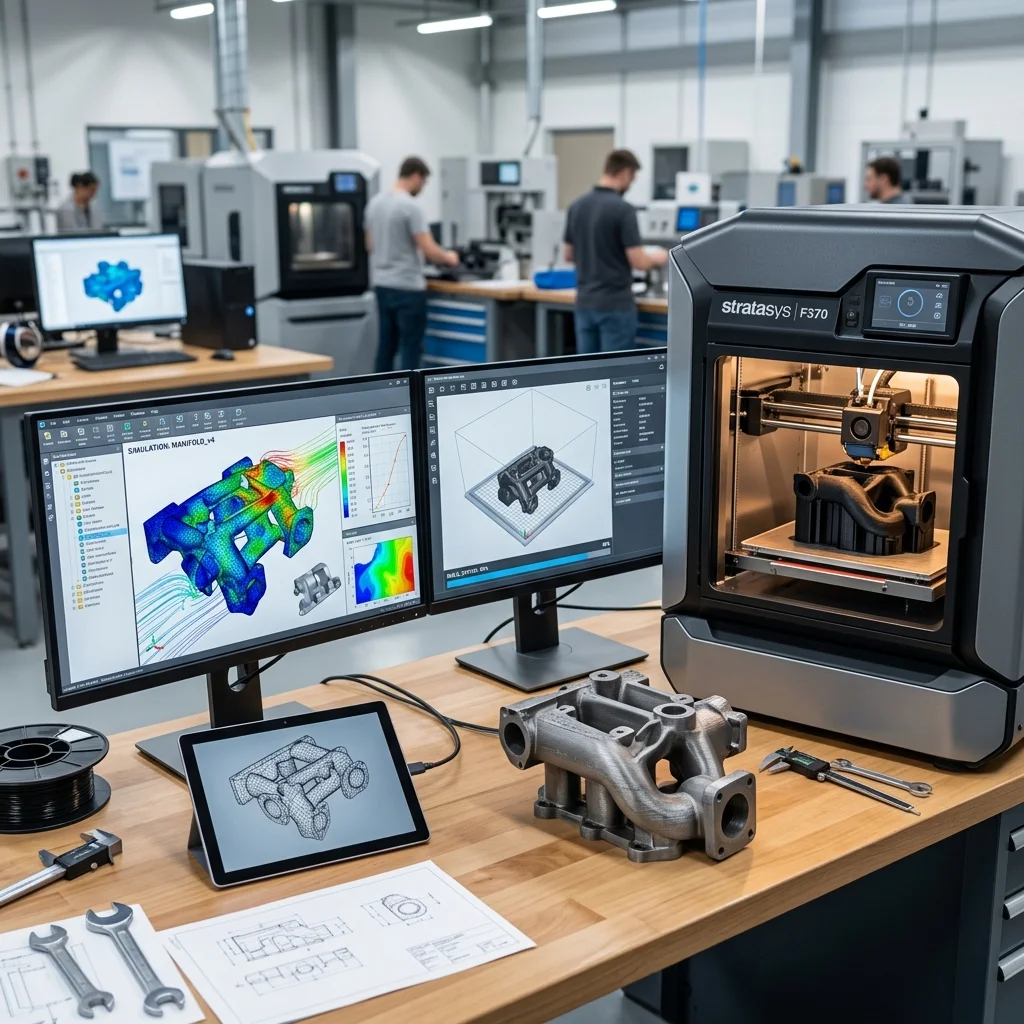
For years, 3D printing was perceived as a craft: an endless loop of trial, error, calibration, and hope. However, as additive manufacturing enters its mature industrial era, hardware alone is no longer the differentiator. The true revolution is unfolding in the digital realm through Digital Twins and advanced thermal simulations. At EduFacturing, our philosophy is to provide you with the 'picks and shovels': the fundamental technical knowledge of these digital tools that breathes purpose into the machine. We are transitioning from a world of iterative prototyping to 'born-qualified' production, where success is mathematically guaranteed before the extruder even heats up.
More Than a 3D Model: Anatomy of a True Digital Twin
Many mistake a Digital Twin for a simple CAD file, but that is only the surface. A true Digital Twin is a dynamic, virtual replica of both the physical part and the entire manufacturing process. It maps the specific kinematics of your machine, the rheological and thermal properties of the polymer or metal, and the ambient environmental variables. This establishes the 'Digital Thread': an unbroken stream of telemetry data bridging the initial conceptual design all the way to the final deposited layer and quality inspection.
Simulating Physics: From Meltpools to Macro-Warpage
Before a single micro-drop of material is extruded, modern simulation software computes the intense physics governing the print. Finite Element Analysis (FEA) allows us to predict the accumulation of residual stresses, thermal distortion (warpage), and inter-layer adhesion failures along the Z-axis. Instead of discovering a severe delamination or lifted corner after a 40-hour print run, the simulation isolates failure points in minutes. It then automatically applies voxel-level geometry compensation or adjusts the toolpath to negate these forces.
AI Orchestration and the 'Zero Defect' Mindset
The era of manual G-code tweaking is rapidly giving way to AI orchestration agents. By evaluating millions of simulated scenarios, these algorithms dynamically optimize speed, cooling, and volumetric flow. This exact engineering philosophy underpins systems like EduFacturing's upcoming 'Zero Defect' tool. The ultimate objective is to achieve 'first-time-right' manufacturing. This approach drastically curtails the waste of expensive engineering-grade materials and eliminates unpredictable machine downtime.
In-Situ Monitoring: Closing the Loop
No matter how precise a simulation is, it remains an idealized plan: real-world physics is inherently chaotic. This is where real-time (in-situ) monitoring bridges the gap. High-resolution optical cameras, thermal arrays, and LiDAR sensors inspect the print layer by layer, feeding data back into the Digital Twin. If the actual thermal gradient of the part deviates from the simulated model, the system executes on-the-fly corrections to flow rate or cooling (closed-loop control). This transforms the 3D printer from a 'blind' executor into an intelligent, self-aware robotic cell.
Conclusion
The transition from an experimental hobbyist endeavor to a predictable, standardized industrial process is fundamentally software-driven. Digital Twins and process simulations are no longer exotic concepts reserved solely for aerospace giants; they are democratizing rapidly. By mastering this digital half of the equation, you are not merely pressing 'Print': you are orchestrating a reliable, high-tech micro-factory.
The full picture
This article is one page from The Big Book of 3D Printing: 704 illustrated pages covering every technology, material and fix in one reference.
Read it on Kindle →Engineer, author of The Big Book of 3D Printing and additive manufacturing expert