

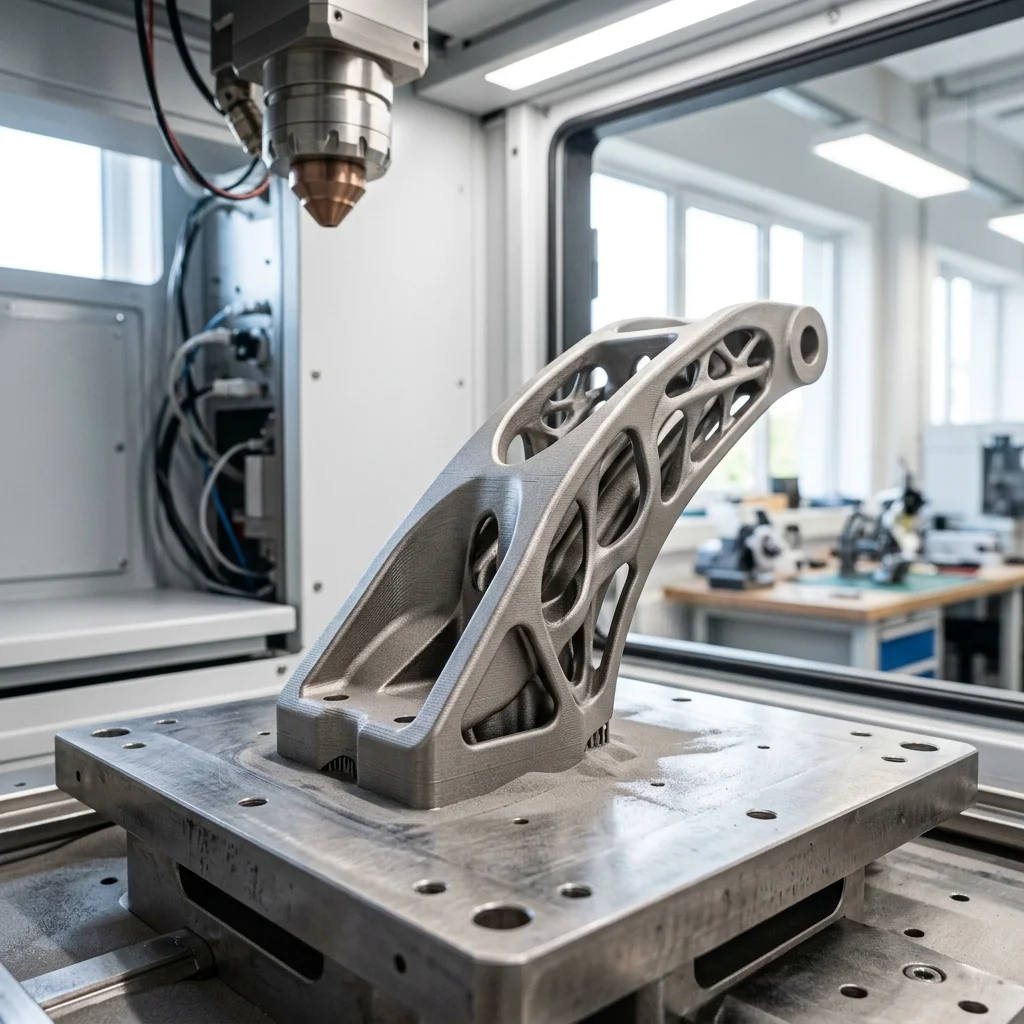
In the world of conventional manufacturing, we are accustomed to thinking in terms of material subtraction. However, 3D printing demands an entirely new paradigm: Design for Additive Manufacturing (DfAM). Our philosophy here, the metaphorical "picks and shovels" of modern engineering, is not just about creating geometry, but understanding how that geometry is built layer by layer.
Support structures are often necessary, but they represent a waste of material, extended print times, and labor-intensive post-processing. True mastery in additive manufacturing lies in designing a part so that it supports itself during the build process. In this guide, we will explore proven engineering approaches to drastically reduce or completely eliminate the need for supports.
1. The 45-Degree Rule and Smart Geometry
The most fundamental law in FDM/FFF and SLA printing is related to overhangs. As a general rule, any angle up to 45 degrees from the vertical can be printed flawlessly without support. Instead of designing straight, 90-degree overhangs, integrate chamfers rather than fillets at the bottom of your part. A fillet creates a progressively increasing angle that eventually becomes nearly horizontal and droops, whereas a 45-degree chamfer provides a perfect, self-supporting foundation.
This same principle applies to horizontally oriented holes. Circular holes have a flat "ceiling" that often sags. By replacing them with teardrop or diamond-shaped holes, we eliminate the horizontal bridge, allowing the machine to close the contour through self-supporting angled layers.
2. Bridges, Arches, and Domes: Lessons from Classical Architecture
When horizontal overhangs are unavoidable, we can borrow solutions from ancient architecture. Replacing flat ceilings with arches or domes distributes stress and allows the material to build upon itself gradually. This not only eliminates the need for internal support structures but also significantly improves the mechanical strength of the part.
For shorter distances (typically under 5–10 mm), modern 3D printers excel at bridging. Through precise cooling and speed control, the printer pulls the filament taut between two anchor points. Designing with bridging in mind allows you to integrate cable channels or small gaps without clogging the interior with support material.
3. Divide and Conquer: Modular Design
Sometimes the best way to print an incredibly complex part is not to print it as a single piece. Modular design is a key DfAM strategy. By strategically splitting the model into two or more components, you can ensure a perfectly flat base for each segment and completely eliminate the need for supports.
To maintain structural integrity, integrate hidden joints directly into the CAD software: dovetails, alignment pins, snap-fit mechanisms, or keyways. When seams are placed at natural geometric transitions, the assembled part looks flawless, and you save hours of printing and post-processing time.
4. Topology Optimization and Generative Design
The future of additive manufacturing belongs to software algorithms that remove mass wherever it is not structurally necessary (the concept of Via Negativa). Using topology optimization, we create organic, bionic structures that are not only much lighter but often entirely self-supporting.
These algorithms generate forms that naturally avoid massive horizontal volumes. Combined with internal lattice structures or gyroid infills, we rethink the part from the inside out. The result is an engineering masterpiece that maximizes strength, minimizes weight, and prints with an absolute minimum of support material.
Conclusion
Designing for minimal support is a true test of an engineer's maturity in 3D printing. It requires a shift in mindset, from conventional subtractive methods to additive construction. By implementing these DfAM principles, we don't just optimize production; we create more elegant, functional, and sustainable products. The industry is moving forward rapidly, and mastering these techniques is the key to unlocking the full potential of EduFacturing technologies.
The full picture
This article is one page from The Big Book of 3D Printing: 704 illustrated pages covering every technology, material and fix in one reference.
Read it on Kindle →Engineer, author of The Big Book of 3D Printing and additive manufacturing expert