

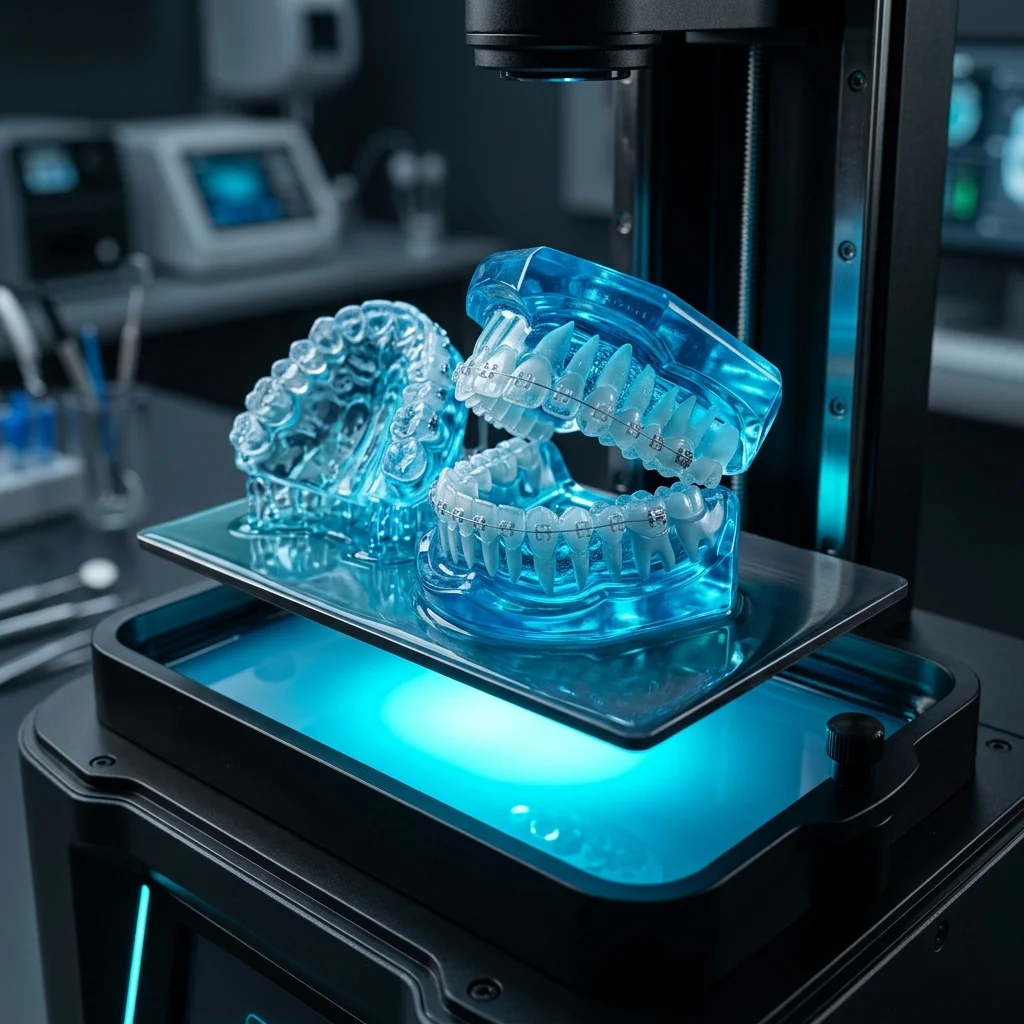
Dental 3D printing is one of the most mature professional uses of the technology, over 95% of dental labs in developed markets use 3D printing for crowns, bridges, surgical guides, and orthodontic clear aligners. In Bulgaria the transformation is slower but steady: dozens of new dental studios open with 3D printing workflow from 2022 onwards. With the right setup (MSLA/DLP printer for €500-€2000 + dental-grade resin + scanner from partner dental practice), one solo dental lab can print 30-50 crowns per day, replacing a 5-week ceramic milling workflow. This guide: typical dental applications, recommended printers, and cost expectations.
What gets printed in a dental lab
Crowns (permanent and temporary): patterns printed in castable resin, then lost-wax cast in cobalt-chrome or gold. Alternative: print directly in ceramic-filled resin (zirconia composite). 3D printed crown ready for patient in 3-5 hours vs 2-3 weeks traditional workflow.
Bridges: same workflow as crowns but with more complex geometry. 3D printing enables complex multi-unit bridges (5+ teeth) impossible to mill conventionally.
Surgical guides: clear or blue resin guides for implant placement. Print directly in Surgical Grade resin (ISO 10993 certified). Used by oral surgeons for precise drill placement.
Orthodontic models: printed patient teeth model for clear aligner trays. Standard resin or dental model resin. ClearCorrect, Invisalign business uses thousands of dental printers for this single application.
Night guards / splints: TPU-like flexible dental resin (Saremco Print Splint, NextDent Ortho IBT). Print directly, no casting needed.
Dentures: full denture base + tooth printing in specialized materials (NextDent Denture 3D+, Detax FreePrint Denture). Replaces 3-4 hour wax-up + casting workflow.
Teaching models: anatomical teeth + jaw models for education. Printed once per design, used hundreds of times.
Implant surgical templates: precision guides for implant placement, custom for each patient.
Recommended printers for dental lab
Anycubic Photon Mono M5s Pro (€529): entry dental MSLA. Build 218×123×200mm: fits 8-10 crowns per batch. 12K display, auto-resin-fill. Recommended for solo dentist starting digital workflow.
Elegoo Saturn 4 Ultra (€499): equivalent capability. Integrated dryer and cure. Best value combination for professional dental.
Formlabs Form 4 (€4500): premium choice. SLA technology, validated dental resin library (35+ approved resins), Form Wash + Form Cure integration. Required for multi-doctor lab serving 50+ crowns/day.
Formlabs Form 4B (€7500) – Form 4 + ISO 13485 medical workflow. Required for labs that ship crowns directly to patients (vs through dentist intermediary).
Anycubic Photon D2 (€471): DLP option. Long-term durability (no LCD replacement) makes it production-friendly. Slightly smaller build than MSLA equivalents.
Asiga MAX UV385 (€10,000+): professional dental DLP. Validated workflow for all major dental software (3Shape, exocad, DentBird). Required for high-volume labs.
For solo dentist starting digital: Anycubic M5s Pro (€529) + Wash & Cure Plus (€110) + 1L Cast resin (€100) + scanner partnership = €739 setup. Pays back in 50-80 crowns.
Recommended dental resins
Crown patterns (for casting):
NextDent Cast (€120-€150/liter): industry standard for crown casting patterns. Burns clean at 730°C.
Formlabs Castable Wax (€199/liter): Form 4 only. Industry gold standard.
Direct crown materials (no casting):
Formlabs Permanent Crown V2 (€399/liter): ceramic-filled, prints directly to permanent crown. CE/FDA approved.
Saremco Print Crown (€350/liter): equivalent to Formlabs Permanent.
NextDent C&B (Crown and Bridge) (€280/liter): temporary crowns.
Surgical guides:
Formlabs Surgical Guide (€199/liter) – clear, ISO 10993 certified.
NextDent SG (€180/liter): equivalent.
Detax FreePrint Surgical Guide (€200/liter): German manufacturer.
Orthodontic models:
NextDent Model 2.0 (€90/liter): fast print, less premium but sufficient for clear aligner production.
Formlabs Grey V5 + slight tinted: many labs use standard grey for models.
Night guards / splints:
NextDent Ortho IBT (€220/liter): biocompatible, FDA/CE approved.
Saremco Print Splint (€250/liter): equivalent. Used by Invisalign network.
Daily lab workflow
Workflow for 5-10 crown lab using Anycubic Mono M5s Pro + NextDent Cast:
8am: lab open. Power on printer, Wash & Cure station, burnout kiln.
8:30am: receive 5-8 STL files from CAD designer (3Shape, exocad, DentBird). Quick review for printability.
9am: slice in Anycubic Workshop with dental preset. Orient crowns margin-down on platform. Auto-generate supports.
9:30am: start print. Batch of 8 crowns on M5s Pro: 90-120 minutes.
11am: print complete. Wash 3 minutes IPA 99%, dry 5 minutes.
11:15am: SHORT cure ONLY (2-3 minutes per side for castable). Remove supports while leather-hard.
11:30am: inspect under loupe. Quality check: re-print any defective patterns (~5-10% defect rate first month, drops to <2% with experience).
12pm-1pm: lunch break. Patterns ready for sprueing.
1pm-2pm: sprue assembly. Attach 8-12 patterns to single wax tree.
2pm: investment pour. Allow 2 hours for investment to set in flask.
4pm: start burnout cycle (5-6 hours overnight ramp).
8am next day: cast metal (cobalt-chrome, gold, titanium). Devest, finish, polish, finalize.
Daily output: 5-10 finished crowns shipped to dentist client. Lab time: 4-6 hours hands-on. Material cost per crown: €5-€10 (resin €2 + investment €1 + metal €3-€7). Lab charges dentist: €60-€150 per crown. Dentist sells to patient: €200-€500.
Cost + ROI analysis for digital dentist starting up
Setup costs:
Minimum digital dental setup (1 dentist, in-office printing): Anycubic Mono M5s Pro: €529 Anycubic Wash & Cure Plus: €110 Initial materials (1L Cast + 1L Surgical Guide + 1L Model): €300-€400 Software (Lychee Slicer 1-year): €60 Total: €1000-€1100
Without casting (direct print only): same setup minus burnout kiln. €1000-€1100.
With casting (full lab): add €500-€2000 burnout kiln + €800-€3000 centrifugal or vacuum caster. Total €2500-€5000.
Professional medium lab setup: Formlabs Form 4: €4500 Form Wash + Form Cure: €1400 Initial materials (3L variety): €700 Total: €6600
Production lab setup (10+ crowns/day): Form 4 × 2 units (redundancy): €9000 Form Wash + Form Cure: €1400 Asiga MAX UV385 (high-volume DLP): €12,000 Burnout kiln (industrial): €5000 Vacuum casting: €4000 Total: €31,400 (capacity 30-50 crowns/day)
ROI: Solo dentist: 50-80 crowns sold to patients pays back €1100 setup. Typically 2-4 weeks at modest pace. Medium lab: 200-300 crowns pays back €6600. Typically 2-3 months. Production lab: 1500-2000 crowns pays back €31K. Typically 4-6 months at full capacity.
Frequently Asked Questions (FAQ)
Traditional ceramic milling: €30-€80 cost per crown (ceramic block + milling time). Lab charges €100-€250. Dentist sells €350-€700.
3D printing with casting is cheaper on material but has longer lead time (1-2 days for burnout cycle). Traditional milling is faster (1-2 hours per crown) but more expensive. Most labs use both depending on case.
Interactive Analyzer for 3D Printing For Dental Models And Impressions
Select a profile to view detailed analysis.
The full picture
This article is one page from The Big Book of 3D Printing: 704 illustrated pages covering every technology, material and fix in one reference.
Read it on Kindle →Engineer, author of The Big Book of 3D Printing and additive manufacturing expert