

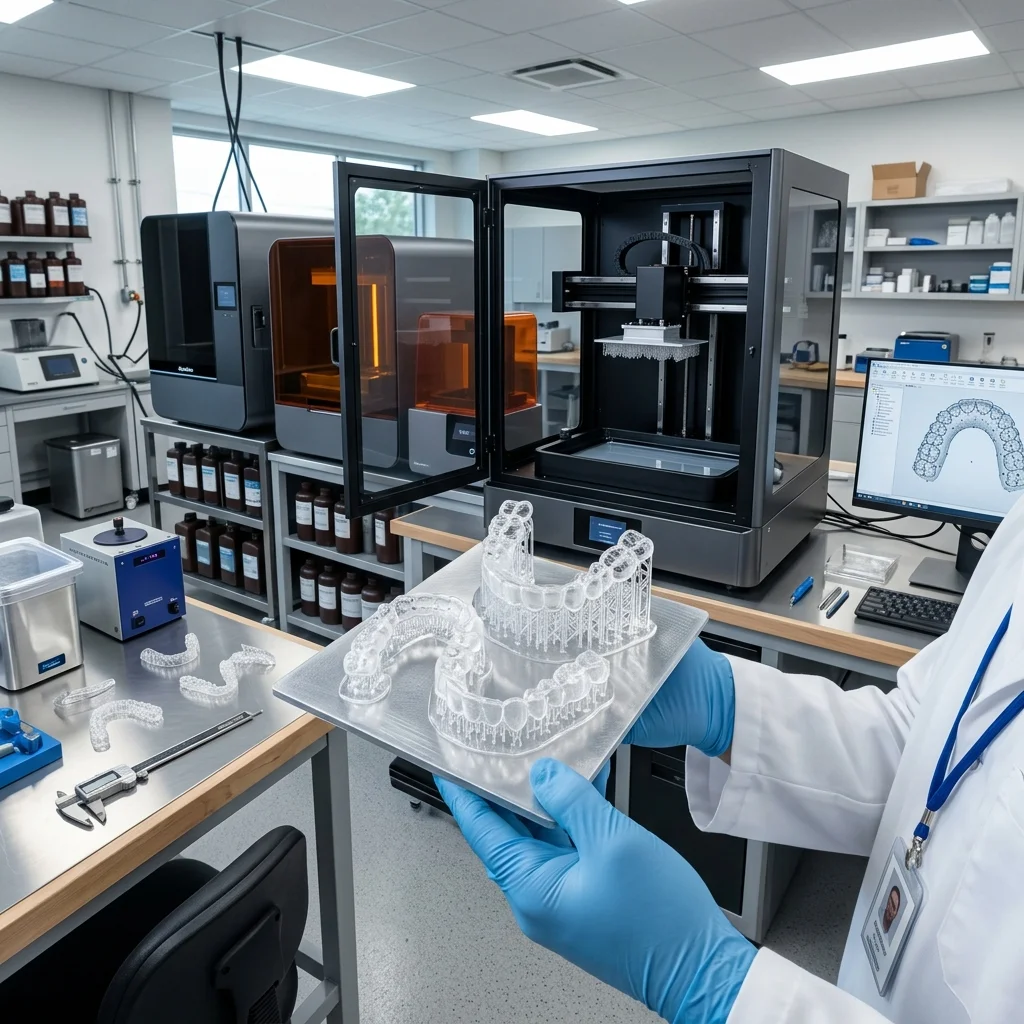
For decades, the production of clear aligners relied on a multi-step thermoforming process: printing physical dental models, heating a thermoplastic sheet, and vacuum-forming it over the model. While effective, this analog constraint within a digital workflow introduced geometric distortions, material limitations, and significant plastic waste. Today, a monumental shift is occurring in digital dentistry: direct 3D printing of clear aligners using advanced biocompatible photopolymers. This technology completely bypasses the physical model, printing the aligner itself layer-by-layer with unprecedented precision and opening new frontiers in orthodontic biomechanics.
The End of Thermoforming Constraints
Traditional thermoforming (using PETG or TPU sheets) inherently limits design. As the heated plastic stretches over the model, it thins out unpredictably, reducing the dimensional accuracy to around 75% compared to the digital plan. Direct 3D printing achieves over 96% accuracy by eliminating the stretching phase. Furthermore, direct printing is a highly sustainable process, generating minimal material waste by using only the exact amount of resin required for the aligner, and entirely eliminating the discarded printed models and plastic cutoffs.
Advanced Photopolymers and Shape Memory Mechanics
The viability of direct-printed aligners hinges on groundbreaking advancements in resin chemistry. Modern aligner resins, such as aliphatic urethane acrylate-based photopolymers (e.g., Graphy’s TC-85) or proprietary multi-component systems (like LuxCreo’s ActiveMemory™ Polymer), feature a unique molecular architecture. They utilize a combination of "hard segments" for structural stability and force retention, and "soft segments" for flexibility. This creates a distinct "shape memory" effect. When exposed to oral temperatures or warm water, the aligner can temporarily deform to easily pass over undercuts, then recover its programmed shape, applying consistent, gentle corrective forces without succumbing to the rapid force decay typical of traditional thermoplastics.
Biomechanical Superiority via Variable Thickness
Perhaps the most revolutionary aspect of direct 3D printing is the ability to engineer variable thickness within a single aligner. Thermoformed plastic has a uniform thickness, forcing orthodontists to rely heavily on bonded composite attachments to direct complex tooth movements. With direct printing, clinicians can computationally design the aligner to be thinner and more flexible at the gingival margin for enhanced patient comfort, while remaining thicker and more rigid at the incisal edges to maximize force delivery. This intrinsic biomechanical control can reduce treatment times and decrease the necessity for numerous clinical attachments.
Integrated Clinical Workflows and Challenges
Transitioning to direct 3D printed aligners enables "chairside" or "same-day" orthodontics. Utilizing high-speed DLP (Digital Light Processing) printers coupled with automated washing and UV curing stations, clinics can move from intraoral scan to final appliance in a matter of hours. These resins meet stringent FDA Class II 510(k) and ISO 10993 biocompatibility requirements. However, the technology is still evolving; current research is heavily focused on minimizing the inherent surface roughness of printed resins to prevent biofilm accumulation and improve optical clarity, ensuring the aligners remain both hygienic and aesthetically invisible throughout treatment.
Conclusion
Direct 3D printing of clear aligners is not just a manufacturing upgrade; it is a fundamental reinvention of orthodontic biomechanics. By combining shape-memory photopolymers with layerless geometric freedom, digital dentistry is entering an era where precision, patient comfort, and clinical efficiency are united.
The full picture
This article is one page from The Big Book of 3D Printing: 704 illustrated pages covering every technology, material and fix in one reference.
Read it on Kindle →Engineer, author of The Big Book of 3D Printing and additive manufacturing expert