

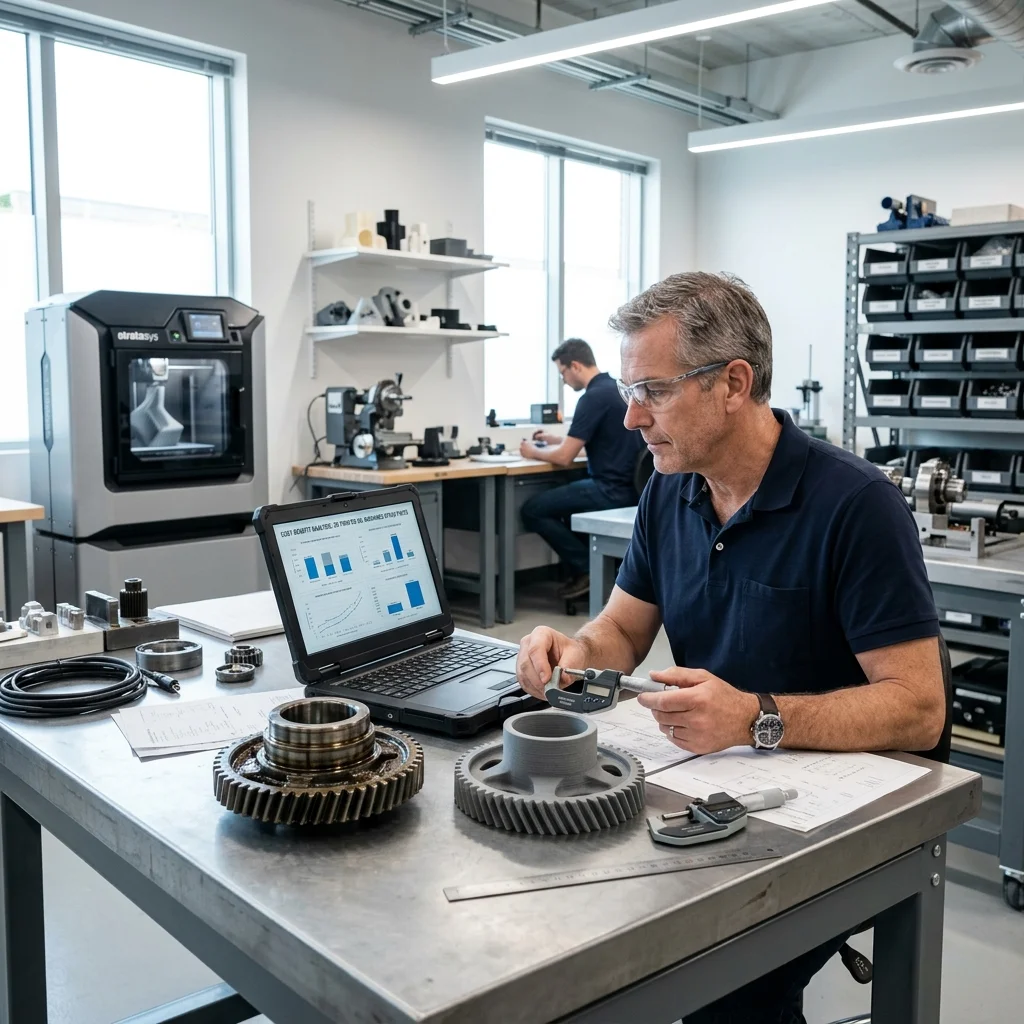
In modern industry, spare parts management is often accompanied by a frustrating paradox: maintaining huge inventory levels ties up massive amounts of capital, yet lacking a critical component can lead to catastrophic financial losses from equipment downtime. Traditional supply chain models constantly struggle to balance these two extremes.
Enter additive manufacturing. 3D printing offers a revolutionary alternative: shifting from physical warehouses to "digital inventory." But is the technology always cost-effective? To answer this, we must look beyond a simple per-part price calculation and apply a comprehensive Total Cost of Ownership (TCO) analysis.
The True Cost of Traditional Spare Parts Management
Before evaluating the investment in 3D printing, we must understand the actual cost of the status quo. Traditional mass manufacturing relies on economies of scale, forcing companies to order thousands of units of a specific part, even when they only need a few. This leads to immense warehousing costs, including rent, security, and climate control, as well as significant inventory management overhead.
The more severe issue is obsolescence. A massive percentage of warehoused components are never used because the machines they are meant for depreciate or are decommissioned. Add to this the complex logistics, shipping fees, and customs delays, and every physical part becomes a substantial financial burden long before it is actually installed on the factory floor.
Direct Costs of 3D Printing (The Investment)
Implementing 3D printing requires both Capital Expenditures (CapEx) and Operational Expenditures (OpEx). Industrial 3D printers (whether they utilize FDM for high-strength engineering polymers, or SLS and LPBF for metals) represent a serious upfront investment.
Direct production costs include the price of raw materials, which in 3D printing are often higher per kilogram than conventional bulk materials. Energy consumption for running the machines must also be calculated, alongside the human labor required for post-processing: such as support structure removal, sanding, heat treatment, and quality assurance (QA). However, unlike injection molding, there are zero expensive tooling costs, which completely alters the financial math for low-volume production.
The Financial Benefits: Digital Inventory and Downtime Mitigation
The true Return on Investment (ROI) of 3D printing does not come from producing millions of cheap plastic widgets, but from strategic risk mitigation. The most obvious benefit is the drastic reduction of unplanned equipment downtime. When a critical machine stops and the Original Equipment Manufacturer (OEM) quotes a 6-week lead time, financial losses can reach hundreds of thousands of dollars. The ability to locally print a replacement part within 24 hours justifies the AM investment almost instantly.
Furthermore, the concept of a "digital inventory" allows companies to store 3D CAD models in the cloud or on a secure local server, printing parts strictly on-demand. This frees up physical floor space, greatly improves the company's cash flow, and entirely eliminates the risk of manufacturing surplus, unsellable components.
When Does 3D Printing Make Financial Sense? The Hybrid Model
A thorough cost-benefit analysis clearly shows that 3D printing is not a universal replacement for traditional manufacturing, but rather a powerful partner. The technology is exceptionally cost-effective in the following scenarios:
1. **Low-Volume Production:** For runs of 1 to 100 units, the absence of tooling costs makes additive manufacturing the undisputed favorite.
2. **Legacy Parts:** When OEMs no longer support older systems, reverse engineering combined with 3D printing is often the only viable sourcing solution.
3. **Design Optimization:** 3D printing allows the consolidation of multi-part assemblies into a single, complex component, reducing assembly time and potential failure points.
Today's most successful organizations deploy a **hybrid model**: mass-produced and simple parts are sourced through traditional channels, while complex, downtime-critical, and low-volume spare parts are manufactured locally via 3D printing.
Conclusion
Ultimately, analyzing the costs and benefits of 3D printed spare parts requires a paradigm shift. Engineers and supply chain managers must stop comparing just the unit price of a printed part against one mass-produced overseas. The true value of additive manufacturing lies in supply chain resilience, drastically reduced downtime risks, and liberated working capital. Investing in the knowledge of how and when to apply this technology is the key to mastering the industry of the future.
The full picture
This article is one page from The Big Book of 3D Printing: 704 illustrated pages covering every technology, material and fix in one reference.
Read it on Kindle →Engineer, author of The Big Book of 3D Printing and additive manufacturing expert