

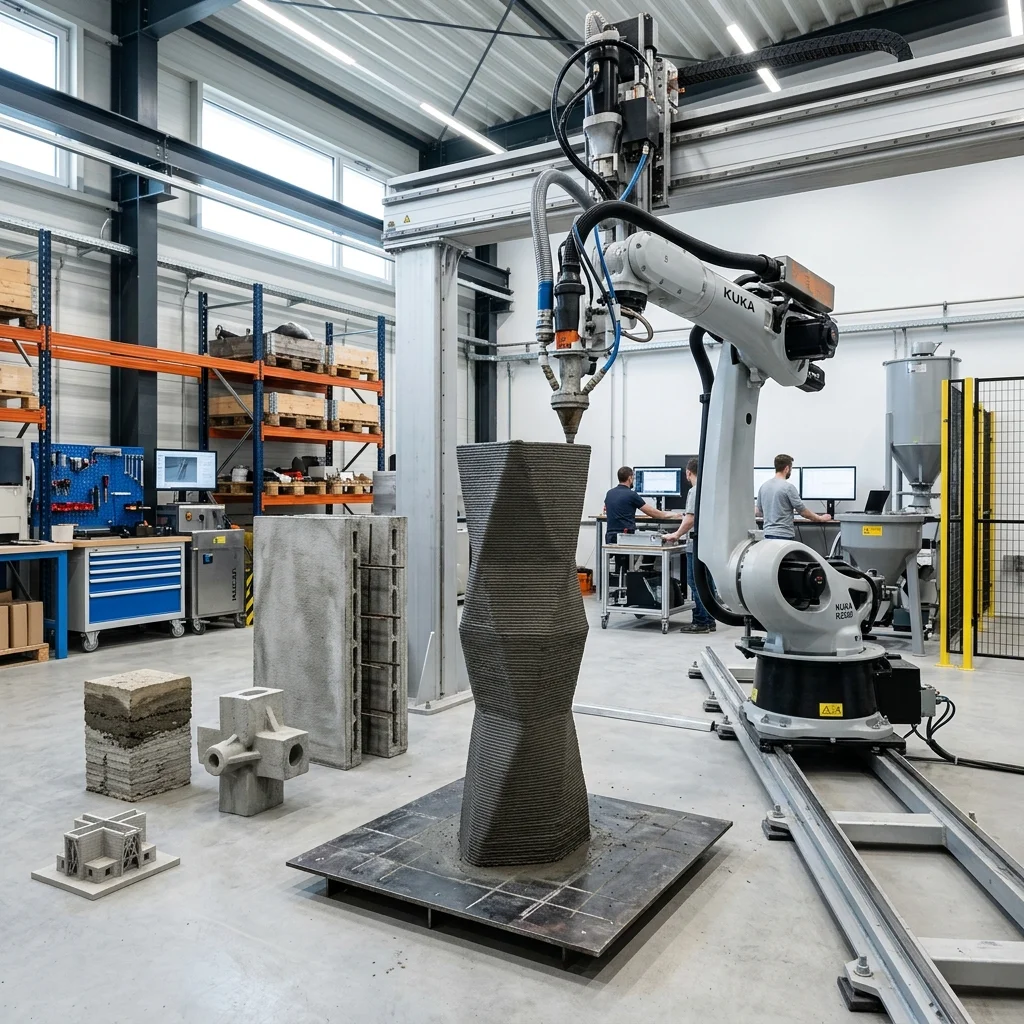
Until recently, 3D concrete printing (3DCP) in construction was perceived largely as an experimental method suited for non-load-bearing walls and architectural aesthetics. Today, in 2026, the technology has undergone a fundamental metamorphosis, maturing into a fully certified and reliable process for fabricating massive, load-bearing structural components. This transition has been driven by breakthroughs in material science, automated reinforcement systems, and the deep integration of complex BIM models into the production pipeline.
For engineers and architects, concrete 3D printing is no longer just a 'fast' way to build; it is a profound tool for geometric optimization, carbon footprint reduction, and breaking free from the constraints of traditional formwork. In this article, we dive deep into the technical details that are turning extruded concrete into the backbone of future infrastructure.
Overcoming the Ultimate Hurdle: Integrated Reinforcement
Historically, the Achilles' heel of 3DCP was the lack of reliable reinforcement systems capable of withstanding tensile and bending forces equivalent to traditional reinforced concrete. Today, this has been resolved through advanced hybrid and fully robotic systems. In modern load-bearing structures, such as the landmark 30-meter-tall Tor Alva tower in Switzerland, methods like 'automated helical reinforcement' are actively deployed. During the printing process, collaborative robots integrate horizontal steel rings between the deposited layers. Concurrently, the printed geometry incorporates pre-designed vertical channels into which longitudinal rebars are inserted. These channels are subsequently filled with self-compacting mortar, effectively 'locking' the system and creating a highly robust, monolithic structure.
Material Science Innovations: Geopolymers and Rheology
The rheology of the concrete mix is the core engine of 3DCP technology. The material must strike an exquisite balance: it requires sufficient 'flowability' to be pumped through delivery systems and the extruder, while simultaneously possessing an immediate 'yield stress' upon deposition to support the weight of subsequent layers without collapsing or deforming. Recently, the industry has shifted toward low-carbon geopolymer concretes and even carbon-capturing mixtures. These advanced materials cure rapidly and offer significant sustainability benefits. By injecting chemical accelerators directly at the print head nozzle, operators can dynamically control the setting time, adjusting on the fly to match the robot's travel speed and ambient environmental conditions.
BIM Integration and Topological Optimization
Additive construction is an inherently digital process that unlocks the full potential of topological optimization. Utilizing modern Building Information Modeling (BIM) software, structural engineers can design nature-inspired, biomimetic structures that distribute loads optimally while utilizing the absolute minimum amount of material. Research demonstrates that by generating complex internal lattice structures within floor slabs and walls, material consumption can be reduced by up to 40%. This sophisticated approach is executed through two primary hardware paradigms: large-scale gantry systems optimized for massive, rectilinear housing projects, and multi-axis articulated robotic arms that provide degrees of freedom for executing complex, organic architectural geometries.
Standardization and Real-Time Quality Assurance
The technology could not have achieved its current maturity without a parallel evolution in regulatory frameworks. Institutions such as the International Code Council (ICC) have actively developed specific guidelines for 3D Automated Construction Technology. Acceptance criteria, such as the AC509 in the United States, have established a rigorous framework for evaluating 3D-printed walls as monolithic concrete structures. Novel testing protocols like the 'slant shear test' are critical in proving interlayer adhesion and shear strength. Furthermore, the printing process itself now integrates real-time quality control via sensor arrays and computer vision. These systems measure strain, displacement, and CAD-model deviations with sub-millimeter precision, preempting structural defects before the concrete even sets.
Conclusion
Concrete 3D printing has decisively moved beyond being a mere marketing novelty; it is a fully functional, certified, and economically viable engineering solution. With the market projected to grow at a staggering CAGR of over 47% through the early 2030s, additive construction provides tangible solutions to global macroeconomic challenges: including severe labor shortages, the demand for affordable housing, and the necessity for disaster-resilient infrastructure. This is the future of the built environment: intelligent, sustainable, and literally printed layer by layer.
The full picture
This article is one page from The Big Book of 3D Printing: 704 illustrated pages covering every technology, material and fix in one reference.
Read it on Kindle →Engineer, author of The Big Book of 3D Printing and additive manufacturing expert