

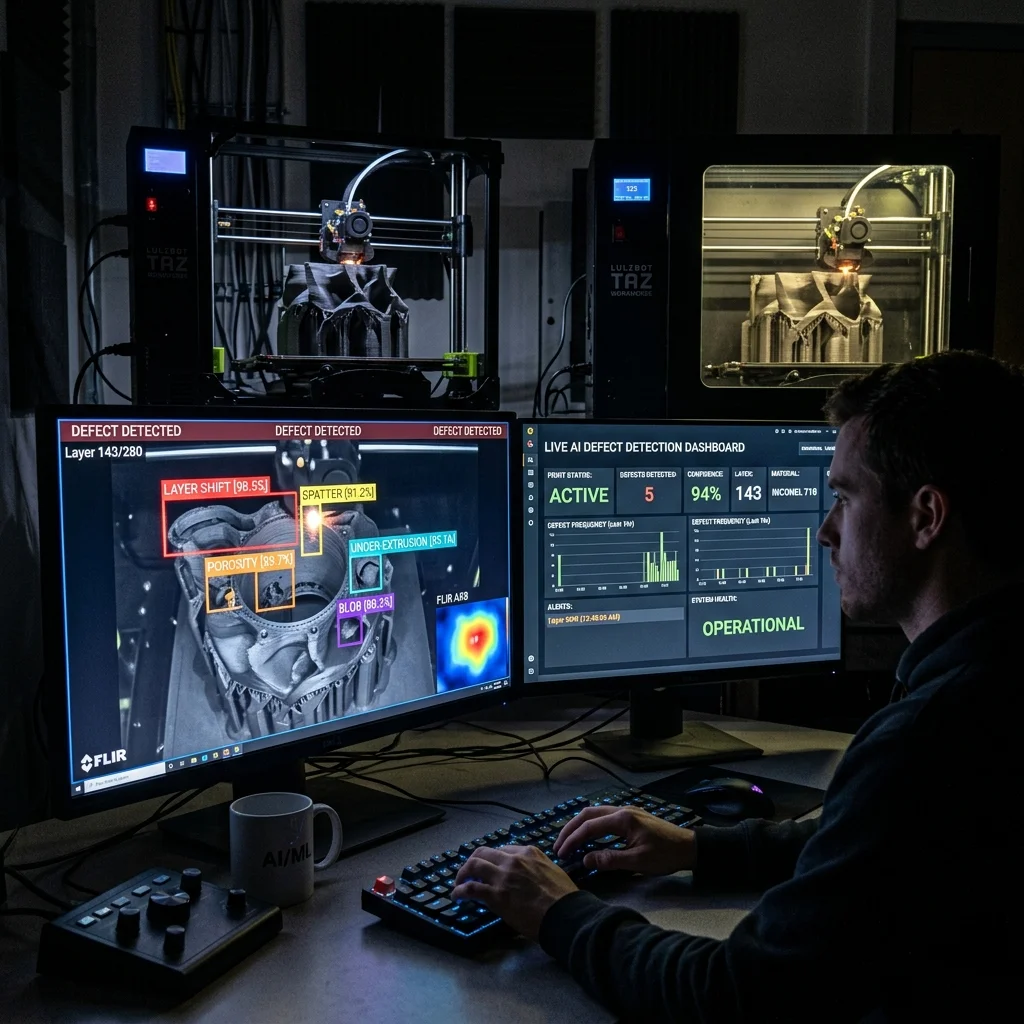
In 2025–2026, Computer Vision (CV) print monitoring is transforming 3D printers from “blind” machines into intelligent agents capable of detecting failures, pausing failed prints, and optimizing quality in real time.
The Problem: The Blind Printer
Standard FDM printers have zero quality feedback: spaghetti failures waste hours of filament, layer shifts go undetected, and defects accumulate unseen.
Interactive Filament Selector
Answer 3 quick questions and find the optimal material for your project.
1. What are the mechanical requirements for the part?
2. What temperature will the part operate at?
3. Are there any specific environmental requirements?
Our recommendation:
PLA filament
Ideal for easy printing, model visualization and decorative parts.
CV Architecture for Print Monitoring
1. Camera + Edge Computing
USB camera (720p–1080p), Raspberry Pi 4/5 or Jetson Nano, OctoPrint + Obico or custom ML pipeline.
2. Detection Models
| Model | Detected Defects | Architecture |
|---|---|---|
| Spaghetti Detection | Detached parts, spaghetti | YOLOv5/v8 |
| Layer Anomaly | Layer shifting, gaps, blobs | CNN Classification |
| Under/Over-Extrusion | Thin/thick beads | Semantic Segmentation |
| Warping | Corner lifting | Edge Detection + ML |
3. Actions on Detection
- Auto-pause/stop on detected failure.
- Push notification to operator’s phone.
- Automatic recovery for certain defects.
Platforms
| Platform | Price | AI Model |
|---|---|---|
| Obico | Free/Pro | YOLOv5 cloud/local |
| OctoEverywhere | Freemium | AI Failure Detection |
| Bambu Lab | Included | Proprietary |
| PrintWatch | Open-source | TensorFlow Lite |
Pros and Cons
Pros:
- Saves Filament: Early failure detection → zero spaghetti waste.
- Safety: Detects dangerous situations (overheating).
- Remote Monitoring: Check prints from phone.
Cons:
- False Positives: 5–10% false positive rate.
- Limited Defects: Cannot detect internal defects.
- Camera Dependent: Poor lighting degrades detection.
FAQ
Interactive Analyzer for Computer Vision Print Monitoring: The Intelligent Printer
Select a profile to view detailed analysis.
The full picture
This article is one page from The Big Book of 3D Printing: 704 illustrated pages covering every technology, material and fix in one reference.
Read it on Kindle →Engineer, author of The Big Book of 3D Printing and additive manufacturing expert