

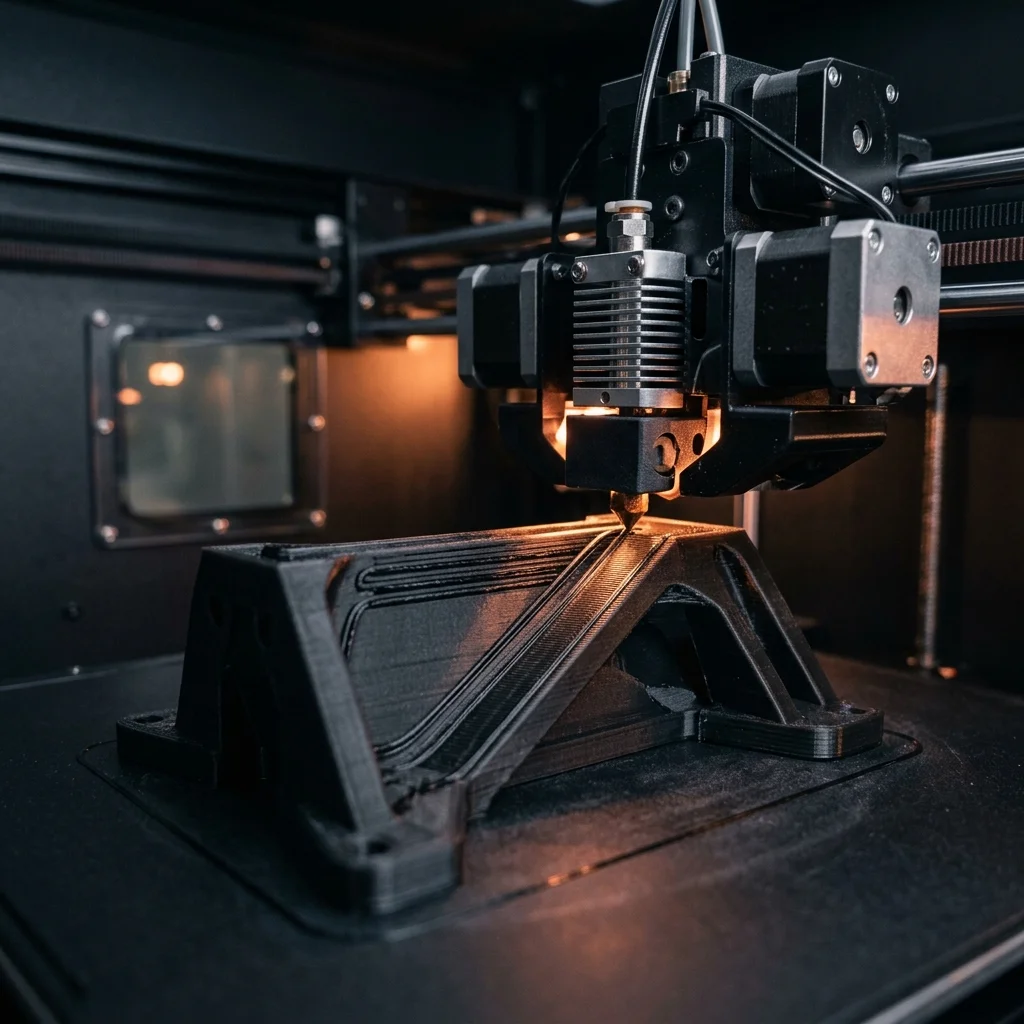
Continuous Filament Fabrication (CFF) has completely changed composite manufacturing by delivering parts with the strength of aluminum. When paired with Flame Retardant materials, this technology becomes essential for the aerospace, automotive, and electronics industries, where fire safety is strictly regulated. This guide covers the critical hardware, material selection, and workflows needed to successfully print flame-retardant components.
Understanding CFF Technology
Continuous Filament Fabrication (CFF) is an advanced composite 3D printing process where a continuous strand of reinforcing fiber (carbon, fiberglass, or Kevlar) is laid within a thermoplastic matrix.
Unlike traditional FDM that uses chopped fibers, the unbroken continuous strand acts like a skeleton inside the part. The process typically utilizes a dual-extrusion system: one nozzle for the plastic matrix and a specialized nozzle to iron down the continuous fiber.
Why Flame Retardant Materials are a Perfect Fit
Flame Retardant materials are specifically formulated to self-extinguish and prevent the spread of fire. They are mandatory for enclosures operating near heat sources or high voltage.
By integrating these properties into the CFF process, engineers can design parts that handle massive mechanical loads while complying with strict fire safety certifications like UL94 V-0. This enables the direct replacement of heavy machined metal parts with lightweight composites.
Recommended CFF 3D Printers
-
Markforged Mark Two: A highly reliable desktop industrial printer. It is considered the benchmark system for printing continuous carbon fiber and Kevlar composites.
-
Markforged X7: The flagship industrial system from Markforged. It features an integrated laser micrometer for quality control and is fully optimized for high-temp flame retardant materials like Onyx FR.
-
Anisoprint Composer A4: An innovative alternative utilizing CFC (Composite Fiber Co-extrusion) technology. It allows users to dynamically adjust the fiber-to-plastic volume ratio during the print.
Recommended Flame Retardant Materials
-
Markforged Onyx FR: A chopped carbon fiber-filled nylon engineered specifically for the Markforged ecosystem. It is UL94 V-0 certified and serves as an exceptional matrix for continuous fibers.
-
Stratasys Ultem 9085: Primarily known for standard FDM, this PEI-based polymer offers legendary fire, smoke, and toxicity (FST) resistance, making it an aerospace standard.
-
Polymaker Polycarbonate FR: A high-performance polycarbonate modified to deliver excellent flame retardancy. It is perfect for applications requiring high thermal stability.
Typical Use Cases
Flame-retardant CFF parts are heavily utilized in aerospace for lightweight brackets, structural mounts, and cabin interiors. In the automotive and drone sectors, they are ideal for custom battery enclosures and high-voltage insulation.
Furthermore, the technology is widely adopted in factory automation to manufacture durable, heat-resistant jigs, fixtures, and robotic end-of-arm tooling without compromising factory safety.
Common Pitfalls and How to Avoid Them
-
Moisture Absorption: Materials like nylon and polycarbonate are highly hygroscopic. They must be printed directly from specialized dry boxes to prevent print failures and degraded mechanical properties.
-
Improper Fiber Routing: Continuous fibers must be aligned with the load paths of the part. If the slicing software (e.g., Eiger) is not configured correctly, the part may fail under stress.
-
Hardware Wear: Continuous fibers are incredibly abrasive. This requires meticulous maintenance of the print nozzles and frequent replacement of the automatic fiber cutter mechanism.
Cost Estimation
Matrix Material (Onyx FR): ~€200 – €300 per kilogram.
Continuous Carbon Fiber: ~€1000 for an equivalent volume spool.
Hardware Depreciation: High, due to specialized mechanisms and proprietary ecosystem.
Cost per Part: Highly competitive compared to CNC machining due to the elimination of tooling and setup time.
Frequently Asked Questions (FAQ)
Interactive Analyzer for Cff 3D Printing With Flame Retardant Materials: Ultimate Guide
Select a profile to view detailed analysis.
The full picture
This article is one page from The Big Book of 3D Printing: 704 illustrated pages covering every technology, material and fix in one reference.
Read it on Kindle →Engineer, author of The Big Book of 3D Printing and additive manufacturing expert