

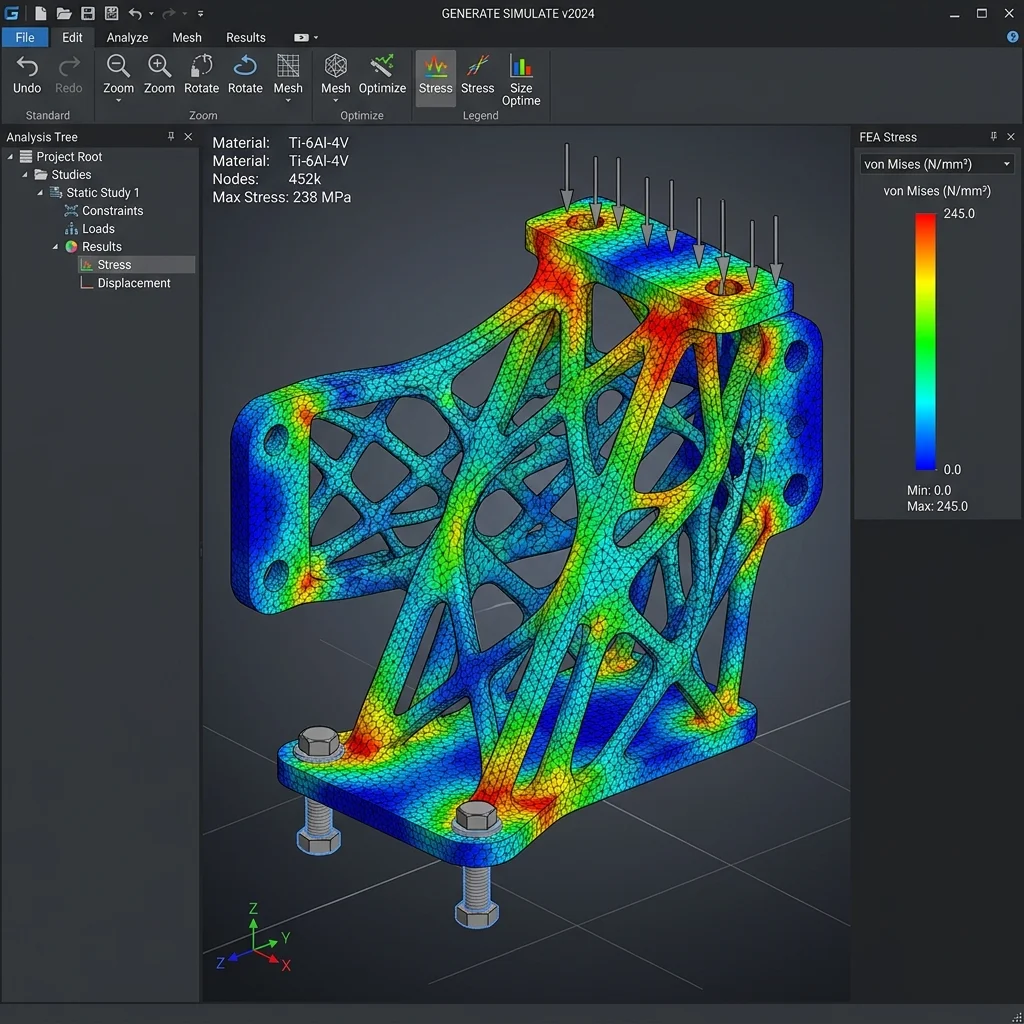
In 2025–2026, Generative Design in CAD platforms transforms 3D printing from “I make what I can draw” to “I make what physics dictates.” Using topology optimization and AI algorithms, generative design automatically creates optimal structures satisfying specific loads at minimum mass.
Principle: Topology Optimization
- Design Space: Maximum volume the part can occupy.
- Loads and Fixtures: Applied forces, moments, thermal loads, fixed supports.
- Constraints: Minimum wall thickness, max stress, AM manufacturing constraints.
- Optimization: Algorithm iteratively removes low-stress material, retains high-stress material.
- Result: Organic, bionic structure with optimal material distribution.
Interactive Filament Selector
Answer 3 quick questions and find the optimal material for your project.
1. What are the mechanical requirements for the part?
2. What temperature will the part operate at?
3. Are there any specific environmental requirements?
Our recommendation:
PLA filament
Ideal for easy printing, model visualization and decorative parts.
Platforms
| Platform | Method | AM Constraints | Price |
|---|---|---|---|
| Fusion 360 | Topology + Generative | Overhang, build direction | Included |
| nTopology | Implicit Modeling + Lattice | Multi-process | Enterprise |
| Altair Inspire | OptiStruct solver | AM-ready designs | Enterprise |
Results
| Metric | Conventional | Generative | Improvement |
|---|---|---|---|
| Mass | 100% | 40–70% | ↓ 30–60% |
| Strength | Satisfactory | Equal or higher | = or ↑ |
| Part Count | Multiple (assembly) | One (consolidated) | ↓ Significant |
FAQ
Interactive Analyzer for Generative Design For 3D Printing: From Load Case To Optimal Form
Select a profile to view detailed analysis.
The full picture
This article is one page from The Big Book of 3D Printing: 704 illustrated pages covering every technology, material and fix in one reference.
Read it on Kindle →Engineer, author of The Big Book of 3D Printing and additive manufacturing expert