

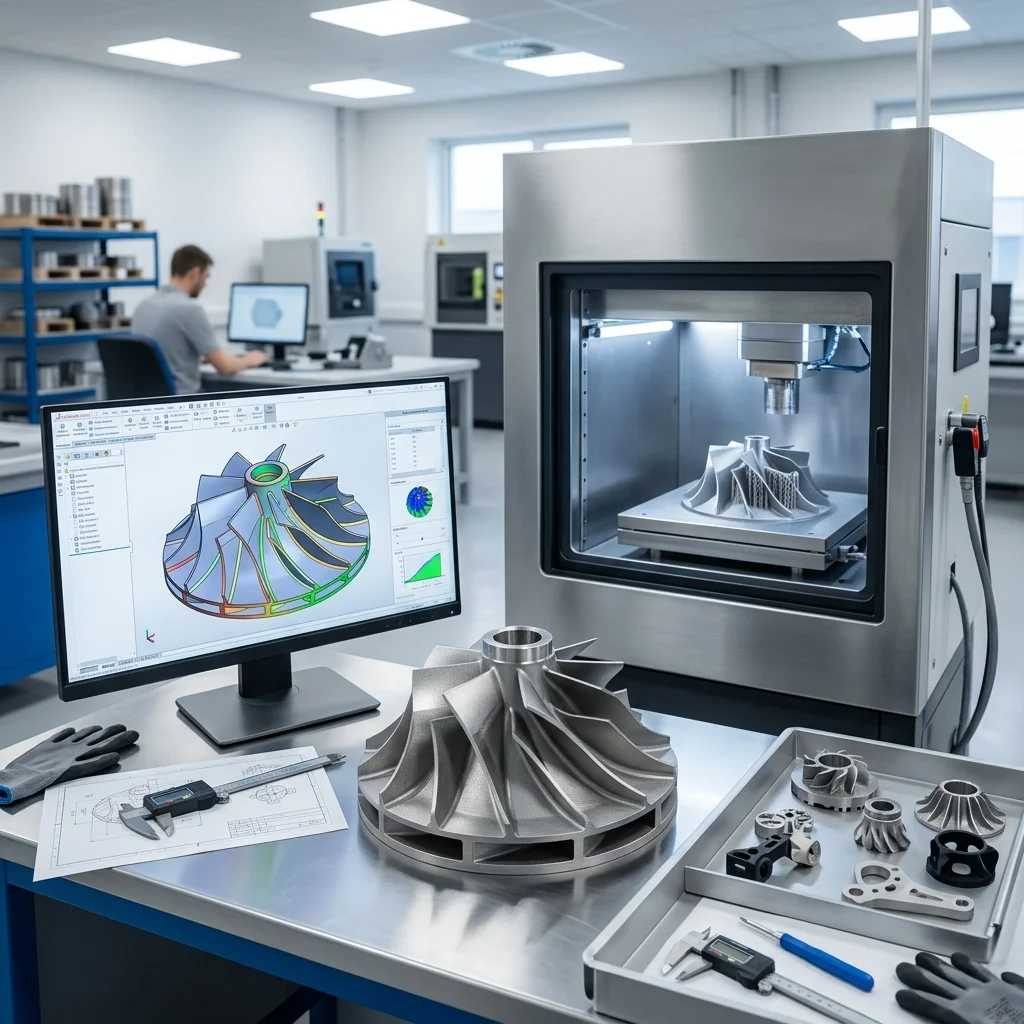
For decades, the manufacturing supply chain has relied on a reactive, capital-intensive model. Companies mass-produced parts overseas, shipped them across the globe, and stockpiled them in massive warehouses "just in case." This model traps capital, increases the risk of obsolescence, and leaves businesses vulnerable to global disruptions.
The paradigm is shifting. On-demand 3D printing introduces the concept of a digital inventory: a secure library of CAD files ready to be produced exactly when and where they are needed. By replacing physical shelves with digital servers, companies can transform their operational costs and dramatically improve their supply chain agility.
Redefining Total Cost of Ownership (TCO)
When evaluating additive manufacturing (AM), many engineers make the mistake of comparing the per-part cost directly against traditional injection molding. This narrow view fails to capture the true economics. To build a compelling ROI case, we must look at the Total Cost of Ownership (TCO). A digital inventory eliminates the hidden indirect costs: warehousing, overseas freight, import duties, and the inevitable write-offs from obsolete parts. When you factor in the elimination of expensive tooling and molds, 3D printing often wins the economic argument for low-to-mid volume production and spare parts.
Compressing Lead Times and Logistics
Time is a metric often undervalued until a critical machine goes down. Localized, on-site 3D printing compresses supply chain lead times from months or weeks to mere hours. Instead of waiting for a part to clear customs, it can be printed on the factory floor or at a localized micro-factory. This nearshoring strategy drastically reduces downtime. In industries where every hour of idle machinery costs thousands of dollars, the ability to print a functional spare part overnight isn't just a convenience: it is a critical operational safeguard.
Supply Chain Resilience in a Volatile World
If recent global events have taught us anything, it is that long, complex supply chains are fragile. Geopolitical tensions, trade route disruptions, and material shortages can paralyze traditional manufacturing. Distributed manufacturing through 3D printing offers inherent resilience. If one facility goes offline, the digital file can instantly be routed to another node in the network. This flexibility allows businesses to dynamically scale production up or down without the constraints of Minimum Order Quantities (MOQs), ensuring continuous service to customers regardless of global volatility.
Starting the Transition: The Pilot Strategy
Migrating to a digital inventory doesn't mean abandoning traditional manufacturing overnight. The most successful implementations follow a targeted pilot strategy. Start by identifying a specific family of parts: such as legacy spare parts, complex jigs, fixtures, or low-volume custom components. Digitize these assets and test the workflow. By measuring the tangible savings in tooling and freight against the recurring costs of AM materials and machine time, organizations can build a bulletproof business case before scaling the solution across their entire portfolio.
Conclusion
The business case for on-demand 3D printing is no longer a theoretical exercise; it is a proven strategy for operational excellence. By adopting a digital inventory model, businesses can unlock trapped capital, dramatically reduce lead times, and insulate themselves against supply chain shocks. The future of manufacturing belongs to those who understand that the most valuable inventory isn't stored on physical shelves, but on secure hard drives, ready to be materialized on demand.
The full picture
This article is one page from The Big Book of 3D Printing: 704 illustrated pages covering every technology, material and fix in one reference.
Read it on Kindle →Engineer, author of The Big Book of 3D Printing and additive manufacturing expert