

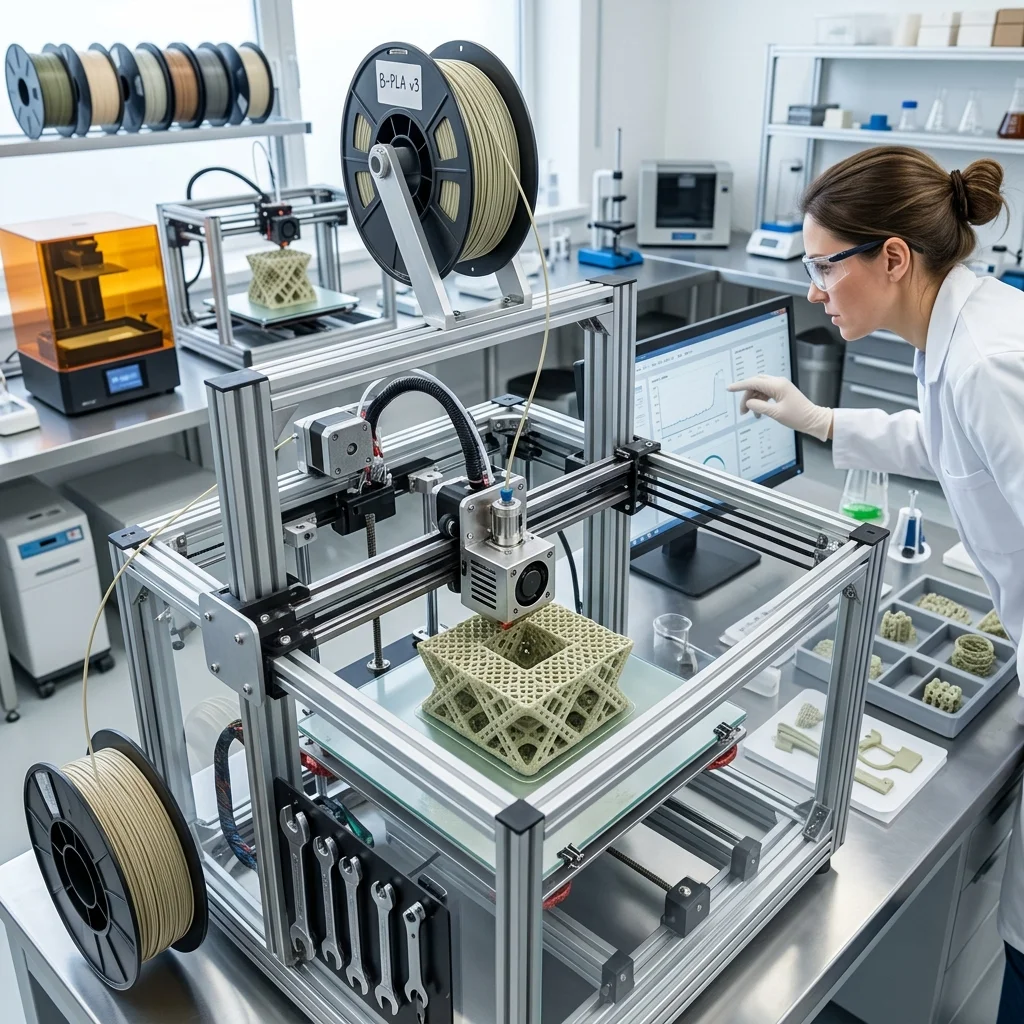
The integration of biodegradable polymers into additive manufacturing (AM) marks a fundamental shift in how we engineer and consume physical objects. While traditional methods and materials leave a lasting environmental footprint, the synergy between 3D printing and biodegradable plastics offers a visionary approach to the circular economy. This is not merely about using 'green' materials, but about precision engineering of their thermal, mechanical, and rheological properties to meet the rigorous demands of 3D printing.
This evolution requires a profound understanding of polymer behavior at the microstructural level. From material extrusion to final degradation, every stage of a part's lifecycle must be calibrated. In this article, we will look at the technical specifics of leading biodegradable polymers, the processing challenges they present, and the innovations propelling the technology forward.
Core Classes of Biodegradable Polymers in AM
Contemporary additive manufacturing is dominated by several key aliphatic polyesters, each with a unique thermal profile and biocompatibility. **Polylactic Acid (PLA)** remains the industry standard. Derived from renewable resources like corn starch, PLA is prized for its ease of printing and excellent mechanical stiffness. However, its brittleness and low glass transition temperature (around 60°C) limit its application in engineering parts requiring high thermal resistance.
Conversely, **Polyhydroxyalkanoates (PHA)**, which are microbially synthesized polymers, offer exceptional biodegradability and flexibility. They represent a promising alternative for high-performance applications, but their narrow processing temperature window makes printing significantly more complex than PLA. Another crucial material is **Polycaprolactone (PCL)**: a synthetic polyester with a low melting point (around 60°C). Its extraordinary elasticity and biocompatibility make it a preferred choice for printing medical scaffolds in tissue engineering.
Engineering Challenges: Rheology and Print Parameters
Working with biodegradable polymers, particularly through technologies like Fused Deposition Modeling (FDM) and Direct Ink Writing (DIW), demands rigorous process control. These materials often exhibit a very narrow window of thermal stability. If the extrusion temperature is too high, thermal degradation of the polymer chains occurs, leading to a loss of mechanical properties. If too low, melt viscosity remains high, causing nozzle clogging and poor interlayer adhesion.
For successful printing, it is critical to optimize not only the extruder and bed temperatures but also the print and cooling speeds. Crystallization during cooling plays a pivotal role: cooling too rapidly can result in an amorphous structure with high internal stresses, causing warping, while slow cooling can degrade dimensional accuracy. Engineers must delicately balance these parameters to achieve optimal structural integrity.
Composite Materials and Reactive Compatibilization
To overcome the inherent shortcomings of neat biopolymers, the industry is pivoting toward the development of advanced composites. By integrating natural fibers (such as wood or flax) or mineral fillers (like hydroxyapatite for medical applications), the mechanical strength and thermal stability of the base matrix can be substantially enhanced.
A key technique in this domain is reactive compatibilization and nano-reinforcement. When blending different polymers, such as PLA and the flexible PBAT (polybutylene adipate terephthalate), phase separation frequently occurs due to chemical incompatibility. The use of compatibilizers improves interfacial adhesion, creating blends that amalgamate the high strength of PLA with the elasticity of PBAT. These innovations are transitioning biodegradable filaments from mere prototyping materials to robust solutions for functional, end-use parts.
Degradation Kinetics and Design for the Circular Economy
One of the most profound challenges confronting these materials is the concept of 'design for degradation'. Different applications necessitate different lifecycles. For instance, a medical implant must degrade at a rate commensurate with the growth of new tissue, whereas an industrial bracket must maintain its integrity for years before being routed to a composting facility.
It is imperative to note that most biodegradable polymers do not simply vanish in nature. PLA, for example, requires specific industrial composting conditions (temperatures exceeding 55-60°C and high humidity) to hydrolyze efficiently. Contemporary research is heavily focused on 4D printing and the creation of smart materials with programmable degradation kinetics, alongside the establishment of robust standards (like ASTM D5511) to validate their real-world environmental behavior.
Conclusion
Biodegradable polymers in 3D printing are not just an alternative to conventional plastics; they are a catalyst for reimagining the entire manufacturing paradigm. By mastering complex polymer chemistry and the precise control of additive technologies, we are transitioning from an era of waste to an era of responsible, circular engineering. This is the future of manufacturing: engineering functionality that possesses the intelligence to return to nature.
The full picture
This article is one page from The Big Book of 3D Printing: 704 illustrated pages covering every technology, material and fix in one reference.
Read it on Kindle →Engineer, author of The Big Book of 3D Printing and additive manufacturing expert