

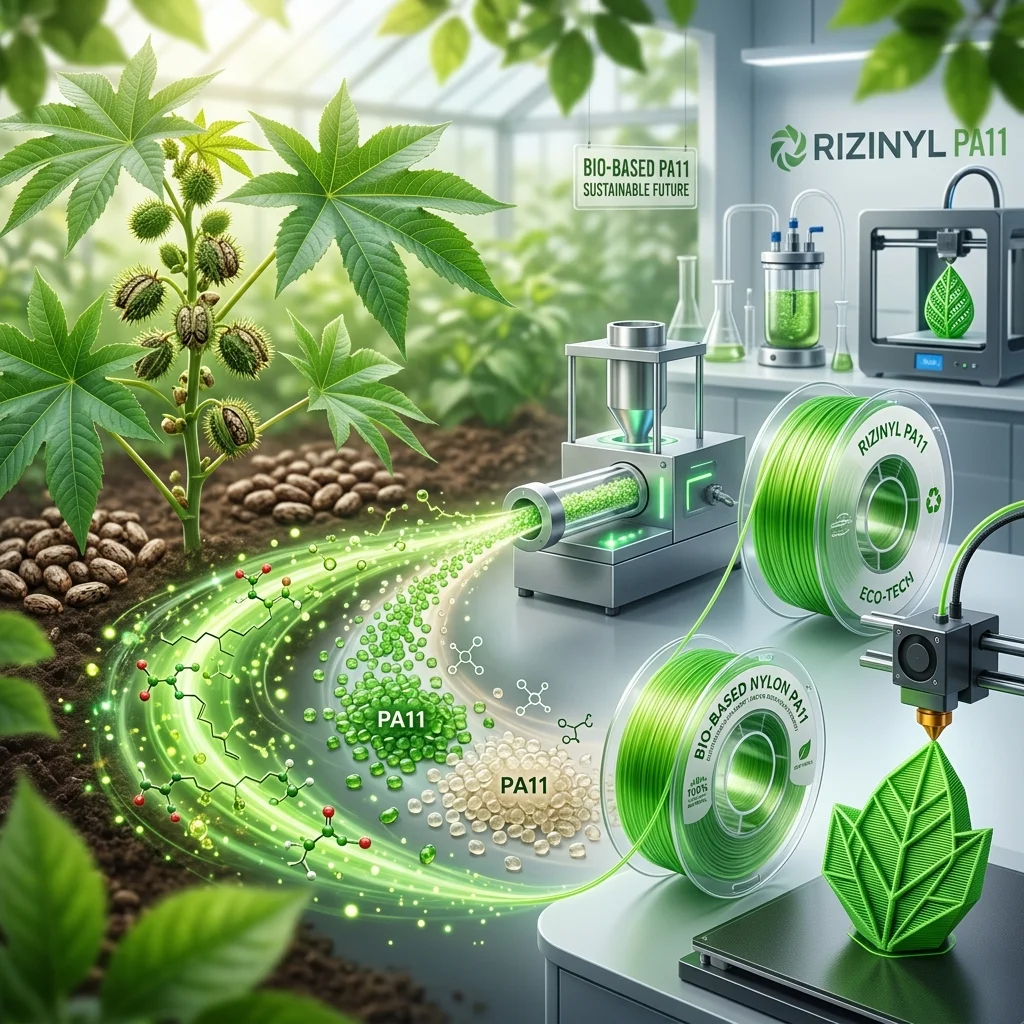
In 2025–2026, the industrial manufacturing sector is prioritizing sustainable materials with high mechanical integrity. Bio-Based Nylon (PA11), derived from castor oil, is leading the transition away from fossil-fuel-based polymers in powder bed fusion (SLS, MJF) and FDM technologies.
Understanding its performance requires analyzing the hydrogen bonding and crystal structure of the polyamide.
Origin and Chemistry: Castor Seed to Polyamide
Unlike standard petroleum-derived nylon, Polyamide 11 (PA11) is a 100% bio-based polymer.
1. Synthesis from Castor Oil
Castor seeds are pressed to extract castor oil, which undergoes chemical cleavage to yield 11-aminoundecanoic acid (the 11-carbon monomer). Polymerization of this monomer produces PA11.
- Chain Symmetry: Because the monomer has an odd number of carbon atoms (11), the polymer chains align with higher symmetry in the crystal lattice compared to odd-even nylons (like PA6,6). This high symmetry optimizes hydrogen-bond density, yielding superior impact resistance and ductility.
2. PA11 vs. PA12: Key Differences
- PA11 (100% Bio-based): Features higher impact strength (especially at sub-zero temperatures), greater flexibility, and superior fatigue resistance. It is highly resilient to stress cracking, making it ideal for prosthetics and living hinges.
- PA12 (Petroleum-based / partial bio): Derived from butadiene. It has a slightly lower melting point (178°C vs. 201°C for PA11) and is more rigid but exhibits lower impact toughness under extreme stress.
3D Printing Technologies: SLS, MJF, and FDM
In 2025–2026, bio-nylons are primarily processed via Powder Bed Fusion:
- SLS and MJF: The build chamber is heated to just below the melting point of the polyamide. The laser (SLS) or fusing agents (MJF) supply the thermal energy required to sinter the particles.
- FDM Extrusion: In filament form, nylon is highly semi-crystalline, resulting in significant volumetric shrinkage upon cooling. Printing requires an extrusion temperature of 240°C–270°C, a bed temperature of 80°C–100°C, and a closed chamber.
Interactive Filament Selector
Answer 3 quick questions and find the optimal material for your project.
1. What are the mechanical requirements for the part?
2. What temperature will the part operate at?
3. Are there any specific environmental requirements?
Our recommendation:
PLA filament
Ideal for easy printing, model visualization and decorative parts.
Hygroscopicity Management
The amide groups ($ ext{–CO–NH–}$) along the nylon backbone act as polar sites that attract water molecules via hydrogen bonding.
- FDM Printing: Moisture absorbed by the filament vaporizes inside the nozzle at 250°C, creating steam bubbles. This causes voids, poor layer adhesion, and a rough surface finish. Filament must be dried at 80°C for 6 hours and stored in a drybox.
- SLS/MJF Printing: Moist powder loses its flowability, leading to uneven spreading by the recoater and creating voids in the sintered part. Powder must be stored in climate-controlled, low-humidity environments.
Pros and Cons of Bio-Based Nylon PA11
Pros:
- 100% Renewable Origin: Sourced from castor oil, reducing carbon footprint compared to petroleum-based polyamides.
- High Impact Toughness: Exhibits excellent shatter resistance, retaining mechanical properties at sub-zero temperatures.
- Chemical Resistance: Outstanding resistance to oils, greases, salts, and industrial solvents.
- Biocompatibility: Approved for skin contact, making it ideal for orthotics and custom prostheses.
Cons:
- High Warpage: Prone to warping during FDM printing on open-frame machines.
- Hygroscopic Nature: Demands strict drying protocols and drybox storage during use.
- Lower Rigidity: Unreinforced PA11 is compliant; structural parts require glass-sphere (PA11-GB) or carbon-fiber (PA11-CF) reinforcement.
Frequently Asked Questions (FAQ)
Interactive Analyzer for Bio-Based Nylon (Pa11/Pa12) From Castor Oil: Sustainable Strength
Select a profile to view detailed analysis.
The full picture
This article is one page from The Big Book of 3D Printing: 704 illustrated pages covering every technology, material and fix in one reference.
Read it on Kindle →Engineer, author of The Big Book of 3D Printing and additive manufacturing expert