

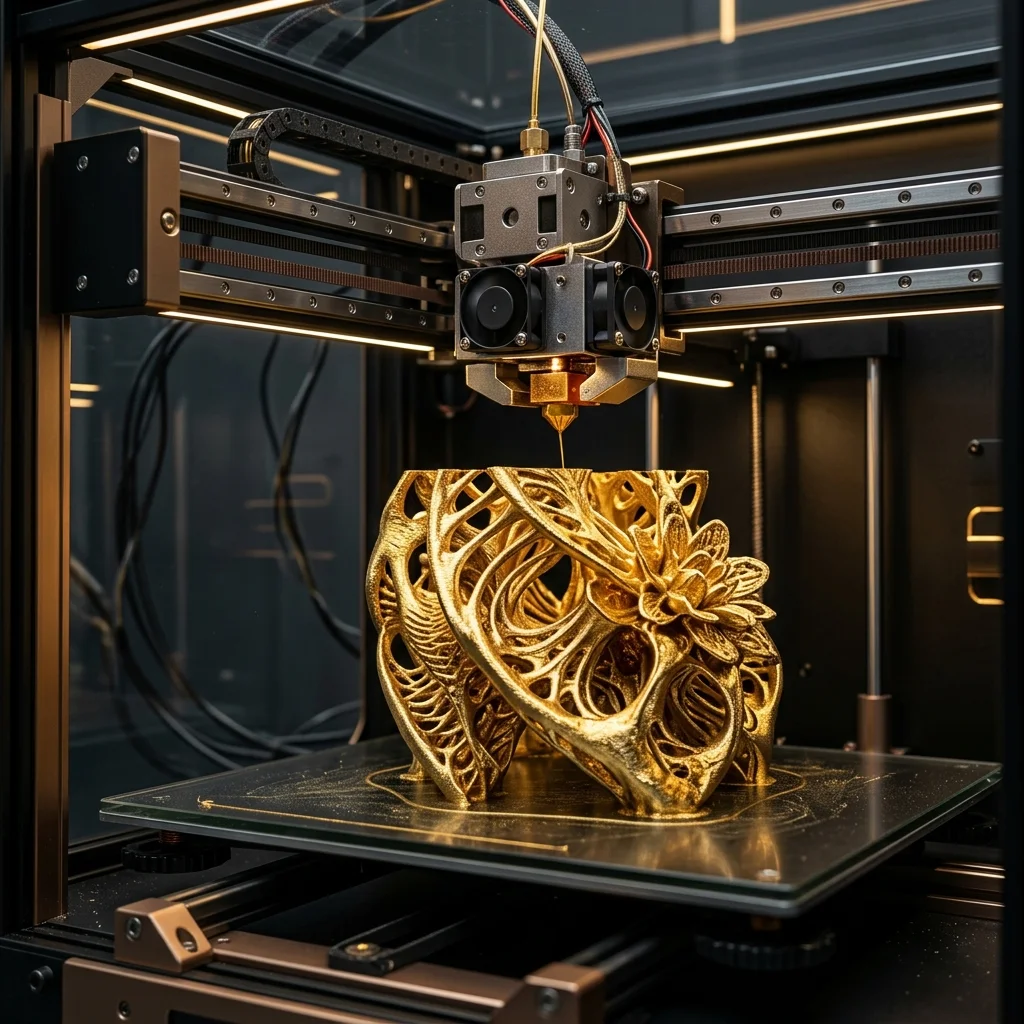
Art and 3D printing have a complex relationship, for some artists, the technology is a denial of craft; for others, it’s an expansion of expressive possibility. The reality is that 3D printing opened doors to forms that aren’t possible by hand: organic sculptures, fractal structures, smooth multi-color objects. There’s a growing community of artists integrating 3D printing into their practice, from sculptors at art academies to experimental designers in private galleries. In this guide we cover printers, materials, techniques for coloring and finishing, and examples from contemporary art projects using 3D printing.
What 3D printing is useful for in art
3D printing adds several new capabilities to the artist’s toolkit:
Complex geometry without manual labor. Spirals, fractals, web-like structures that would take weeks to produce by hand (modeling, precision milling, casting): print in hours. Antony Gormley’s sculptures at Tate Modern, printed with 3D-printed elements, would not be possible by classical means.
Series and variations. An artist can print 50 different iterations of a concept for an exhibition, each with small variations, without remaking the mold. This supports a serial artistic method.
Digital-analog hybridization. Start with a CAD sketch, print a model, work it by hand (sanding, painting, inlay, engraving), and the final object is simultaneously digital and handmade.
Replicas and reinterpretations of classical works. Scanning a Venus de Milo sculpture → 3D printing at various scales → a new artistic statement. This is a thematic area in contemporary art (Timo Aarne, Kengo Kuma installations).
Budget access to sculptural expression. Before 3D printing, a young sculptor needed a bronze furnace, marble block, and years of technical preparation. Now with a €500 printer, they can start.
AVOID: if an artist uses 3D printing as automated production with no artistic value-add, the result is indifferent. The technology doesn’t make art: the artist does.
Materials for artistic expression
PLA in expressive colors: the main working medium for sculptural prototypes. Polymaker PolyTerra (€28/kg) has 30+ colors with a matte surface that looks like painted plaster. Bambu Lab Silk PLA (€30/kg) gives a shiny metallic effect: gold, silver, bronze.
PLA with glitter or gradient: eSUN Galaxy PLA (€35/kg) has micro-crystals in the material that shine like a starry sky. Ideal for space or magical themes.
Clear MSLA resin: Anycubic Clear (€45/liter) for transparent sculptural objects, light installations with LEDs behind. MSLA resolution enables fine details in a clear material.
Color resin (multi-tone): Phrozen Aqua-Gray (€60/liter) or Anycubic Multicolor print. A single printer with multi-color equipment can produce a gradient.
Gypsum-like powder (binder jetting), for photorealistic coloring. Only at a specialized bureau: send STL with UV-mapped colors and receive a finished full-color model. Cost: €1-€3 per cm³.
Wood PLA or Metal PLA composites (Fillamentum Timberfill (€40/kg) looks and smells like wood, can be sanded like wood. eSUN Bronze Metal PLA (€45/kg)) with real bronze powder in the material, the post-oxidation surface looks like patina bronze.
Carbon Fiber composites, for technical art objects (futuristic sculpture, engineering art). Polymaker PolyMide PA6-CF (€80/kg) gives a matte black surface with visible carbon fiber texture.
Flexible materials (TPU), for interactive installations that can be crumpled, stretched. NinjaFlex TPU (€60/kg).
Recommended printers for an artistic practice
For a beginner artist or art student:
- Bambu Lab A1 (€420): open FDM with AMS lite for multi-color prints, excellent for PLA sculptures.
- Anycubic Photon Mono M5s (€368): MSLA for transparent and detailed objects, jewelry-like forms.
For an experienced artist with a small studio:
- Bambu Lab X1-Carbon (€1449) + AMS (€350): full multi-color FDM system with 16 colors. For large projects.
- Elegoo Saturn 3 Ultra (€420): large MSLA build volume, for bigger resin sculptural objects.
- Prusa MK4S (€999): European quality, flexible upgrades.
For an artist making large installations:
- Prusa XL with 5 heads (€3500): multi-color FDM, large 360×360×360 mm build volume. Ideal for large color objects without assembly.
- Anycubic Kobra 3 Max (€600): 420×420×500 mm large FDM, budget option.
- External bureau for PolyJet multi-color: send STL to a service bureau for a photorealistic multi-color model. €500-€3000 per object.
For an artist focused on transparent and optical forms:
- Phrozen Sonic Mighty 8K (€420) or Saturn 4 Ultra (€500): excellent high-resolution MSLA printers for transparent objects.
- Polyjet J826 (€80,000+): professional multi-color and multi-material system. Only for galleries or funded university labs.
For an art teaching lab at an art academy: a combination of Bambu X1-Carbon + Anycubic Photon Mono M5s + an external PolyJet bureau covers full artistic needs at an investment under €2000.
Post-print processing techniques
The artistic result often begins after the print is finished. A standard 3D-printed object has visible layers (FDM) or support marks (MSLA) that are often not wanted in the final piece.
1. Sanding and polishing (FDM PLA): Sequential sanding with 240 → 400 → 800 → 1500 → 2500 grit wet sandpaper, followed by waxing. Removes layers, gives a smooth surface like cast plaster. Time: 1-3 hours per 100×100 mm of surface.
2. Vapor smoothing (FDM ABS): Chemical smoothing with acetone vapor (only in a sealed container, well-ventilated space). Yields a glossy, ceramic-like surface. Warning: fire hazard. Work in a ventilated room or outdoors with fire equipment nearby.
3. Primer and airbrush (for photorealistic color expression): Primer (Mr. Surfacer 1000, Vallejo Primer) → airbrush with acrylic paints → varnish for protection. This is the standard method for miniatures and sculptural objects. Investment in airbrush €80-€200 + compressor €100-€300.
4. Inlay and mixing with other materials: 3D-printed skeleton → embedded in gypsum, resin, cement. Hybrid method: part of the volume is 3D printed, the other is traditionally cast. This opens new artistic possibilities.
5. Galvanizing or chrome plating: Specialized electrochemical processing (only in specialized studios). Turns a plastic 3D-printed object into a metal-coated piece. Cost: €30-€100 per object.
6. UV curing and stabilization (MSLA): After the standard UV cure (10-30 minutes), an additional 24-hour daylight exposure gives maximum resin stability.
Artistic projects and communities
Several artistic communities are active around 3D printing.
Sculpture studios: specialized in sculptural prototypes. Collaborate with young sculptors from art academies. 3D print prototypes in PLA, then use sand casting for final bronze pieces.
Maker spaces: community spaces with 4 FDM + 2 MSLA printers, open to the community. Monthly workshops for local artists. Monthly subscription: €30, includes unlimited printer access.
Tech park maker spaces: open labs with 6 printers (Bambu X1, Prusa MK4, Phrozen MSLA). Access €40/month, includes training.
Art academy digital labs: 2 FDM Bambu Lab X1-Carbon, 1 Elegoo Saturn 3 Ultra, training courses for students. Open to outside artists with special passes.
Online communities: Maker Facebook groups, 5000+ members, sharing STLs, techniques, hardware. Older technical forums with technical focus.
International resources: Thingiverse (Make: store), MyMiniFactory (paid platform), Cults3D (French platform with European-oriented content).
Frequently Asked Questions (FAQ)
Interactive Analyzer for 3D Printing For Art And Design, Materials, Techniques, Artistic Applications
Select a profile to view detailed analysis.
The full picture
This article is one page from The Big Book of 3D Printing: 704 illustrated pages covering every technology, material and fix in one reference.
Read it on Kindle →Engineer, author of The Big Book of 3D Printing and additive manufacturing expert