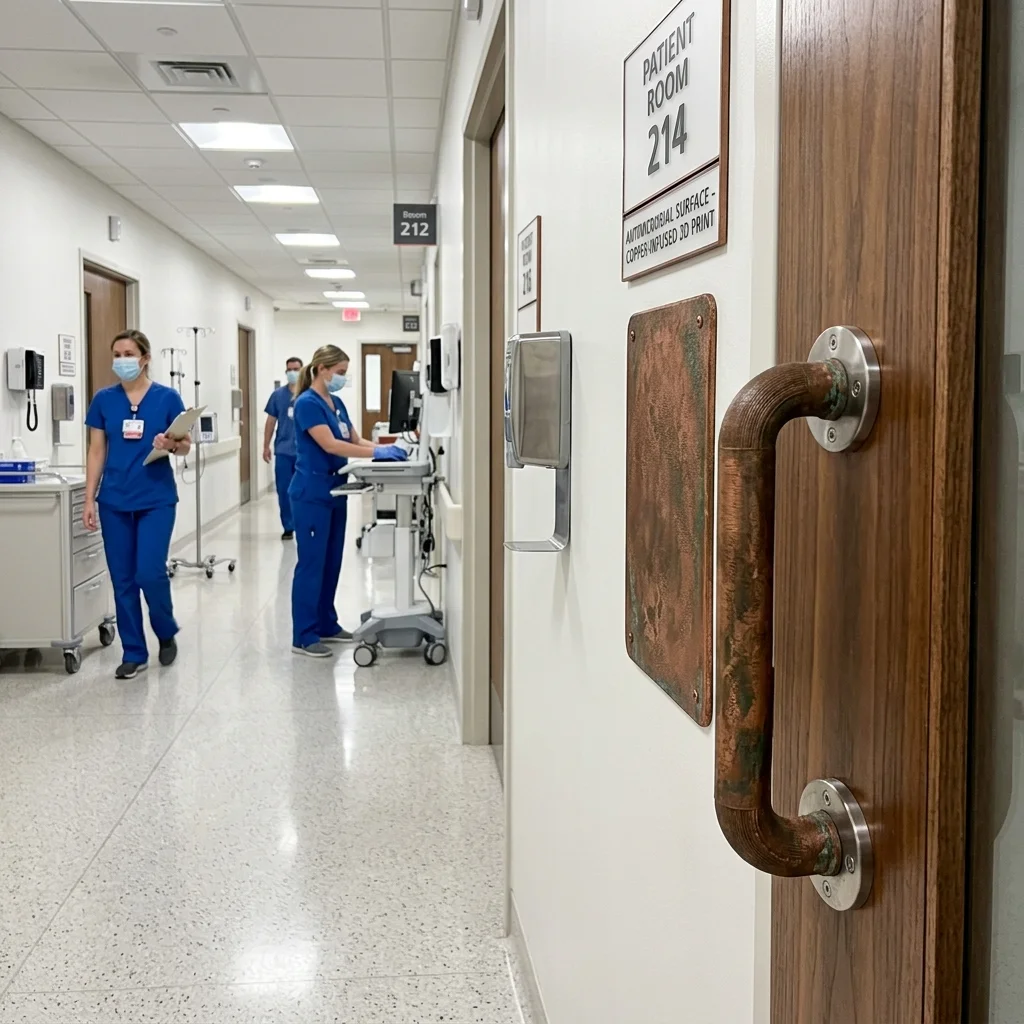
In 2025–2026, the convergence of additive manufacturing and antimicrobial engineering has produced a compelling new material class: copper nanoparticle-loaded filaments. These composites embed copper’s millennia-old pathogen-killing properties into 3D-printable polymers, enabling on-demand fabrication of self-sanitizing components for healthcare, public transit, and food processing environments.
This article examines the oligodynamic mechanism, material formulations, print parameters, and application domains for antimicrobial copper filaments.
The Oligodynamic Effect: How Copper Kills Pathogens
The antimicrobial properties of copper have been known for millennia: ancient Egyptians sterilized water in copper vessels. Modern science explains this through the oligodynamic effect:
Mechanism of Action
- Release of Copper Ions ($Cu^{2+}$): Upon contact with moisture (including bacterial moisture), the copper nanoparticle surface oxidizes and releases free $Cu^{2+}$ ions.
- Membrane Disruption: $Cu^{2+}$ ions bind to the phospholipid bilayer of bacterial membranes, disrupting their permeability. The cell “leaks” its cytoplasmic contents and dies.
- Reactive Oxygen Species (ROS) Generation: Copper ions catalyze Fenton-like reactions, generating hydroxyl radicals (·OH), highly aggressive oxidants that destroy pathogen DNA and proteins.
- Viral Envelope Destabilization: For enveloped viruses (influenza, SARS-CoV-2), $Cu^{2+}$ ions destabilize the lipid envelope, rendering the virus non-infectious.
Result: Laboratory testing (per ISO 22196) demonstrates elimination of 99.9% of MRSA, E. coli, and Klebsiella pneumoniae within 2–4 hours of contact with copper surfaces.
Interactive Filament Selector
Answer 3 quick questions and find the optimal material for your project.
1. What are the mechanical requirements for the part?
2. What temperature will the part operate at?
3. Are there any specific environmental requirements?
Our recommendation:
PLA filament
Ideal for easy printing, model visualization and decorative parts.
Copper Filament Types and Particle Loading
| Filament Type | Polymer Matrix | Cu Content (wt%) | Effectiveness |
|---|---|---|---|
| Copper-PLA | Polylactic Acid | 15% – 25% | Good, ideal for prototyping |
| Copper-PETG | Glycol-Modified PET | 20% – 30% | Higher temperature resistance |
| Copper-ABS | Acrylonitrile Butadiene Styrene | 15% – 25% | Good impact resistance |
| CuNP-PLA (Nanoparticles) | PLA with Cu nanoparticles (< 100 nm) | 3% – 10% | Maximum efficacy (high specific surface area) |
Key Factor: Nanoparticles ($< 100$ nm) are orders of magnitude more effective than microparticles ($> 10$ μm) at the same weight loading because they have dramatically higher specific surface area ($m^2/g$), from which $Cu^{2+}$ ions are released.
Print Parameters
| Parameter | Copper-PLA | Copper-PETG |
|---|---|---|
| Nozzle Temperature | 200°C – 220°C | 230°C – 250°C |
| Bed Temperature | 50°C – 60°C | 70°C – 80°C |
| Nozzle | Hardened Steel ≥ 0.4 mm | Hardened Steel ≥ 0.4 mm |
| Print Speed | 25 – 40 mm/s | 25 – 40 mm/s |
| Retraction | Reduced (3–4 mm) | Reduced (3–4 mm) |
| Cooling Fan | 50% – 80% | 30% – 50% |
Critical Nozzle Warning: Copper particles are highly abrasive. A standard brass nozzle will be completely worn out within 200 grams of filament. Hardened steel or ruby-tipped nozzles are mandatory.
Application Domains
- Hospital Door Handles and Elevator Buttons: Antimicrobial 3D-printed covers for high-touch surfaces.
- Dental Instruments and Frames: Custom auxiliary devices with built-in antimicrobial protection.
- Public Transit: Cladding for handrails and seat surfaces, reducing bacterial load.
- Food Processing: Custom tools with bactericidal surfaces for food handling.
- Laboratory Equipment: Racks, frames, and organizers with antimicrobial functionality.
Pros and Cons
Pros:
- Continuous Antimicrobial Protection: Unlike surface coatings, copper particles are distributed throughout the part volume, the surface retains efficacy even after wear.
- 99.9% Pathogen Elimination: Proven effectiveness against MRSA, E. coli, and viral pathogens.
- Customization: 3D printing allows form-factor adaptation to any specific environment.
- No Electricity or Chemicals: The antimicrobial effect is passive and permanent.
Cons:
- Abrasiveness: Requires expensive hardened nozzles and more frequent hardware replacements.
- Not Food-Contact Safe: Despite antimicrobial properties, filaments are not certified under EU 10/2011 for direct food contact.
- Surface Discoloration: Copper particles oxidize over time, causing the surface to darken (green/brown patina).
- Reduced Mechanical Properties: Metal particle loading reduces tensile strength and impact resistance of the polymer matrix.
Frequently Asked Questions (FAQ)
Anti-Microbial Copper Nanoparticle Filaments For Medical Gear Calculator
Interactive optimization calculator.
The full picture
This article is one page from The Big Book of 3D Printing: 704 illustrated pages covering every technology, material and fix in one reference.
Read it on Kindle →Engineer, author of The Big Book of 3D Printing and additive manufacturing expert
Updated on 11 September 2026
This article was written with AI assistance; the facts were checked against the sources on 11 September 2026.