

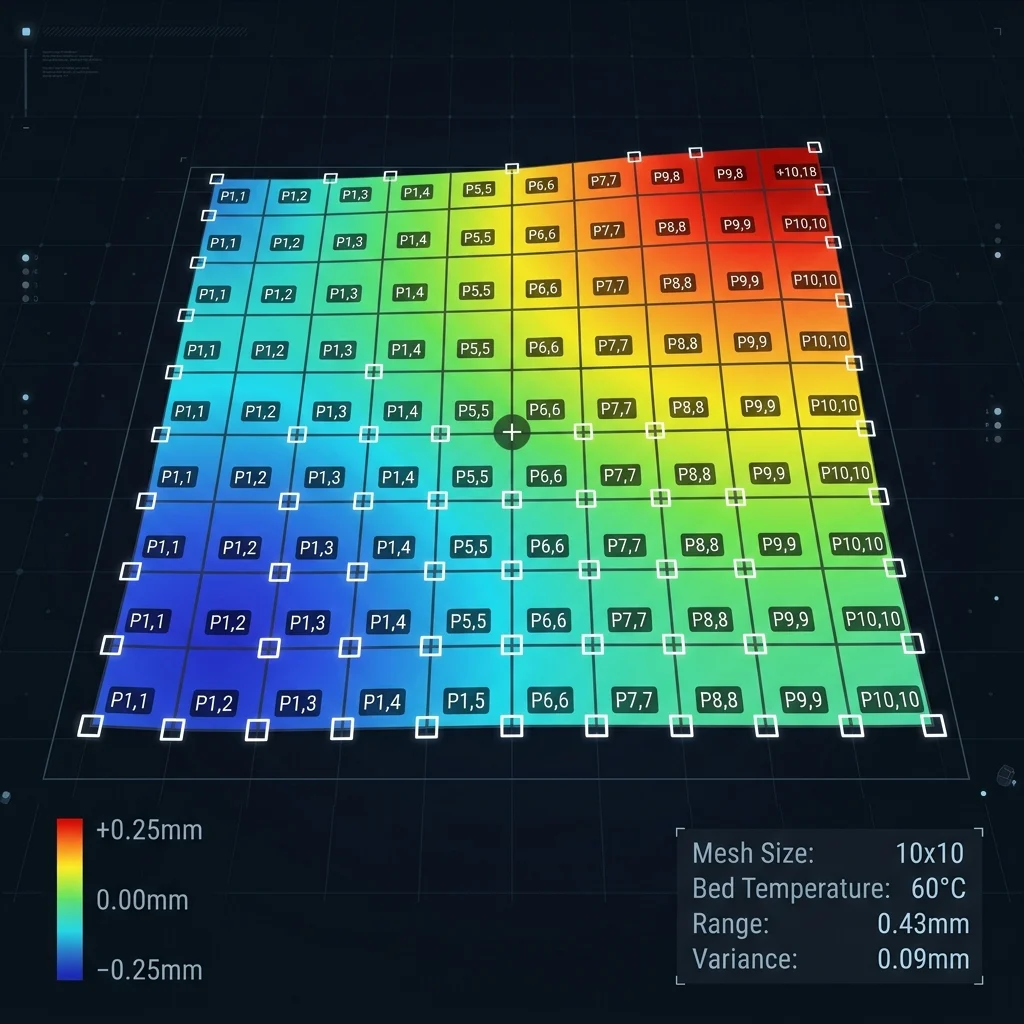
In 2025–2026, AI-enhanced mesh bed leveling goes beyond standard bilinear compensation, using machine learning for real-time prediction and correction of bed surface irregularities, including thermal deformation and wear compensation.
Standard Mesh Bed Leveling
- Probe: BLTouch measures Z-distance at N×M points.
- Mesh Map: Software interpolates bed surface.
- Z-Compensation: Z-axis corrected for each XY position during print.
Limitations: Fixed mesh, no thermal adaptation, no wear tracking.
Interactive Filament Selector
Answer 3 quick questions and find the optimal material for your project.
1. What are the mechanical requirements for the part?
2. What temperature will the part operate at?
3. Are there any specific environmental requirements?
Our recommendation:
PLA filament
Ideal for easy printing, model visualization and decorative parts.
AI Enhancements
- Thermal Compensation: ML predicts mesh changes with temperature (bed flat at 20°C, bowed 0.1–0.3 mm at 110°C). Interpolates mesh for any temperature without re-scanning.
- Predictive Wear Compensation: Tracks mesh changes over time, predicts future wear, suggests bed rotation.
- First Layer AI: CV camera + ML analyze first layer, auto-correct Z-offset.
Pros and Cons
Pros:
- Adaptivity: Thermal compensation without re-scanning.
- Long-term Accuracy: Wear compensation.
- Automation: Eliminates manual Z-offset tuning.
Cons:
- Data Collection: Requires many scans at different temperatures.
- Niche Technology: Mostly research phase.
FAQ
Interactive Analyzer for Ai Mesh Bed Leveling: Thermal Compensation And Predictive Wear
Select a profile to view detailed analysis.
The full picture
This article is one page from The Big Book of 3D Printing: 704 illustrated pages covering every technology, material and fix in one reference.
Read it on Kindle →Engineer, author of The Big Book of 3D Printing and additive manufacturing expert