

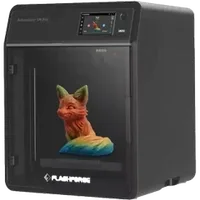
The FlashForge Adventurer 5M Pro is an enclosed CoreXY FDM printer in the budget class, designed for users who want high speed and a safe working environment without an industrial price tag. With a 220×220×220 mm build volume, speeds up to 600 mm/s and a built-in air filtration system, the 5M Pro brings engineering materials like ABS, ASA and PC within reach at an accessible price point.
What it is
The Adventurer 5M Pro is a fully enclosed machine with CoreXY kinematics and integrated air filtration: features rarely found at this price. The enclosed chamber is key: it maintains a stable elevated temperature around the model, preventing warping in demanding materials like ABS and ASA. Built-in HEPA and activated carbon filters capture particles and volatile organic compounds, making the printer well-suited for an office or classroom. Targeting enthusiasts, engineers and educational institutions, it delivers real performance without the need to manually rig an enclosure.
Technical specifications
| Technology | FDM (CoreXY, enclosed chamber) |
|---|---|
| Build volume | 220 × 220 × 220 mm |
| Maximum speed | up to 600 mm/s |
| Nozzle | quick-swap, standard and hardened steel |
| Calibration | automatic bed leveling + automatic Z-offset |
| Filtration | HEPA + activated carbon |
| Class / Price | Budget · ~€450 |
Who it’s for
- Rapid prototyping: producing fast iterations of CAD models to test ergonomics, fit and form factor before committing to expensive mass production (Product design and engineering)
- Jigs and fixtures: manufacturing custom assembly aids, alignment templates and low-volume production tools from durable engineering materials like CF-Nylon or PC inside the enclosed chamber (Automotive and manufacturing)
- Educational projects and STEM: creating safe, hands-on learning models, robotics components and functional student prototypes inside an enclosed, filtered printer (Education)
Calibration step by step
- Clean the PEI plate with isopropyl alcohol (IPA). An oil- and dust-free surface guarantees maximum first-layer adhesion.
- Execute the automatic bed leveling routine. The printer's sensor probes the bed and builds a digital mesh to precisely compensate for any surface unevenness.
- Fine-tune the Z-offset during the first layer print. The nozzle maintains the optimal distance from the bed: perfect squish without an "elephant's foot" defect.
- Calibrate extruder E-steps and material flow rate. The extruder motor feeds the exact requested amount of filament, preventing dimensional errors and over- or under-extrusion.
Common defects and fixes
Recommended settings by material
Pick a material to see the recommended temperatures (empirical ranges from 561 OrcaSlicer/Bambu profiles) plus machine-specific tips:
Conclusion
The Adventurer 5M Pro is a rare exception in the budget class: enclosed chamber, high speed and air filtration in a single device. It suits enthusiasts and small workshops that want to work with ABS, ASA and engineering polymers without investing in a more expensive machine. If the 220 mm build volume is sufficient, the 5M Pro delivers a compelling price-to-performance ratio.
The full picture
This article is one page from The Big Book of 3D Printing: 704 illustrated pages covering every technology, material and fix in one reference.
Read it on Kindle →Engineer, author of The Big Book of 3D Printing and additive manufacturing expert