

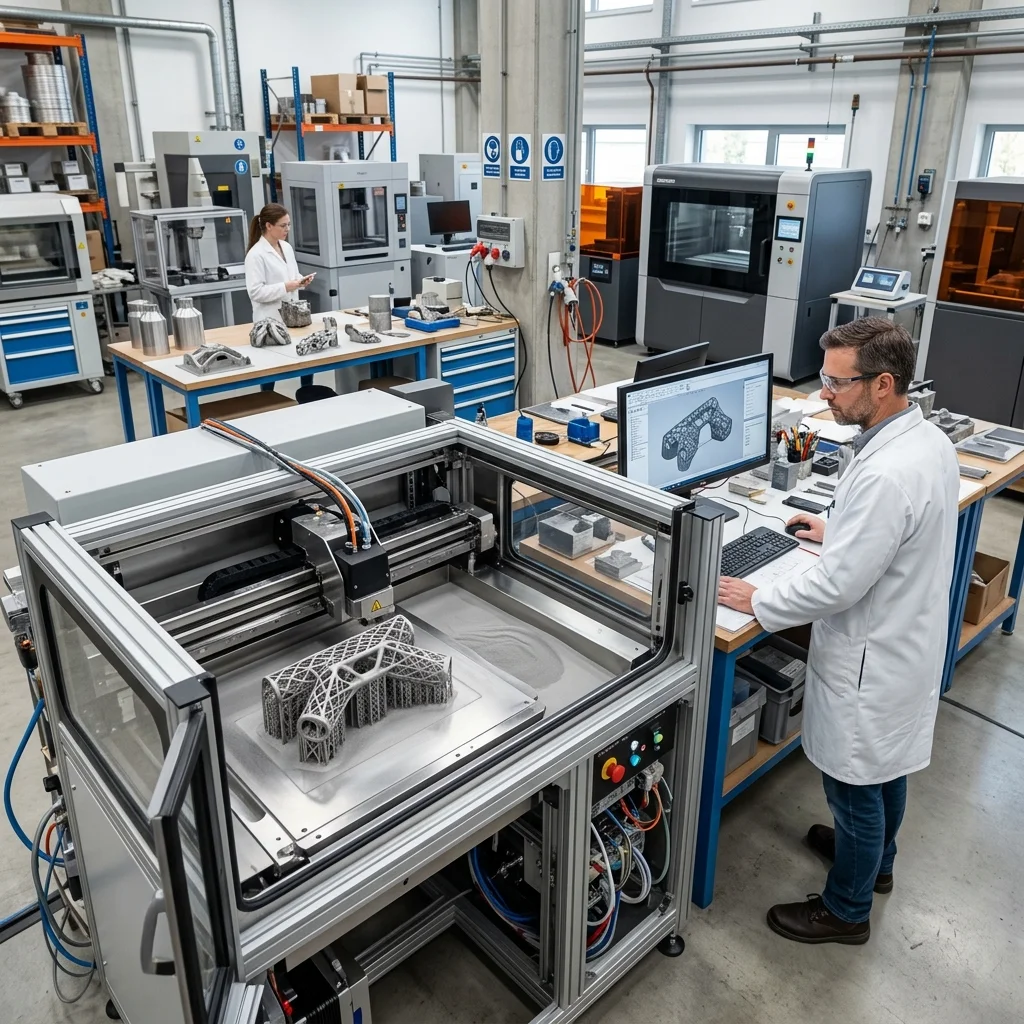
Additive manufacturing (AM) has long crossed the boundary of hobbyist technologies and rapid prototyping. Today, it forms the backbone of Industry 4.0, creating a critical demand for highly trained professionals. Having access to the machine is only the beginning: the true value lies in the knowledge of how to orchestrate the process.
At EduFacturing, we believe in the "picks and shovels" philosophy: hardware is practically useless without the engineering mindset that gives it purpose. In this article, we will explore how online courses and educational programs in additive manufacturing are transforming to meet modern industrial demands, and how hybrid learning models are changing the rules of the game.
From Hobbyist Printing to Industrial Standards
The educational landscape is decisively shifting away from basic concepts towards industrial-grade production knowledge. Modern courses no longer focus merely on how to run a desktop FDM printer, but look at complex processes like topology optimization, supply chain integration, and specific post-processing methods such as debinding and sintering in metal AM. Understanding ISO/ASTM standards is no longer a bonus, but an absolute requirement for engineers who want their parts certified for the aerospace or medical industries.
The Rise of Hybrid Models: Theory Backed by Practice
One of the greatest challenges of fully online manufacturing education is the lack of physical access to machines. The industry is solving this through Hybrid Learning Models. These programs combine the flexibility of self-paced online lectures for foundational theory with virtual labs, simulation software, and Digital Twins. At EduFacturing, we heavily rely on this approach: interactive 3D simulations that allow learners to test and optimize processes virtually before applying them to real equipment. This method drastically reduces material waste and accelerates the learning curve.
DfAM: The Art of Designing for Additive Manufacturing
Design for Additive Manufacturing (DfAM) is the most critical skill modern engineers need to master. It is not just about exporting a CAD model to a slicer. DfAM requires rethinking the geometry itself to leverage the unique advantages of 3D printing: internal lattice structures, part consolidation, and weight optimization through Generative Design algorithms. The best contemporary courses invest a massive portion of their curriculum in DfAM, because efficient design is what makes additive manufacturing economically viable at scale.
Certification as an Industry Gateway
As the AM sector matures, companies are increasingly seeking standardized validation of skills. Professional certifications like the Certified Additive Manufacturing – Fundamental (CAM-F) are becoming mandatory hiring requirements in top engineering firms. The integration of knowledge regarding AI-driven design and Multi-Material Printing systems is now expected from highly qualified specialists. Educational platforms are adapting by offering highly specialized pathways that culminate in internationally recognized accreditations.
Conclusion
Knowledge is what turns raw polymer or metal powder into innovation. Online education in additive manufacturing is evolving to offer industrial depth, practical applicability through hybrid systems, and an intense focus on DfAM. Whether you are just entering the field or upgrading your expertise, choosing the right educational ecosystem is your best investment. At EduFacturing, we continue to democratize this high-tech knowledge, because the future belongs to those who know how to design and manufacture it.
The full picture
This article is one page from The Big Book of 3D Printing: 704 illustrated pages covering every technology, material and fix in one reference.
Read it on Kindle →Engineer, author of The Big Book of 3D Printing and additive manufacturing expert