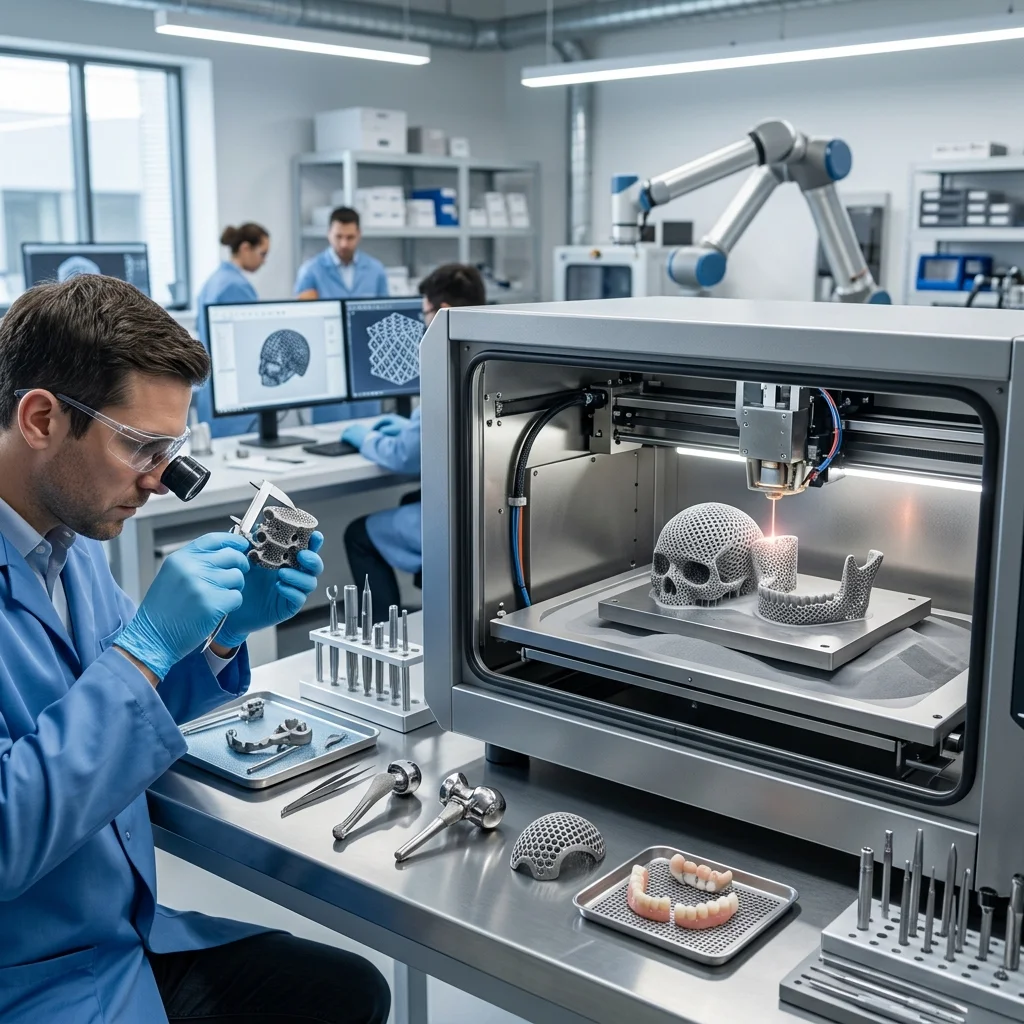
For decades, the medical field relied heavily on a "one-size-fits-all" approach to implants, or at best, an inventory of standard sizes. However, human anatomy is as unique as a fingerprint. Today, thanks to additive manufacturing, we are transitioning from mass production to mass customization. 3D printing isn't just churning out spare parts for the human body; it is crafting highly engineered components that integrate with our biology.
At EduFacturing, we believe that understanding the "picks and shovels" of this technology is the key to unlocking future medical innovations. The workflow behind a patient-specific implant brings together software modeling, materials science, and biomechanics to deliver solutions that were previously unimaginable.
The Digital Workflow: From Scan to CAD Model
The journey of a customized implant begins with high-resolution medical imaging, typically CT or MRI scans. This raw data is meticulously translated into a precise 3D digital model using specialized software. This stage is absolutely critical, as it enables engineers and surgeons to design an implant that perfectly matches the patient's exact bone topology. Instead of the surgeon modifying the patient's bone to fit a standard implant during the operation, the 3D-printed implant is pre-engineered to fit the bone perfectly, drastically reducing surgical time and patient trauma.
Lattice Structures and Defeating Stress Shielding
One of the most profound advantages of 3D printing in medicine is the ability to generate complex, porous geometric patterns known as lattice structures. Traditional solid metal implants are significantly stiffer than human bone. This stiffness mismatch leads to a phenomenon called "stress shielding", because the implant bears the brunt of the mechanical load, the surrounding natural bone begins to atrophy from lack of stimulation. Through the intelligent design of lattice structures, engineers can precisely tune the implant's Young's modulus to match the flexibility of human bone. Furthermore, this porous architecture mimics the trabecular structure of natural bone, heavily promoting osseointegration. This is the biological process where native bone cells grow deep into the porous scaffold of the implant, creating a long-lasting mechanical bond.
Biocompatible Materials of the Future
Materials science is the beating heart of successful medical 3D printing. Currently, two main material classes dominate the field. On the metal side, titanium alloys (most notably Ti6Al4V) remain the gold standard due to their exceptional strength-to-weight ratio, corrosion resistance, and superb biocompatibility. Powder Bed Fusion (PBF) systems, such as DMLS and EBM, are the heavy lifters that fuse fine titanium powder into finished, life-changing devices. On the polymer side, high-performance thermoplastics like PEEK (Polyetheretherketone) and PEKK are gaining serious traction. They are radiolucent (meaning they don't interfere with X-rays) and possess mechanical properties incredibly close to cortical bone, making them ideal candidates for spinal cages and cranial reconstruction.
Clinical Outcomes and What's Next
The fusion of anatomical precision, biomechanical optimization via lattice design, and advanced biomaterials yields unprecedented clinical outcomes. Patients experience drastically accelerated recovery times, minimized risk of implant loosening, and enhanced longevity of the prosthesis. Looking ahead, the integration of 4D printing, smart sensor-embedded implants, and the bioprinting of living tissues directly onto titanium scaffolds will define the next frontier of medical engineering.
Conclusion
3D printing of medical implants stands as a shining example of how deep technical knowledge and advanced hardware can converge to improve human life. We are no longer simply "patching up" our bodies; we are restoring them with absolute engineering precision. For us at EduFacturing, this represents the true power of technology: solving critical real-world problems and relentlessly pushing the boundaries of what is possible.
The full picture
This article is one page from The Big Book of 3D Printing: 704 illustrated pages covering every technology, material and fix in one reference.
Read it on Kindle →Engineer, author of The Big Book of 3D Printing and additive manufacturing expert
Updated on 11 September 2026
This article was written with AI assistance; the facts were checked against the sources on 11 September 2026.