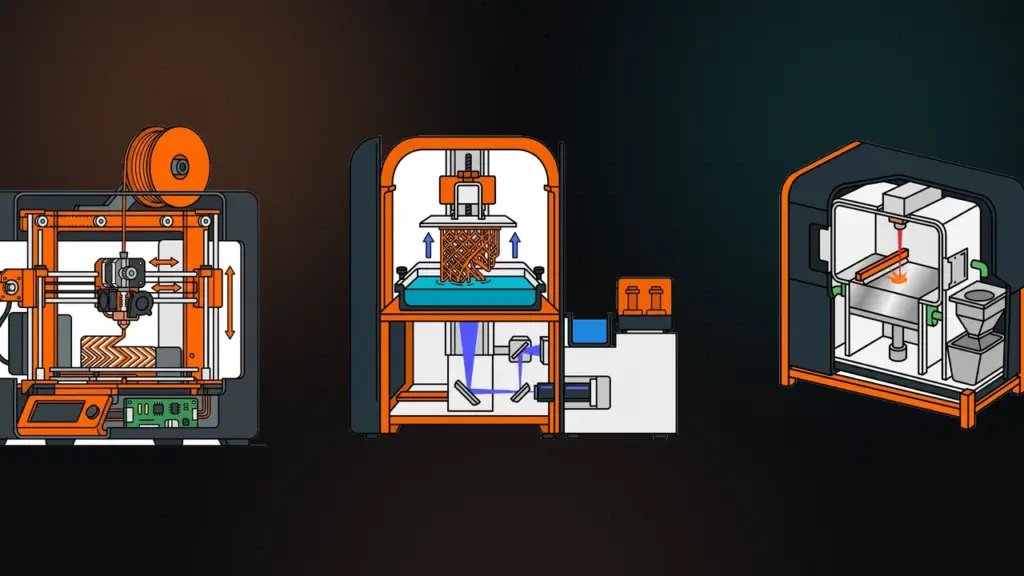
The same part, printed from different materials, can be a toy or an industrial component. The material determines strength, heat resistance, flexibility and the type of application. That is why choosing it matters just as much as choosing a printer. Here are the main 3D printing materials, grouped by technology, and how to decide which one you need.
FDM filaments
The most common materials – thermoplastic strands for extrusion printing.
PLA
The easiest to print. Bio-based, low odour, minimal warping. For models, prototypes and decor. Not for heat-loaded parts.
PETG
The balance between easy printing and strength. Moisture- and impact-resistant, flexible. Excellent for functional parts.
ABS / ASA
Strong and heat-resistant. ASA withstands UV (for outdoor use). They require an enclosed chamber and ventilation.
TPU
Flexible, rubber-like. For seals, dampers, cases. Prints slowly but enables parts rigid plastic cannot.
Engineering and high-temperature
For demanding applications there are higher-performance materials:
- Nylon (PA) – strong, wear-resistant; for gears, hinges, functional mechanisms.
- Composites (CF, GF) – nylon or PLA reinforced with carbon or glass fibre; high stiffness at low weight.
- PC (polycarbonate) – very strong and heat-resistant; for engineering parts.
- PEEK, PEI – the peak of polymers; withstand high temperatures and chemicals, for aerospace and medicine.
Resins for SLA / DLP
Liquid photopolymers for high detail. They range from standard (models, miniatures) through tough and heat-resistant (engineering parts) to specialized (dental, biocompatible, castable for jewellery).
Powders for SLS / MJF / metal
For industrial printing: polymer powders (PA11, PA12) for strong parts without supports, and metal powders (stainless steel, titanium, aluminium, Inconel) for functional metal parts.
How to choose a material
Start from the part’s requirements: will it bear load? Will it be hot or in the sun? Does it need to be flexible or precise? For beginners – start with PLA, then PETG. For functional parts – nylon or composite. For detail – resin.
Find the right material
The filament catalog holds over 17,000 products with properties and parameters, and the materials library organizes them by technology. For help choosing see the tools in the tools hub, and for deep understanding – The Big Book of 3D Printing. Not sure which technology a material uses? Review the types of 3D printing technologies.
The full picture
This article is one page from The Big Book of 3D Printing: 704 illustrated pages covering every technology, material and fix in one reference.
Read it on Kindle →Frequently asked questions
What is the easiest 3D printing material for beginners?
What is the difference between PLA, PETG, and ABS?
When should I use resin instead of filament?
Which materials are used for industrial or high-performance 3D printing?
Engineer, author of The Big Book of 3D Printing and additive manufacturing expert
Updated on 30 May 2026
This article was written with AI assistance; the facts were checked against the sources on 30 May 2026.