

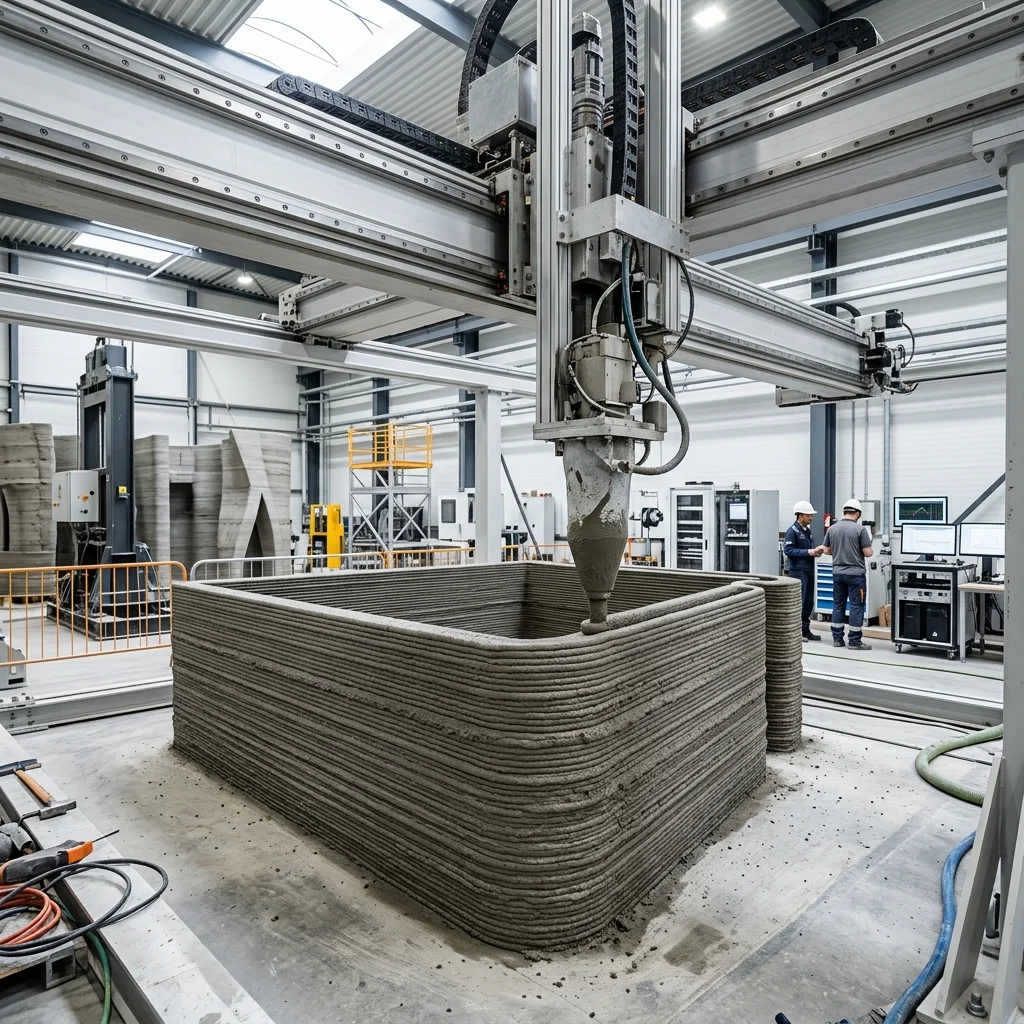
The construction sector, traditionally conservative and slow to adapt to change, stands on the brink of an unprecedented technological revolution. What was considered a futuristic experiment for printing miniature demo houses just a few years ago is now a proven, industrial-scale practice. By 2026, large-scale 3D construction printing (Additive Manufacturing in Construction) has moved beyond the question of "can we do this?" to focus entirely on "how do we optimize it at scale?". The convergence of advanced robotics, artificial intelligence, and innovative materials is establishing a new paradigm for building infrastructure and housing.
Architecture Without Borders: From Experiments to Industrial Scale
Today, large-scale construction projects: ranging from multi-story residential buildings and military barracks to complex infrastructure components like wind turbine bases, are being completed routinely via 3D printing. Extrusion-based systems (like Contour Crafting) dominate the market due to their ability to operate directly on construction sites. The time required to build the structural envelope of a building has been reduced to an astonishing 24 to 48 hours. This speed not only drastically cuts logistical costs but also directly addresses one of the sector's most pressing issues: the global shortage of skilled manual labor.
Swarm Robotics and AI Integration
Perhaps the most visionary leap in the technology is the transition toward autonomous systems and robotic "swarms." Instead of relying on a single massive gantry crane that dictates the maximum size of the building, the industry is deploying multiple smaller, coordinated robots working in synchronization. This process is orchestrated by artificial intelligence (AI) and machine vision systems that provide real-time quality control, optimize extruder pathways, and perform predictive maintenance. Generative design software is being utilized to create topologically optimized structures that are lighter, stronger, and exceedingly difficult to build using traditional formwork.
Material Science: Beyond Traditional Portland Cement
Industrial printing doesn't stop at mechanics; the chemical composition of the materials is just as critical. While standard 3D-printable concrete (3DPC) is already a mature product, the focus is shifting heavily toward sustainability. Researchers are developing geopolymers, fiber-reinforced blends, and eco-friendly binders that promise to reduce embedded carbon by more than 70% compared to conventional methods. Intense work is also underway on multi-material systems capable of simultaneously extruding insulation and load-bearing structures, thereby eliminating additional post-printing construction steps.
Overcoming Barriers: Regulations and Economics
Despite these technological triumphs, widespread adoption still faces hurdles. The high initial capital expenditure for printing equipment limits market entry for small to mid-sized firms. Historically, the most significant barrier has been the lack of standardized building codes. Today, we are witnessing massive progress in the creation of standardized compliance pathways through organizations like ASTM and ISO. This is de-risking investments and paving the way for full commercialization and integration into standard urban planning.
Conclusion
Large-scale 3D printing in construction is no longer a niche attraction: it is the foundational tool needed to address the global housing crisis and ecological challenges. At EduFacturing, we believe the future belongs to those who do not merely operate the hardware, but deeply understand the knowledge that drives it. It is time to rethink how we build the world around us.
The full picture
This article is one page from The Big Book of 3D Printing: 704 illustrated pages covering every technology, material and fix in one reference.
Read it on Kindle →Engineer, author of The Big Book of 3D Printing and additive manufacturing expert