

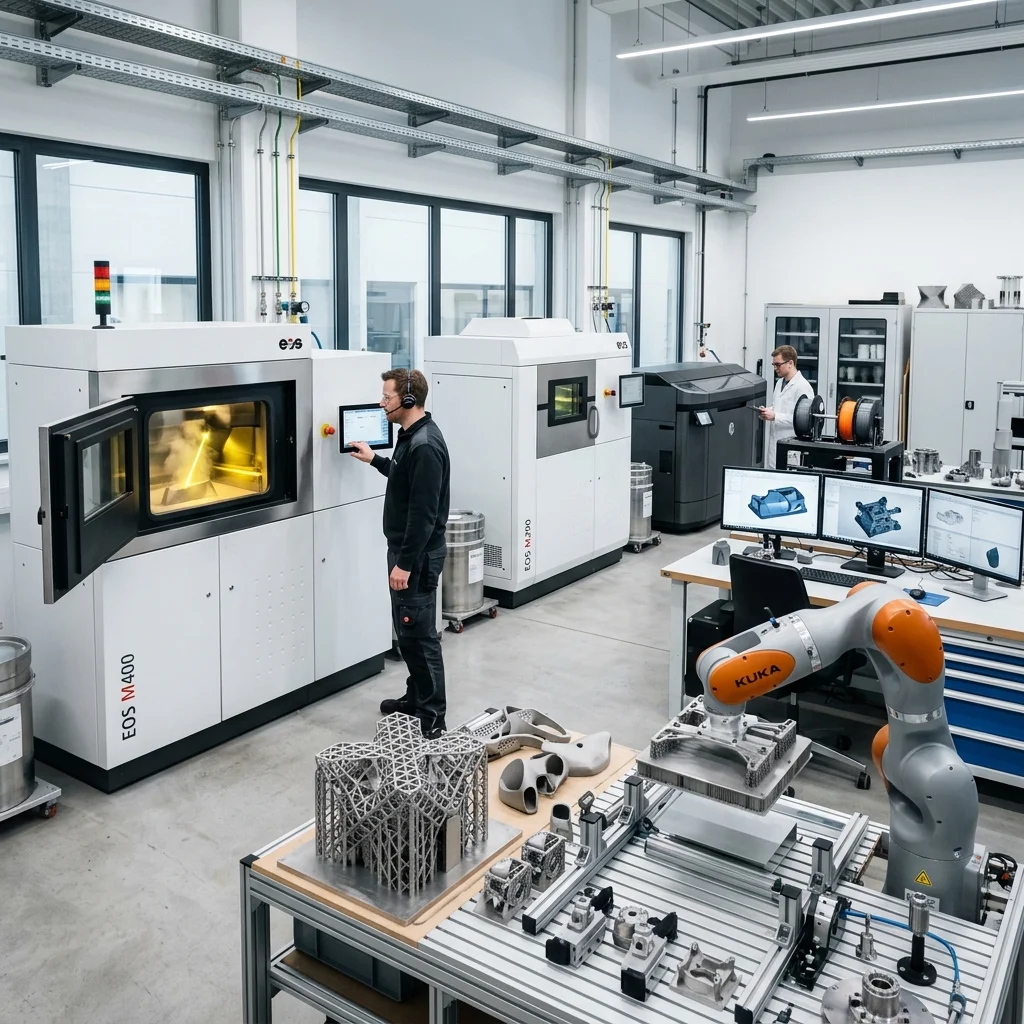
The additive manufacturing (AM) landscape across 2025 and 2026 is no longer defined by the novelty of rapid prototyping. It has matured into a foundational, production-ready pillar of modern industrial infrastructure. As we look closely at this pivotal window, the true paradigm shift isn't just about faster machines; it's about the deep synthesis of software intelligence, material science, and manufacturing hardware.
At EduFacturing, our philosophy is simple: we provide the "picks and shovels", the applied knowledge that transforms raw hardware capability into true innovation. Over the next year, the companies that thrive will not be those who just buy the most expensive printers, but those who understand how to orchestrate these machines into intelligent, distributed, and sustainable workflows. Here is an inside look at the macro-trends actively reshaping additive manufacturing today and tomorrow.
AI-Driven Metrology and Generative Design
The integration of Artificial Intelligence into 3D printing has transitioned from experimental to essential. We are witnessing the era of 'hyper-automation' in part design and in-situ monitoring. Generative design tools now natively account for anisotropic material behaviors and complex fluid dynamics, producing geometries that are both lighter and structurally superior. However, the most profound leap is in real-time quality control. Advanced computer vision, coupled with machine learning algorithms, now monitors melt pools in metal PBF (Powder Bed Fusion) and tracks layer adhesion in high-speed FDM systems. When a defect is predicted, the system corrects parameters (such as laser power or extrusion flow) on the fly. This closed-loop control guarantees the repeatability required for critical aerospace and healthcare components.
Radical Hardware Scaling and Multi-Material Capabilities
Hardware architecture has crossed a major threshold in both speed and multi-material versatility. Multi-laser metal systems and ultra-fast polymer architectures have increased throughput by hundreds of percent compared to just a few years ago. But beyond mere speed, the ability to deposit completely distinct materials in a single continuous build is revolutionizing assembly lines. Modern tool-changing mechanisms and advanced print heads can now transition between flexible elastomers, conductive traces, and rigid structural polymers. This eliminates the need for complex post-print assemblies, dramatically reducing failure points and opening the door to fully integrated electro-mechanical components printed in a single go.
The Circular Economy and Advanced Material Science
Sustainability is no longer just a corporate buzzword; it is a strict engineering requirement. The 2025-2026 period is defined by a massive pivot toward closed-loop material ecosystems. We are seeing a surge in bio-based resins, highly recyclable filaments, and systems designed to shred and re-extrude failed prints into near-virgin quality feedstock. Simultaneously, the upper echelon of high-performance materials (such as PEEK, PEKK, carbon-fiber-reinforced composites, and technical ceramics) are becoming much more accessible. These materials are increasingly replacing traditionally machined metals in extreme environments, from hypersonics to specialized medical implants.
Distributed Micro-Factories and Supply Chain Resilience
The global supply chain shocks of the early 2020s taught the industry a valuable lesson. In response, 2026 is the year of the distributed micro-factory. Instead of relying on massive, centralized overseas production facilities, companies are leveraging 'digital inventories'. Parts are stored as data and printed locally, on-demand, exactly where they are needed. This shift not only mitigates logistical risks but slashes shipping times and carbon footprints. Additive manufacturing acts as the critical enabler here, allowing agile facilities to swap production from automotive brackets to drone chassis simply by loading a new G-code.
Conclusion
The evolution of 3D printing in 2025 and 2026 is undeniable, yet the hardware alone is just dormant potential. The true differentiator is knowledge. Understanding how to calibrate an advanced multi-material process, how to leverage AI for generative structures, and how to qualify new bio-materials: this is the expertise that drives the industry forward. At EduFacturing, we remain committed to democratizing this high-tech knowledge. The future of manufacturing is already here; now it's time to build the expertise to harness it.
The full picture
This article is one page from The Big Book of 3D Printing: 704 illustrated pages covering every technology, material and fix in one reference.
Read it on Kindle →Engineer, author of The Big Book of 3D Printing and additive manufacturing expert