

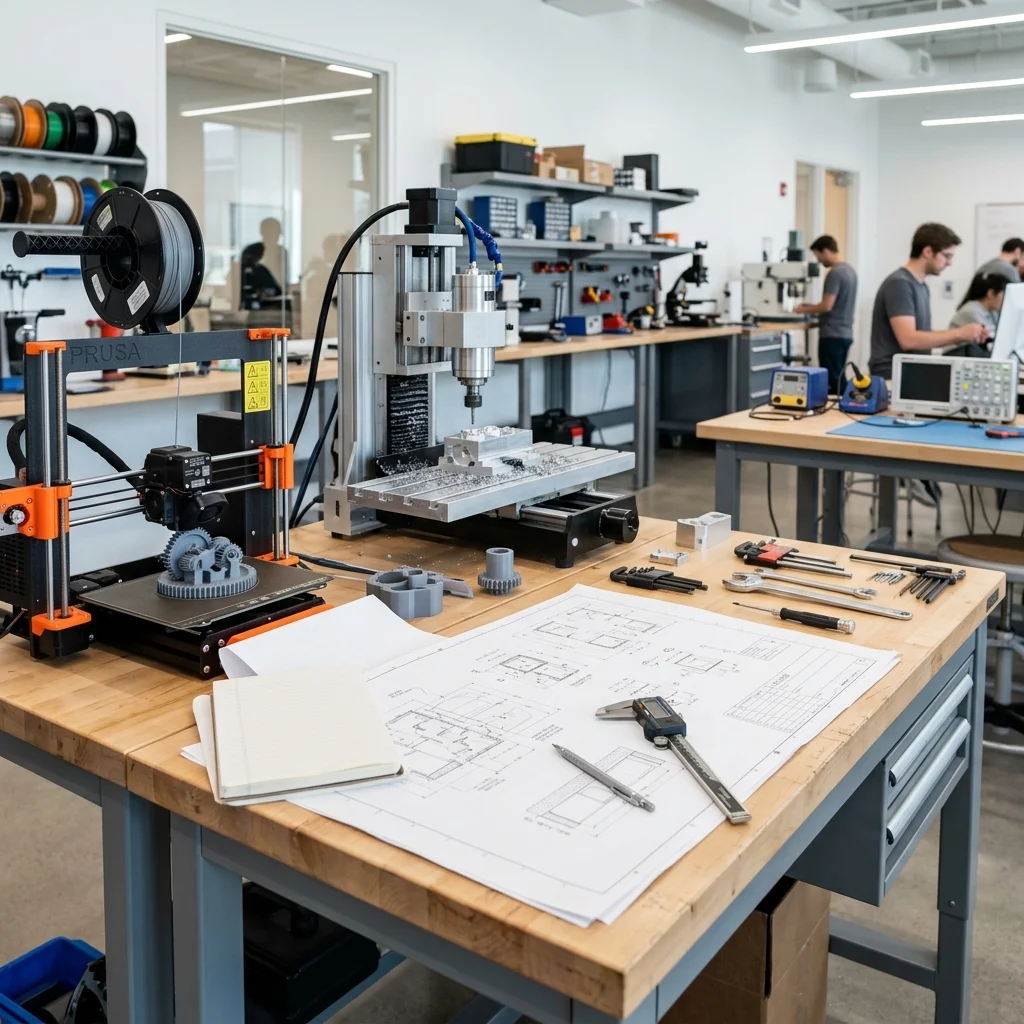
The industrial revolution of our time is digital, decentralized, and additive. However, building a successful 3D printing startup requires more than just buying a fleet of printers. At EduFacturing, our philosophy is 'picks and shovels': we provide the deep technical knowledge that gives purpose to the hardware. Whether you are aiming to run a local print-on-demand farm or a highly specialized prototyping bureau, success hinges on architecture, from machine kinematics to cloud-based Manufacturing Execution Systems (MES). This checklist is your ultimate technical blueprint for launching and scaling a resilient 3D printing business.
1. Hardware Architecture & Workspace Infrastructure
Your hardware selection forms the bedrock of your operations. Instead of chasing the cheapest machines, focus on MTBF (Mean Time Between Failures) and ecosystem reliability. For FDM (Fused Deposition Modeling), modern CoreXY architectures offer the speed and precision required for scalable production. If your niche is high-resolution miniatures or jewelry, MSLA or DLP resin systems are non-negotiable. Beyond the printers themselves, your workspace infrastructure is critical. Ensure you have dedicated, load-balanced electrical circuits to prevent tripped breakers during peak farm operation. Implement climate control with active HEPA/VOC ventilation, especially when handling engineering-grade filaments (like ABS/ASA) or photopolymer resins. Stable temperature and humidity are the unseen variables of repeatability.
2. The Digital Thread: Software Stack & MES
A print farm without a centralized brain is just a collection of machines. To scale efficiently, you must implement a software stack, creating a smooth 'digital thread' from CAD to finished part. Your design suite might include Fusion 360 for parametric engineering or Blender for organic modeling. However, the real difference comes from your MES (Manufacturing Execution System). Platforms like AutoDesk Fusion 360 Manage, 3DPrinterOS, or MakerOS allow you to track job queues, manage digital inventory, and automate slicing workflows across multiple printer clusters. A proper MES minimizes idle time, automatically routes jobs to available machines, and aggregates telemetry data so you can accurately predict maintenance cycles.
3. Materials Strategy & Supply Chain
Profitable 3D printing startups segment their materials into commodity and engineering tiers. While PLA and PETG are excellent for rapid prototyping and low-stress parts, high-margin opportunities lie in engineering-grade polymers. Materials like Carbon Fiber reinforced Nylon (PA-CF), Polycarbonate (PC), and even PEEK command premium pricing but require enclosed, high-temperature chambers and hardened nozzles (like ruby or tungsten carbide). Proper material management is equally important. Hygroscopic materials must be stored in sealed, desiccant-filled dry boxes or active filament dryers. Printing wet nylon not only compromises the visual quality of the print but destroys its mechanical integrity, leading to catastrophic part failure.
4. Post-Processing & Quality Assurance (QC)
Printing the part is only 50% of the manufacturing process. Post-processing is where the actual value is unlocked. For resin printing, automated wash and cure stations using IPA or water-washable solvents are mandatory to ensure safe, fully cross-linked final products. For FDM, consider investing in vapor smoothing equipment (e.g., PolySmooth or ABS/Acetone setups) to achieve injection-molding-like surface finishes, or dedicated support removal tools (like ultrasonic baths for soluble supports like PVA/HIPS). Quality Assurance (QC) must be rigorous. Implement a failure rate buffer in your workflow and invest in basic metrology tools (digital calipers, micrometers, or even affordable 3D scanners) to verify dimensional accuracy against the original CAD file before shipping to the client.
5. Economics, Pricing Strategy, and IP
Many startups fail because they price their services based solely on material weight. A sustainable pricing model must factor in machine depreciation, electricity, labor (design, slicing, post-processing, and packing), and overhead. Use automated quoting engines integrated into your website to provide instant, accurate pricing based on bounding box volume and print time. Additionally, safeguard your digital assets. In a business where your inventory is virtual, protecting Intellectual Property (IP) is essential. Ensure you have clear licensing agreements with designers and secure your local networks to prevent unauthorized access to proprietary STL or STEP files.
Conclusion
Transitioning from a hobbyist to a manufacturing entrepreneur is a profound leap. It requires systematic thinking, strict quality control, and a scalable digital infrastructure. By following this technical checklist, you lay down a resilient foundation capable of handling real-world production demands. Equip yourself with the right knowledge, master the 'picks and shovels' of additive manufacturing, and build the factory of the future with EduFacturing.
The full picture
This article is one page from The Big Book of 3D Printing: 704 illustrated pages covering every technology, material and fix in one reference.
Read it on Kindle →Engineer, author of The Big Book of 3D Printing and additive manufacturing expert