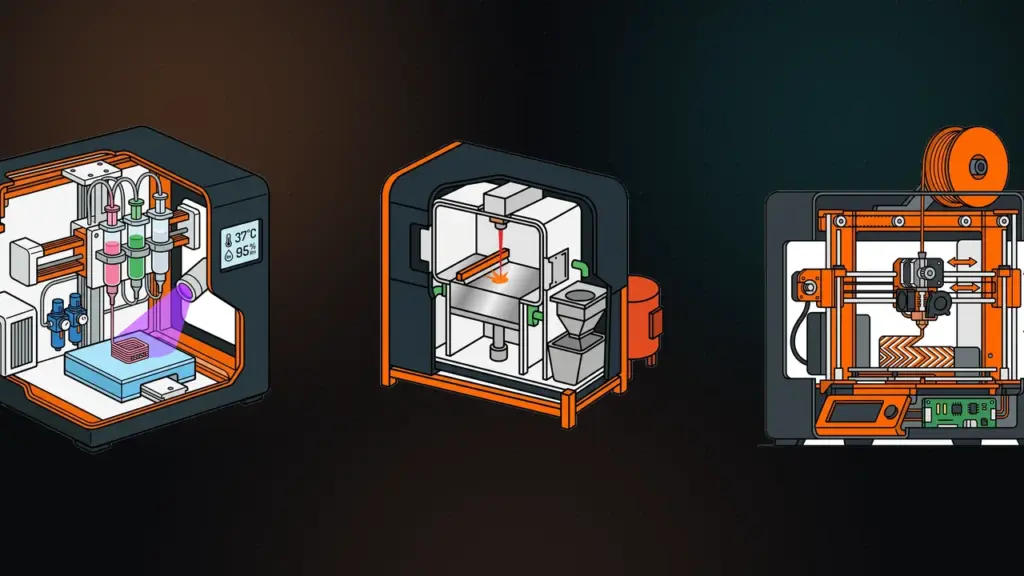
3D printing left the lab long ago. Today we find it in hospitals, factories, schools and homes – wherever shape freedom, speed or customization is needed. Here are the real applications of the technology across industries, with concrete examples of what gets made.
Industry and manufacturing
Prototyping
The most mature application. Fast iterations in product development – from idea to a hands-on model in a single day.
End-use production
Small series, spare parts on demand, customized items – without expensive moulds.
Tooling
Jigs, templates and fixtures that speed up and safeguard production.
Medicine and healthcare
One of the most impactful areas. 3D printing enables bespoke prosthetics and implants, anatomical models for planning complex surgeries, dental crowns and aligners, and biocompatible surgical guides. Customization here literally changes lives.
Education
3D printing is a powerful teaching tool – it turns abstract concepts in engineering, design and maths into physical objects students hold in their hands. This is exactly what EduFacturing’s Academy is built on.
Automotive and aerospace
Lightweight parts, complex cooling channels, customized components and spare parts for old models. In aerospace every gram of weight saved has value – so metal printing of titanium parts is standard for critical components.
Architecture and construction
From detailed architectural models to experimental printing of concrete structures. The technology enables shapes traditional construction struggles to achieve.
Jewellery, art and home
Jewellery
Castable resins for precise models later cast in gold or silver.
Art and design
Sculptures, furniture, lighting – shapes limited only by imagination.
Home and hobby
Gadgets, repairs, toys, organizers – solve small everyday problems yourself.
What all applications share
Wherever a unique shape, speed, customization or small quantities are needed – 3D printing is almost always the better choice than traditional methods. That is why its applications grow every year.
Start your application
Whatever your idea, the path starts with understanding the technology: what is 3D printing and the types of technologies. To realize it – browse the printers, materials and tools. And if you need a finished part for a specific application – our 3D printing services are available. See the whole ecosystem.
The full picture
This article is one page from The Big Book of 3D Printing: 704 illustrated pages covering every technology, material and fix in one reference.
Read it on Kindle →Frequently asked questions
What industries use 3D printing today?
How is 3D printing used in medicine?
What is 3D printing used for in aerospace?
When is 3D printing better than traditional manufacturing?
Engineer, author of The Big Book of 3D Printing and additive manufacturing expert
Updated on 30 May 2026
This article was written with AI assistance; the facts were checked against the sources on 30 May 2026.