

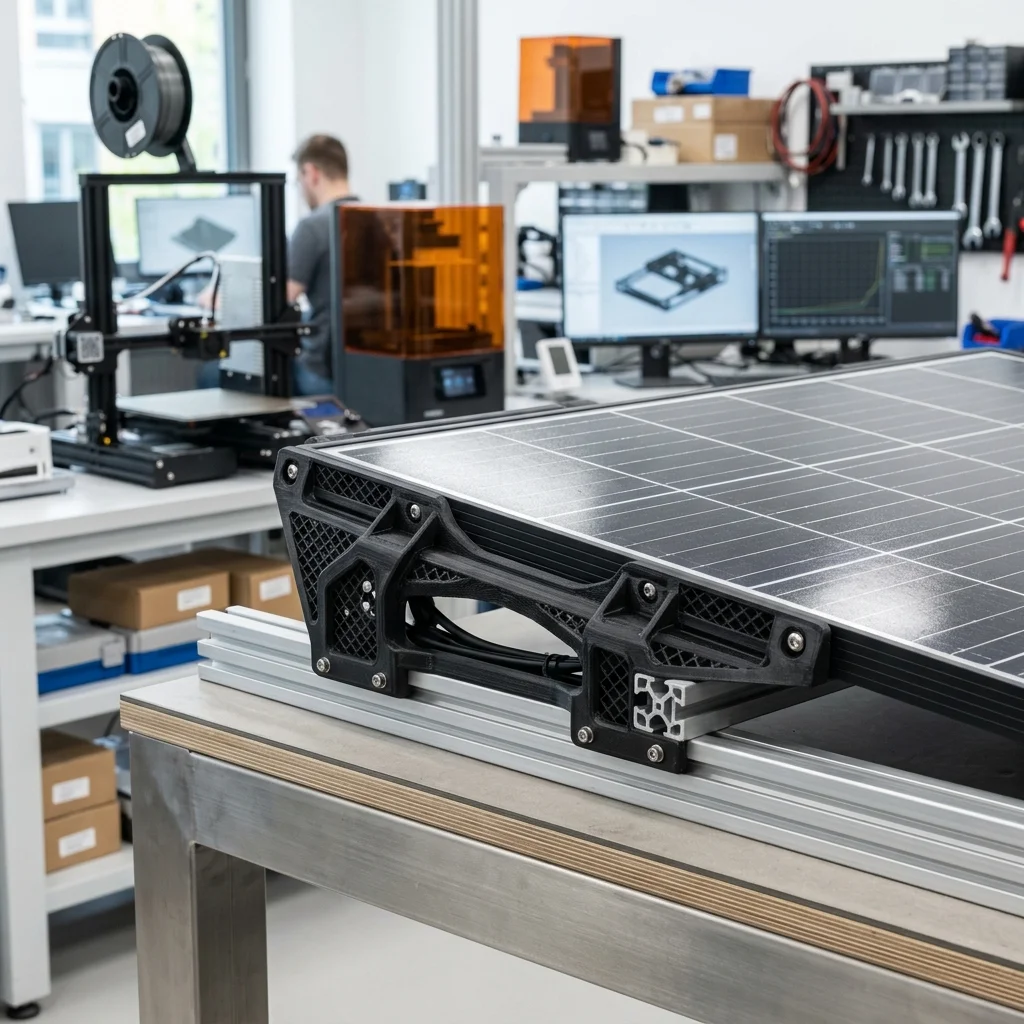
The transition toward renewable energy demands flexible, efficient, and scalable infrastructure. Traditional solar panel installations rely heavily on standard aluminum extrusions, which, while durable, offer limited adaptability for complex architectural integrations or irregular surfaces. Enter additive manufacturing. 3D printed solar panel frames and custom mounting systems are unlocking new possibilities for Building-Integrated Photovoltaics (BIPV), off-grid setups, and rapid prototyping. By leveraging advanced weather-resistant polymers, engineers and makers can now design and deploy highly specialized components that bridge the gap between rigid standard hardware and the unique requirements of modern solar deployments.
Moving Beyond Standard Aluminum Extrusions
While aluminum remains the undisputed king of large-scale, structural solar racking due to its strength and longevity, standard extrusions struggle when confronted with unconventional installation environments. Curved roofs, marine applications, balconies, and specialized off-grid vehicles often require custom brackets and angles that are expensive or impossible to source off-the-shelf. 3D printing fills this exact void. By shifting from subtractive to additive manufacturing for these auxiliary components, developers can rapidly iterate custom geometries, optimizing tilt angles for maximum energy yield based on specific geographic locations.
The Material Science of Outdoor 3D Printing
The viability of any 3D printed solar component hinges entirely on material selection. Solar mounts are subjected to extreme conditions: intense UV radiation, thermal expansion, moisture, and mechanical loads from wind and snow. Standard PLA or even standard PETG will warp or degrade quickly in direct sunlight. The industry standard for outdoor additive manufacturing is Acrylonitrile Styrene Acrylate (ASA). ASA offers exceptional UV resistance and high thermal stability (withstanding temperatures up to 100°C), ensuring that structural integrity and color are maintained over years of exposure. For high-stress applications, UV-stabilized Polycarbonate (PC) provides unmatched toughness, though it requires professional-grade enclosures to print successfully.
Prototyping, BIPV, and Complex Geometries
Additive manufacturing shines in the realm of Building-Integrated Photovoltaics (BIPV), where solar elements must blend with architectural designs. 3D printing allows for the creation of intricate, aesthetically pleasing frames that double as functional structural elements. Furthermore, the technology enables the rapid prototyping of new junction boxes, cable management systems, and specialized heat dissipation fixtures. In advanced experimental setups, researchers are even using 3D printing to create complex optical structures (such as light-focusing lenses) directly onto or within the panel housings to concentrate sunlight and boost overall cell efficiency.
Challenges and the Path Forward
Despite its immense potential, 3D printing solar frames is not without hurdles. Scalability remains a primary challenge; printing individual frames is ideal for custom jobs but cannot currently compete with the mass-production speeds of aluminum extrusion. Additionally, a lack of standardized regulatory frameworks for printed structural polymers in solar arrays can complicate certification for commercial installations. However, as large-format metal 3D printing and continuous carbon fiber reinforcement technologies become more accessible, we are moving closer to a future where even the primary load-bearing structures of customized solar arrays could be printed on-demand, reducing global supply chain dependencies and material waste.
Conclusion
3D printing is not here to replace aluminum in massive solar farms, but rather to complement it by solving the complex, edge-case challenges of solar integration. From custom-angled ASA brackets to integrated BIPV frames, additive manufacturing enables a more adaptable, efficient, and aesthetically integrated renewable energy future.
The full picture
This article is one page from The Big Book of 3D Printing: 704 illustrated pages covering every technology, material and fix in one reference.
Read it on Kindle →Engineer, author of The Big Book of 3D Printing and additive manufacturing expert