

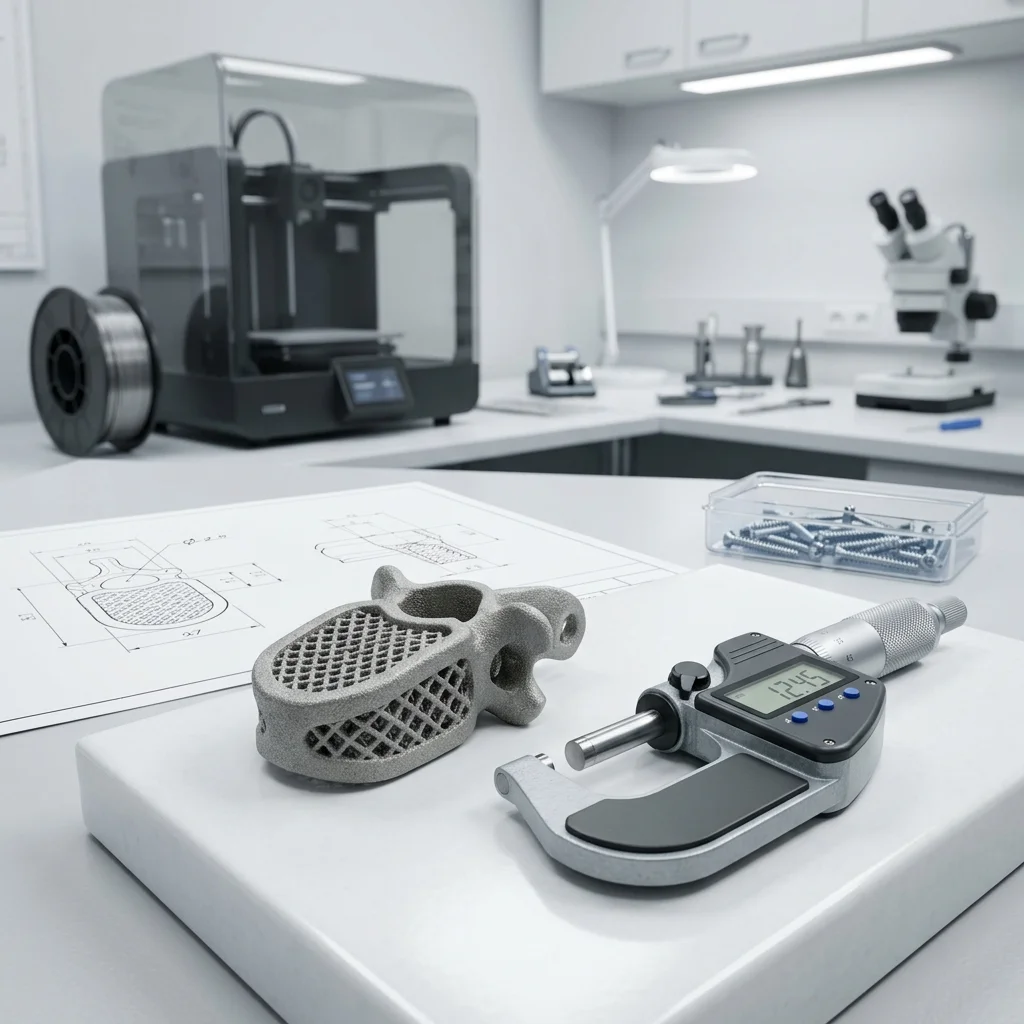
The shift from mass-manufactured, off-the-shelf orthopedic implants to patient-matched, 3D-printed titanium and PEEK structures is one of the most profound medical revolutions of our decade. However, the true bottleneck isn't the hardware: it's the regulatory framework. As the primary Technical Architect at EduFacturing, I often emphasize that mastering the hardware is only half the battle; the real "picks and shovels" lie in understanding how to legally and safely deploy these life-changing devices. The regulatory landscape, governed primarily by the FDA in the US and the MDR in Europe, is undergoing a seismic shift to accommodate Point-of-Care (PoC) manufacturing without compromising patient safety.
The FDA Paradigm: 510(k), De Novo, and the PoC Discussion
In the United States, the FDA does not grant a blanket exemption for 3D-printed medical devices. Currently, most patient-matched orthopedic implants, such as complex acetabular cups or spinal cages, are cleared via the 510(k) pathway, demonstrating substantial equivalence to a predicate device. For truly novel lattice structures or hybrid materials, the De Novo pathway is required. The turning point came with the FDA’s 2017 guidance on Technical Considerations for Additive Manufactured Medical Devices, followed by the 2023 discussion paper on "3D Printing Medical Devices at the Point of Care." The core FDA philosophy is strict: moving a 3D printer into a hospital does not lower the regulatory bar. Hospitals acting as manufacturers must implement rigorous Quality Management Systems (QMS) compliant with 21 CFR Part 820, ensuring process validation and staff expertise match traditional OEMs.
EU MDR 2017/745: The End of the "Custom-Made" Loophole
The European Medical Device Regulation (MDR) 2017/745 drastically tightened the rules for custom devices. Previously, many patient-specific implants bypassed stringent clinical evaluations under the guise of being "custom-made." Today, under Annex XIII, manufacturers must maintain exhaustive technical documentation, post-market surveillance, and clinical evaluation reports. Interestingly, Article 5(5) offers a "Health Institution Exemption" that allows hospitals to produce implants in-house on a non-routine basis. However, this is far from a free pass. Hospitals must justify why commercial alternatives are inadequate and uphold General Safety and Performance Requirements (GSPR) that closely mirror full commercial certification. This has driven the rise of "MDR-compliant PoC" partnerships, where hospitals use closed-loop, pre-validated hardware and software ecosystems provided by established AM companies.
Quality Control and Standardization: ISO 13485 and ASTM
Whether operating in a centralized facility or at the hospital bedside, compliance is anchored in standardization. ISO 13485 is the non-negotiable bedrock for any medical QMS, dictating risk management (ISO 14971) at every step. For additive manufacturing specifically, engineers must look to ASTM International and ISO standards. Standards like ASTM F3303 (for Powder Bed Fusion) define the stringent requirements for machine calibration, powder recycling, and post-processing steps like Hot Isostatic Pressing (HIP) and sterilization. The software chain is equally critical; from DICOM segmentation to the final STL/3MF generation, software must be validated under IEC 62304. At EduFacturing, we stress that a successful print is meaningless if the digital thread leading to it isn't fully validated and traceable.
The Future: Decentralized Manufacturing and AI Validation
The next decade will see a transition from centralized production hubs to decentralized, hospital-based micro-factories. To make this economically and legally viable, the industry is pivoting towards "turnkey" regulatory solutions. This involves locked machine parameters, certified raw materials, and AI-driven in-situ monitoring that acts as an automated quality inspector. By proving that a specific print job didn't deviate from the validated parameters, hospitals can release parts with confidence. The convergence of digital twins, blockchain for traceability, and advanced AM hardware will soon make Point-of-Care 3D bioprinting as routine as taking an MRI, provided the regulatory "picks and shovels" are properly utilized.
Conclusion
Navigating the regulatory pathways for 3D-printed orthopedic implants is a complex, high-stakes endeavor that requires a deep understanding of FDA and MDR frameworks. We are no longer just printing parts; we are manufacturing Class II and Class III medical devices. By embracing Quality Management Systems and leveraging validated workflows, innovators can bring patient-matched healthcare into practice. At EduFacturing, we believe that education is the key to bridging the gap between engineering potential and clinical reality.
The full picture
This article is one page from The Big Book of 3D Printing: 704 illustrated pages covering every technology, material and fix in one reference.
Read it on Kindle →Engineer, author of The Big Book of 3D Printing and additive manufacturing expert