

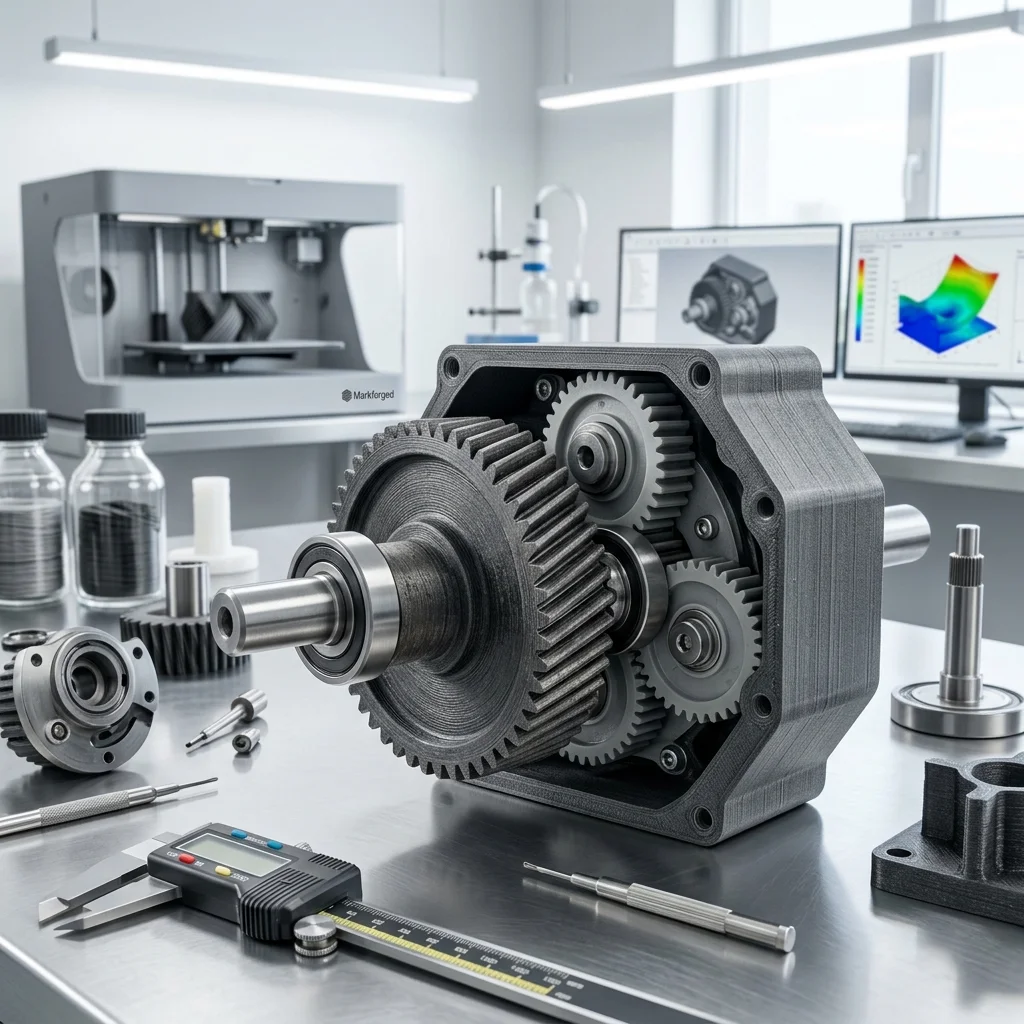
The evolution of additive manufacturing has pushed 3D printing far beyond the boundaries of rapid prototyping, transforming it into a viable method for fabricating functional, load-bearing mechanical systems. One of the greatest challenges in this domain remains the production of gearbox components (gears, housings, and shafts) that must withstand significant torque, friction, and thermal loads.
With the right engineering mindset, precise material selection, and optimized design, 3D printed transmissions are already finding applications in robotics, drones, and even specialized automotive subassemblies. In this article, we explore the key factors that ensure the longevity and structural integrity of 3D printed gearbox components.
Material Science: The Backbone of Mechanical Integrity
Material selection is the most critical step in creating a durable gearbox. Unlike decorative models, these assemblies require polymers with high resistance to impact, fatigue, and wear.
The most widely recommended material for high-load applications is Nylon (PA6 or PA12). It possesses an excellent combination of flexibility, toughness, and self-lubricating properties that reduce friction between meshing gears. For even more extreme applications, polymers reinforced with carbon or glass fibers (Carbon Fiber/Glass Fiber Nylon/PPA) are utilized. These composites offer exceptional rigidity and resistance to thermal deformation. In the industrial sector, superpolymers like PEEK and PEKK can even replace aluminum components, though they require specialized high-temperature 3D printers.
For lower loads, PETG is a reliable and cost-effective alternative that balances strength and printability better than PLA, which is generally too brittle and thermally unstable for mechanical applications.
Overcoming Anisotropy: Print Optimization
3D printed parts have anisotropic properties: their strength varies depending on the direction of the load due to their layered structure. Interlayer adhesion is typically the weakest link in any FDM/FFF printed part.
To guarantee maximum durability, gears must always be printed flat on the build plate. This ensures that the layers are stacked parallel to the axis of rotation, meaning the forces acting on the teeth run perpendicular to the layer lines, preventing them from shearing off along the Z-axis. Furthermore, infill density should range between 50% and 100%, with 100% solid infill recommended for key transmission components. Using a minimum of 3 to 5 perimeters (walls) significantly reinforces the gear teeth profile and improves wear resistance.
Design for Additive Manufacturing (DfAM) in Transmissions
Traditional CAD models of gears designed for milling or injection molding are often sub-optimal for 3D printing. Engineers must apply the principles of DfAM (Design for Additive Manufacturing).
One of the most successful strategies is the use of herringbone gears. They distribute loads more evenly, eliminate axial thrust forces, and operate much more quietly than standard spur gears. Additionally, increasing the gear module (using larger, thicker teeth) compensates for the lower absolute strength of plastics compared to metals. It is also vital to incorporate adequate clearance of about 0.2mm to 0.5mm between meshing components to prevent binding and accommodate thermal expansion during operation.
Post-Processing and Hybrid Assemblies
Even a perfectly printed gearbox requires proper maintenance and a hybrid approach. 3D printed polymers are excellent for housings and gears, but shafts and bearings should generally remain metal. Integrating threaded brass heat-set inserts and steel ball bearings drastically extends the lifespan of the entire mechanism.
Tribology (the science of friction and wear) is key. Surfaces should be smoothed after printing, and the application of appropriate lubricants (such as PTFE-based greases or dry graphite) is mandatory to minimize heat buildup and reduce the wear rate of the plastic mating surfaces.
Conclusion
3D printed gearbox components are no longer mere prototypes; they are functional engineering solutions. By combining advanced polymers like carbon-fiber-reinforced nylon, intelligent DfAM practices, and optimized printing strategies, modern creators can produce transmissions capable of handling serious loads. As material technologies continue to advance, the role of 3D printing in custom, lightweight mechanics will only grow, paving the way for more efficient robotics and automation.
The full picture
This article is one page from The Big Book of 3D Printing: 704 illustrated pages covering every technology, material and fix in one reference.
Read it on Kindle →Engineer, author of The Big Book of 3D Printing and additive manufacturing expert