

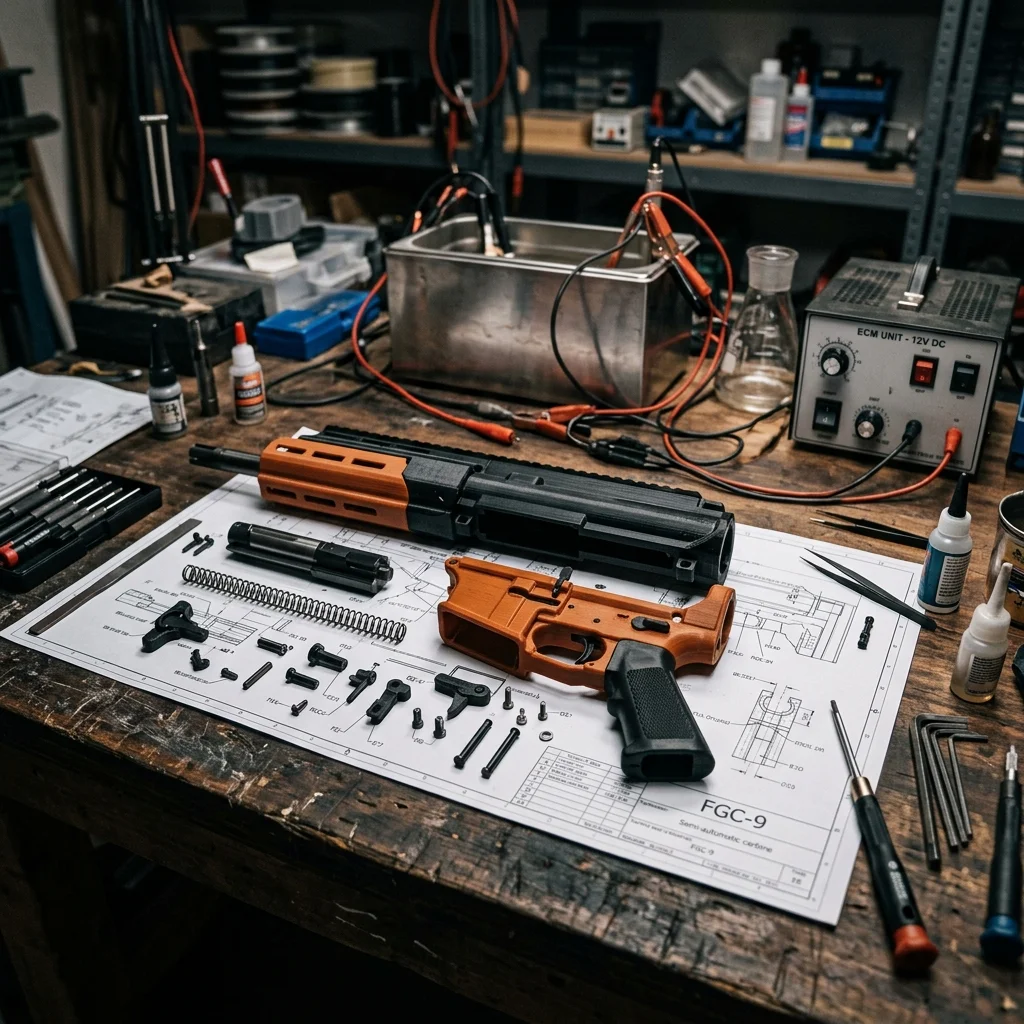

California is trying to ban open-source 3D printers like Klipper and Marlin! In June 2026, the global maker community faced its most severe legal challenge to date. California Assembly Bill AB 2047 (the Firearm Printing Prevention Act), having cleared the state assembly and now under active debate in the state senate (with a crucial hearing scheduled for June 23, 2026), threatens to fundamentally disrupt open-source 3D printing.
The Mechanics of AB 2047 “Censorware”
Introduced to prevent the illicit fabrication of untraceable firearms like the FGC-9, the proposed bill introduces unprecedented technical mandates:
- Detection Algorithms: All consumer 3D printers sold in California must contain firmware-level shape detection algorithms to scan model geometry prior to printing and block recognized firearm parts.
- Banning Open Source: The bill makes it a misdemeanor to disable, modify, or bypass these algorithms. This effectively criminalizes standard open-source firmwares (Klipper, Marlin) and slicing tools (OrcaSlicer, PrusaSlicer) that lack state-certified scanning loops.
- Stiff Manufacturer Penalties: Selling non-compliant hardware in the state will carry civil penalties of up to $25,000 per unit starting in 2029.
Anatomy and regulation of 3D printed firearms
Review how the FGC-9 is structured, and follow how the law has tightened around it.
The FGC-9 in outline:
Choose a component from the menu on the left
Select one of the FGC-9 assemblies to see what it is and where it stands legally.
The “Stop the 3D Printing Ban” Movement
Digital rights groups (including the EFF) and the maker community have mobilized under the “Stop the 3D Printing Ban 2026” campaign:
- Technical Impracticability: Hardware engineers argue that 3D printers interpret raw toolpaths (G-code), not 3D CAD files. Identifying components purely from vector movements is mathematically prone to false positives, potentially blocking plumbing tubes or brackets.
- Ending the Right to Modify: Restricting firmware modification prevents custom calibration, repairs, and community upgrades, locking users into proprietary software.
- Surveillance Concerns: To verify compliance, manufacturers may be forced to implement remote logging, monitoring exactly what users attempt to print.
The Impact on Additive Manufacturing
If signed into law, AB 2047 will likely establish a legal precedent for similar bills across the US and the EU. This risks splitting the ecosystem:
- “Compliant” Printers: Locked-down, online-only machines equipped with DRM-style software filters.
- “Non-Compliant” Printers: Custom-built RepRap, Voron, or open hardware setups that refuse to run monitoring algorithms, potentially pushing standard maker workflows into legal grey zones.
California Bill Ab 2047: The June 2026 Battle Against 3D Printer Censorware Calculator
Interactive optimization calculator.
The full picture
This article is one page from The Big Book of 3D Printing: 704 illustrated pages covering every technology, material and fix in one reference.
Read it on Kindle →Engineer, author of The Big Book of 3D Printing and additive manufacturing expert