

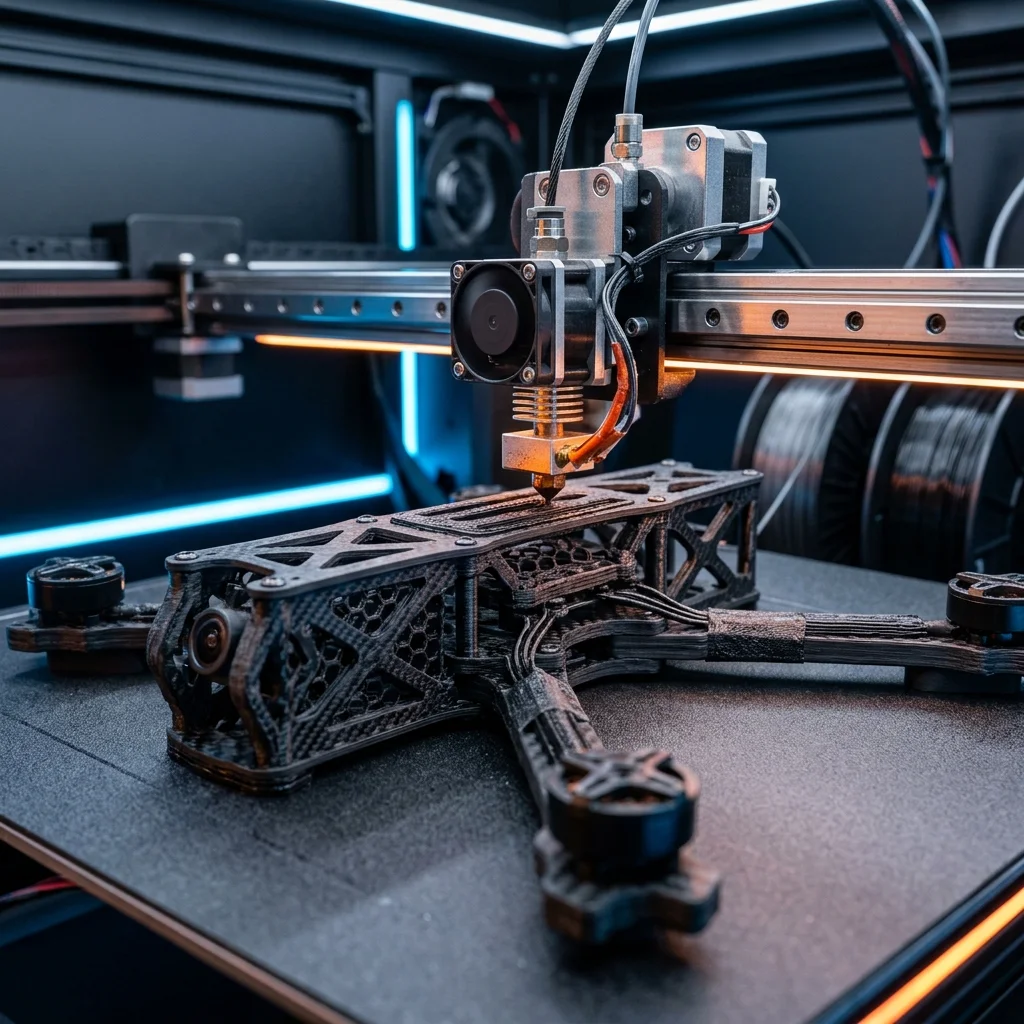
The convergence of additive manufacturing and unmanned aerial systems is unlocking a new generation of drone frames that are lighter, stronger, and customizable on demand, reshaping design cycles and market economics.
Material Science & Structural Design
Advanced polymers such as carbon‑fiber reinforced nylon (CF‑Nylon) and high‑temperature PEKK enable lattice infill patterns that achieve up to 45% weight reduction while preserving a tensile strength comparable to aluminum alloys. Topology‑optimization algorithms, fed with finite‑element analysis, generate organic geometries that concentrate material only where stress peaks occur. Multi‑jet fusion and continuous fiber printing further improve inter‑layer bonding, eliminating the anisotropy that traditionally plagued FDM parts. The result is a frame that can sustain gust loads of 15 m/s without compromising payload capacity.
Manufacturing Efficiency & ROI
Pros/Cons:
- Pros: rapid design iteration, on‑site production, reduced inventory, lower tooling costs, and the ability to integrate internal cable channels.
- Cons: initial material cost premium, need for post‑processing (support removal, surface finishing), and reliance on calibrated printers for repeatability. These factors translate into a typical ROI window of 12–18 months for medium‑scale drone manufacturers, especially when the reduced weight yields a 10% increase in flight endurance and a corresponding boost in service contracts.
Cost Breakdown
Material (CF‑Nylon filament, 1 kg): $120 Printer depreciation (industrial SLS machine, annualized): $45,000 Labor – design and post‑processing (40 h): $2,400 Quality assurance & testing (10 h): $600 Overhead (facility, utilities): $1,200 Total:
Implementation Timeline
Step 1: Conceptual design and load analysis (2 weeks). Step 2: Topology‑optimization and CAD modeling (1 week). Step 3: Print trial runs and parameter tuning (1 week). Step 4: Full‑scale production of flight‑ready frames (2 weeks). Step 5: Certification testing, documentation, and launch (1 week).
Emerging Applications & Market Outlook
In medicine, 3D‑printed frames support lightweight delivery drones capable of transporting temperature‑controlled biologics to remote clinics, cutting logistics costs by up to 30%. In robotics, modular frames enable plug‑and‑play sensor pods for inspection swarms used in oil‑rig maintenance. Aerospace firms are piloting hybrid‑frame UAVs that combine printed carbon‑fiber skins with metal motor mounts, achieving a 20% reduction in overall aircraft weight and opening new revenue streams in high‑altitude surveillance. Market analysts project a CAGR of 22% for printed drone components through 2032, driven by regulatory acceptance and supply‑chain resilience.
Frequently Asked Questions (FAQ)
How 3D‑Printed Drone Frames Are Redefining Innovation Calculator
Interactive optimization calculator.
The full picture
This article is one page from The Big Book of 3D Printing: 704 illustrated pages covering every technology, material and fix in one reference.
Read it on Kindle →Engineer, author of The Big Book of 3D Printing and additive manufacturing expert