

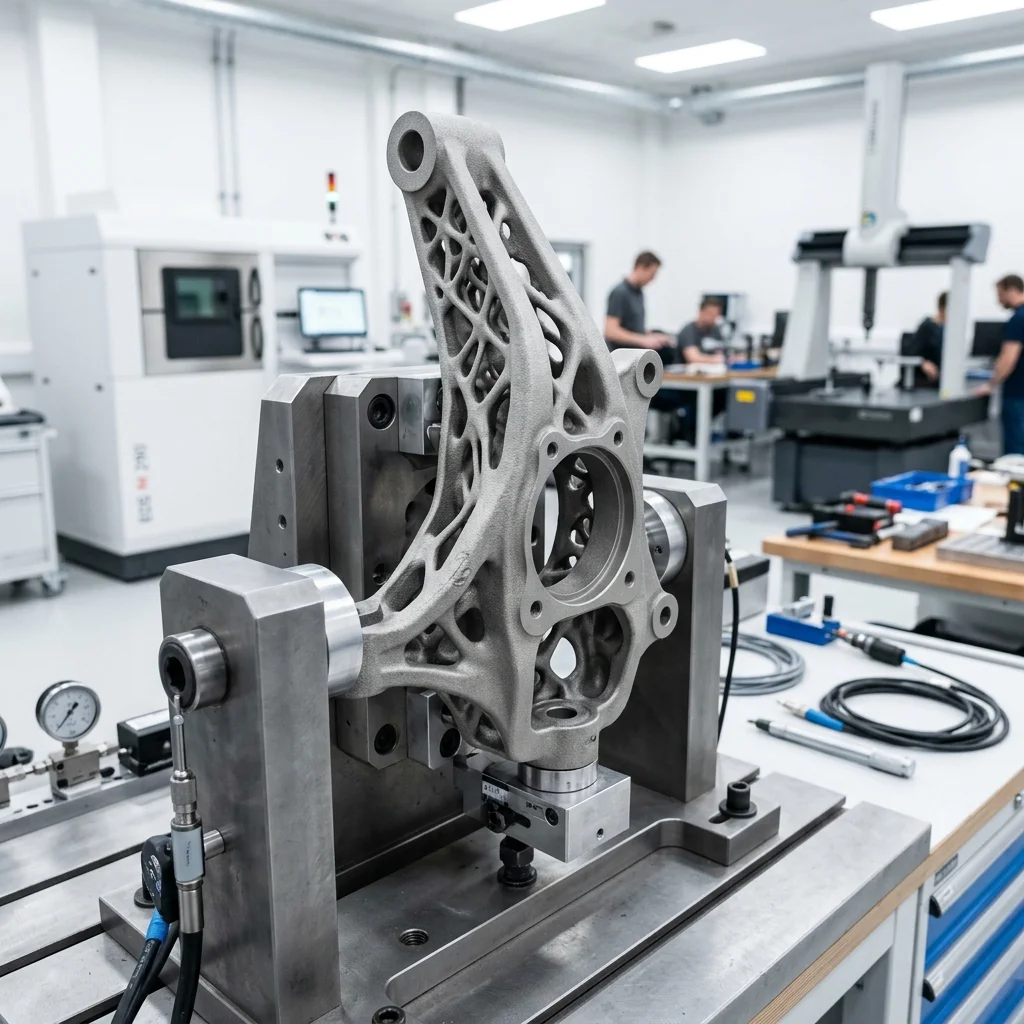
The automotive industry is in the midst of a tectonic shift, driven by the relentless pursuit of efficiency, speed, and sustainability. At the heart of this transformation is additive manufacturing (AM). No longer confined to rapid prototyping, 3D printing has matured into a robust production technology capable of delivering end-use automotive parts that rival, and often surpass, traditional manufacturing methods.
By merging advanced material science with AI-driven generative design, engineers are unlocking unprecedented levels of performance. They are successfully and radically reducing vehicle weight, enhancing thermal management, and consolidating complex assemblies into cohesive, monolithic structures.
The Material Revolution: Polymers that Outperform Metals
One of the primary catalysts for the adoption of 3D printing in final automotive production is the evolution of materials. High-performance thermoplastics like PEEK, PEKK, and ULTEM™ (PEI), alongside carbon or glass fiber-reinforced polymers (like Nylon), are now viable alternatives to aluminum and steel. These materials offer an exceptional strength-to-weight ratio, high thermal stability (often withstanding operating environments above 150°C), and superb chemical resistance. This makes them ideal drop-in replacements for heavy metal under-the-hood components, from air ducts and structural brackets to engine mounts and housings.
Generative Design and Topology Optimization
The true power of 3D-printed automotive parts is unlocked when combined with generative design. AI-driven software algorithms simulate thousands of potential design iterations based on strict physical constraints: stress points, load paths, thermal limits, and specific kinematic requirements. The result: organic, often bone-like lattice structures that utilize material only where it is absolutely necessary. This profound synergy between software and additive manufacturing results in weight reductions of up to 40% without any compromise to structural integrity, a critical advantage for extending the range of electric vehicles (EVs).
Part Consolidation and the End of Assembly Lines
Traditional automotive manufacturing frequently requires complex assemblies comprising dozens of individual stamped, cast, or machined parts that must be welded or bolted together. 3D printing disrupts this through "part consolidation": designing and manufacturing entire sub-assemblies as a single, contiguous unit. This approach drastically reduces assembly time and eliminates critical points of failure, such as seams, welds, and fasteners. As a result, not only is the supply chain simplified, but the durability and longevity of the parts under high-vibration and high-stress conditions are vastly improved.
Thermal Dynamics and Aerodynamic Efficiency
Additive manufacturing provides engineers with the geometric freedom to create internal cooling channels and conformal shapes that are physically impossible to machine or cast. In motorsports and high-performance hypercars, custom 3D-printed heat exchangers and brake cooling ducts can be designed with unprecedented precision to optimize fluid dynamics. This advanced thermal control leads to better cooling of critical powertrain components, reduces aerodynamic drag, and directly translates to enhanced performance on the track and the road.
Conclusion
The convergence of advanced AM technologies, high-grade engineering polymers, and intelligent software is doing more than just changing how cars are made: it is redefining what a car can be. As electric vehicles continue to demand lighter structures for extended operational range and motorsports push the absolute limits of extreme engineering, 3D printed automotive parts will unequivocally remain the vanguard of performance innovation. The future of mobility is lighter, smarter, and additively manufactured.
The full picture
This article is one page from The Big Book of 3D Printing: 704 illustrated pages covering every technology, material and fix in one reference.
Read it on Kindle →Engineer, author of The Big Book of 3D Printing and additive manufacturing expert