

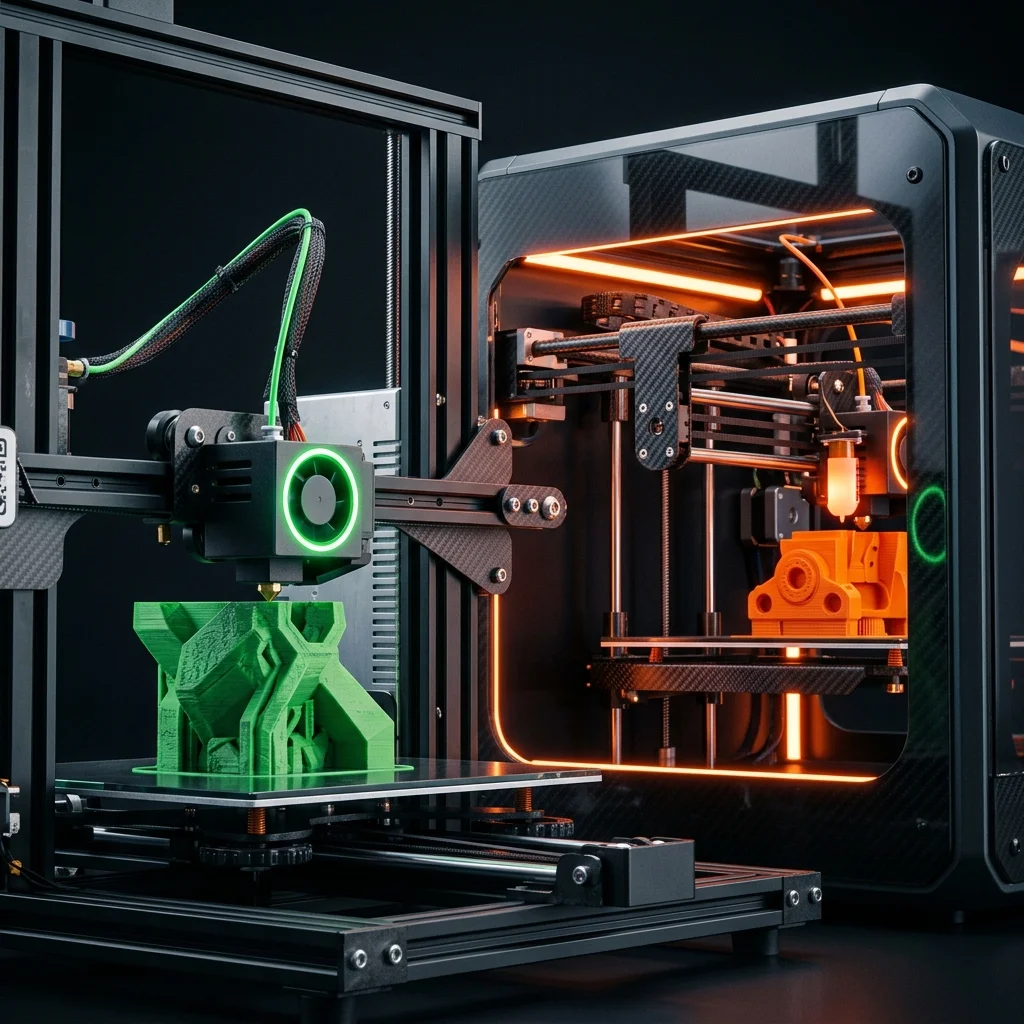
Choosing between the Prusa i3 MK4 and the Bambu Lab X1-Carbon is probably the most significant decision facing any professional or enthusiast in the additive manufacturing sector today. On one side, we have the Czech standard for absolute reliability, an open-source ecosystem, and repairability (Prusa Research), and on the other – the Chinese revolution in speed, AI automation, and multi-material printing (Bambu Lab). In this guide, we will deeply explore the architecture, software, and real-world production capabilities of both machines.
Fundamental Architectural Differences
The two machines are based on fundamentally different kinematic systems, which dictates their strengths and weaknesses in a production environment.
Prusa i3 MK4 (Cartesian Bed Slinger): Uses the classic i3 kinematics, where the extruder moves along the X and Z axes, and the print bed moves along the Y-axis. This makes the machine extremely easy to maintain, accessible from all sides, and very quiet. However, the lack of an enclosed chamber limits the reliable printing of technical polymers like ABS, ASA, and PC, which require a stable temperature environment.
Bambu Lab X1-Carbon (CoreXY): Based on the high-speed CoreXY kinematics, where two stationary motors drive the extruder along X and Y, while the print bed moves solely along the Z-axis. This minimizes moving mass and allows phenomenal speeds and accelerations (up to 20,000 mm/s²). The printer arrives with a fully enclosed aluminum chamber and an active carbon filter, making it ideal for printing high-temperature and off-gassing materials.
Extruder System: Nextruder (Prusa) vs AI Micro Lidar (Bambu)
The MK4 utilizes the innovative Nextruder – a highly precise direct extruder with a planetary gear and a built-in load cell sensor, which guarantees a perfect first layer without the need for manual calibration (Live Z). On the other hand, the X1C uses a combination of a dual-drive extruder, a built-in AI camera, and a Micro Lidar sensor. The lidar automatically scans the first layer for defects and calibrates the filament flow rate and pressure advance before every print.
Specifications and Performance
Build Volume: 250 x 210 x 220 mm (Prusa) vs 256 x 256 x 256 mm (Bambu Lab).
Maximum Speed: Up to ~200 mm/s for Prusa (with Input Shaper) vs an impressive 500 mm/s for Bambu Lab.
Maximum Hotend Temperature: 290°C (Prusa) vs 300°C (Bambu Lab).
Maximum Bed Temperature: 120°C (Prusa) vs 110°C (Bambu Lab) – 120°C is only available with 220V power for Bambu.
Speed and Quality: Thanks to the CoreXY kinematics and powerful Active Vibration Compensation algorithms, the X1-Carbon can print parts up to 2-3 times faster than the MK4 at similar quality. However, the MK4 with Input Shaper enabled is also significantly faster than its predecessors and often provides better results on small, highly detailed models due to the precision of the Nextruder and the finely tuned profiles in PrusaSlicer.
Multi-material Printing: Here the X1-Carbon shines thanks to the AMS (Automatic Material System), which stores 4 rolls of filament in a sealed dry-box and allows their automatic swapping during printing. It is extremely fast but generates a fair amount of waste (purge tower). For Prusa, the alternative is the MMU3 (Multi Material Upgrade 3) – a more accessible but mechanically more complex solution that requires more fine-tuning.
Software, Ecosystem and Support
The software environment and philosophy of the two companies are diametrically opposed.
PrusaSlicer and Open Source: Prusa is a pioneer in the open-source movement. All blueprints, firmware, and software are fully accessible. PrusaSlicer is arguably the most powerful slicer on the market, with extremely fine control over every parameter. The machine can operate completely offline, making it preferred in corporate and government environments with high data security requirements (Air-gapped environments). Repairs are easy, and most spare parts can be printed directly on the printer itself.
Bambu Studio and Cloud Integration: Bambu Lab uses a closed ecosystem, similar to Apple. The printer relies heavily on the company’s cloud services for sending files and remote monitoring via the Bambu Handy mobile app. Although there is a LAN Only mode, the full potential of the AI camera is unlocked when connected to the internet. Bambu Studio is based on PrusaSlicer but with a much more user-friendly and modern interface. Repairs on the X1C are more difficult due to the enclosed design and the necessity of purchasing specific spare parts directly from the manufacturer.
Final Verdict: Which Machine to Choose?
Choose the Prusa MK4 if: You want a machine that simply works around the clock for years. You seek absolute data security, value the open-source ideology, and want to maintain and modify the printer yourself. The MK4 is the perfect choice for educational institutions, print farms, and users who work primarily with PLA, PETG, and TPU.
Choose the Bambu Lab X1-Carbon if: Time is your most valuable resource. If you need maximum speed, an enclosed chamber for printing industrial polymers (ABS, PC, carbon-filled filaments), and easy multi-color printing right out of the box (plug-and-play). This is the machine for product designers, engineers, and innovators who want the printer to be a tool, not a project in itself.
Prusa I3 Mk4 Vs Bambu Lab X1-Carbon: Full Technical Comparison Calculator
Interactive optimization calculator.
The full picture
This article is one page from The Big Book of 3D Printing: 704 illustrated pages covering every technology, material and fix in one reference.
Read it on Kindle →Engineer, author of The Big Book of 3D Printing and additive manufacturing expert