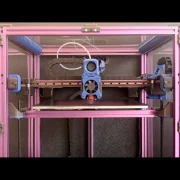
The Voron Trident 300 is an open-source DIY CoreXY FDM printer, self-assembled by engineers who want full control over their machine. With a 300×300×300 mm build volume, Klipper firmware and a panel-enclosed chamber, the Trident is a platform for precision printing with engineering polymers at speeds unattainable by a typical desktop printer.
What it is
The Trident is the third-generation CoreXY design from the Voron Design community – an open-source project where the user self-sources components, self-assembles and self-configures the machine. A closed chamber made from acrylic or aluminium panels creates a stable thermal environment mandatory for ABS, ASA, PC and CF-Nylon. Klipper firmware running on a Raspberry Pi provides access to resonance compensation (Input Shaper), Pressure Advance and virtually unlimited customisation. The result is a prosumer machine with industrial character, built entirely by its owner.
Technical specifications
| Technology | FDM (CoreXY, panel-enclosed chamber) |
|---|---|
| Build volume | 300 × 300 × 300 mm |
| Maximum speed | up to 300 mm/s (Klipper Input Shaper) |
| Firmware | Klipper (Raspberry Pi) |
| Assembly | DIY – self-sourced and self-assembled |
| Class / Price | Prosumer · ~€1000 (kit/self-sourced) |
Who it’s for
- Automotive jigs and fixtures – manufacturing specialised, high-strength production templates and assembly tools capable of withstanding heavy mechanical loads using CF-Nylon (Automotive)
- Functional enclosures and housings – producing durable, heat-resistant electronic housings from ABS or ASA, leveraging the enclosed chamber to prevent warping and delamination (Consumer electronics)
- Rapid prototyping – quickly iterating designs for mechanical parts to perform fit-checks and ergonomic testing before mass production (Engineering and manufacturing)
Calibration step by step
- Calibrate the extruder Rotation Distance in Klipper by commanding 100 mm of extrusion and measuring the actual length pulled. The extruder pushes exactly the requested amount of filament, preventing under-extrusion and over-extrusion.
- Perform bed leveling and fine-tune the Z-offset to ensure the correct distance between the nozzle and the build plate. Perfect first-layer adhesion with a properly squished extrusion line – no bed adhesion failure and no elephant's foot.
- Run Input Shaper calibration using an ADXL345 accelerometer or manual ringing tower test. Active compensation of mechanical resonances – smooth walls without ghosting even at high print speeds.
Common defects and fixes
Recommended settings by material
Pick a material to see the recommended temperatures (empirical ranges from 561 OrcaSlicer/Bambu profiles) plus machine-specific tips:
Conclusion
The Voron Trident 300 is a machine for engineers who want to understand every bolt in their printer. The DIY character means total freedom of customisation, while Klipper and the panel-enclosed chamber open the door to the full spectrum of engineering polymers. Those willing to invest the effort in assembly and configuration gain a prosumer platform with performance unattainable from closed systems at the same price point.
The full picture
This article is one page from The Big Book of 3D Printing: 704 illustrated pages covering every technology, material and fix in one reference.
Read it on Kindle →Engineer, author of The Big Book of 3D Printing and additive manufacturing expert
Updated on 30 June 2026
This article was written with AI assistance; the facts were checked against the sources on 30 June 2026.