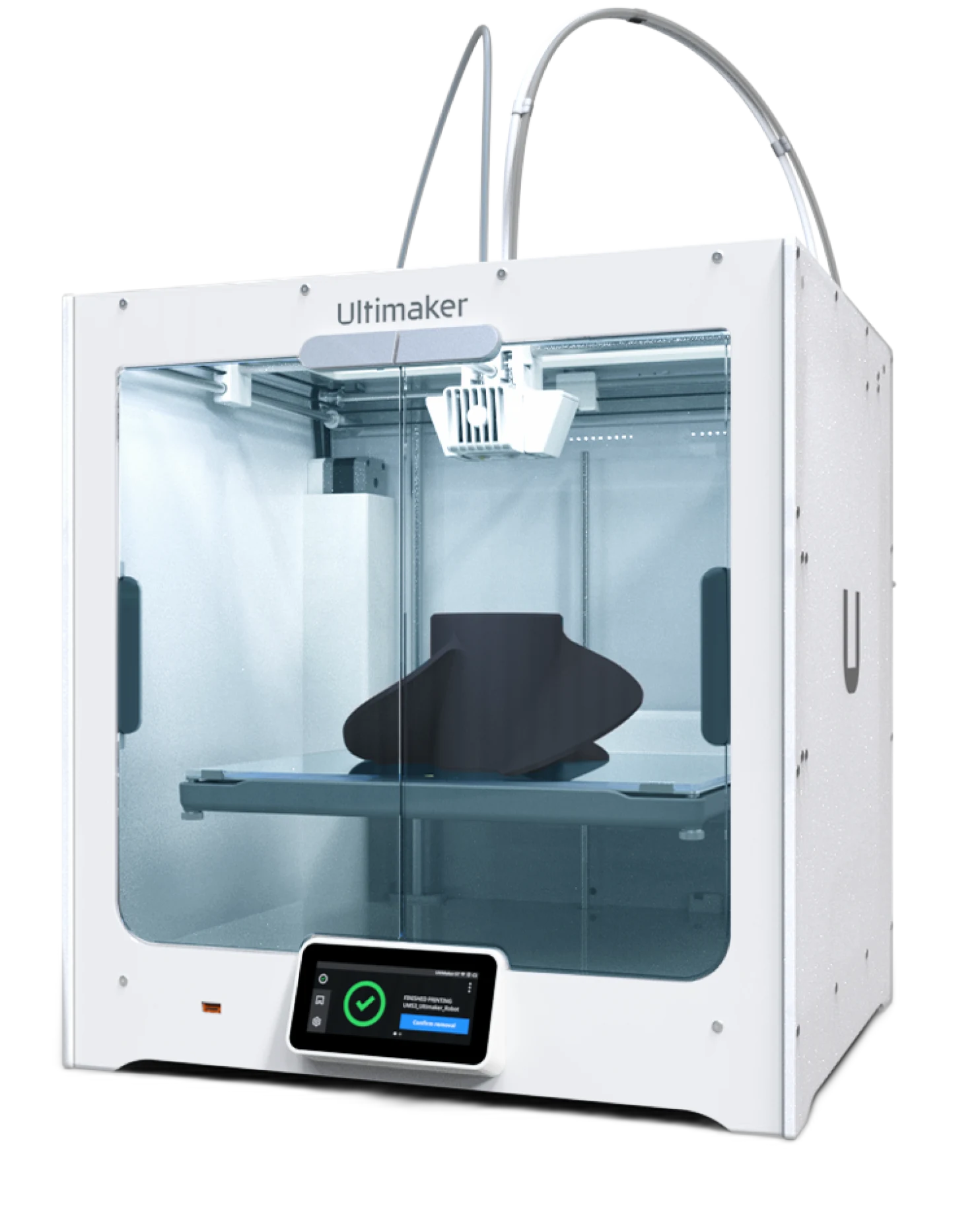
The UltiMaker S5 is a professional desktop FDM printer with dual extrusion, engineered for reliable and repeatable work in engineering and manufacturing environments. With a 330×240×300 mm build volume, NFC material recognition and deep Cura integration, the S5 is an industrial workhorse for functional prototypes, tooling and small-batch production.
What it is
The S5 is UltiMaker's flagship desktop printer – an enclosed machine with two Print Core slots (BB 0.4 for soluble PVA or CC 0.6 for abrasive materials), active nozzle switching and an NFC reader that automatically recognises UltiMaker Material Station or standard spools. Cura generates validated profiles for every material/Print Core combination, eliminating most manual tuning. It targets engineers, product designers and production teams who value predictability and engineering-polymer compatibility over speed.
Technical specifications
| Technology | FDM with Dual Extrusion |
|---|---|
| Build volume | 330 × 240 × 300 mm |
| Print Core system | 2 slots – AA (material) + BB (PVA) or CC (abrasive) |
| Material recognition | NFC reader – automatically loads material profile |
| Calibration | automatic leveling + manual Z-offset fine-tune |
| Class / Price | Industrial · ~€6 000 |
Applications and industries
- Functional prototypes – complex dual-material parts with soluble PVA supports to verify form, fit and mechanical function (Mechanical engineering and R&D)
- Jigs and Fixtures – production of custom jigs, fixtures and alignment tools from Tough PLA, Nylon or PC for manufacturing lines (Automotive and manufacturing)
- Small-batch end-use parts – serial batches of 1 to 100 parts from engineering polymers (CPE, ABS, PC) with high repeatability between prints (Consumer electronics and medical devices)
Production workflow
- Set up Cura: select the material for each Print Core and verify the NFC profile. Cura loads a validated profile (temperatures, speed, retraction) for the exact Print Core/material combination.
- Clean the PEI/glass platform with IPA and run the automatic leveling sequence. An evenly trammed platform and correct Z-offset – no elephant's foot or adhesion problems.
- Print a dual-material test object with PVA supports. Validates the handoff between Print Core A (model) and Print Core B (PVA) – no cross-contamination and clean dissolution.
- Dissolve the PVA supports in warm water (30–35°C) and finish the surfaces. Smooth supported surfaces with no support marks – typically unachievable with conventional single-material FDM.
Key considerations
Materials and applications
Pick a material/alloy this machine processes to see its properties and typical applications:
Conclusion
The UltiMaker S5 is the choice for engineering teams that value reliability and broad material compatibility over speed. The dual Print Core with soluble PVA unlocks complex geometries unreachable by single-material FDM, while Cura with NFC profiles reduces manual tuning to a minimum. It is not a machine for rapid iteration – but it is a machine you can trust for production repeatability.
The full picture
This article is one page from The Big Book of 3D Printing: 704 illustrated pages covering every technology, material and fix in one reference.
Read it on Kindle →Engineer, author of The Big Book of 3D Printing and additive manufacturing expert
Updated on 5 August 2026
This article was written with AI assistance; the facts were checked against the sources on 5 August 2026.