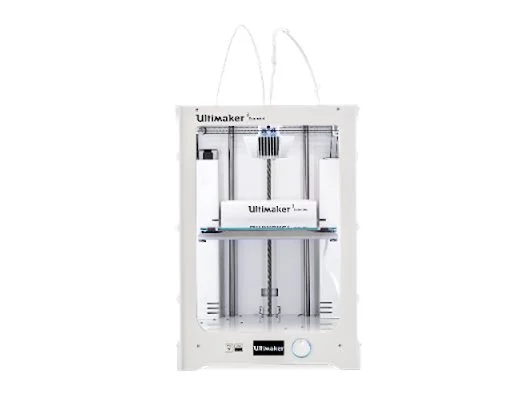
The Ultimaker 3 Extended is an enclosed prosumer FDM printer with a dual independent extrusion head designed for production environments and research labs where precision and reliability matter more than speed. With an extended build volume of 215×215×300 mm, soluble PVA support capability and NFC material recognition, it sets the standard for quality on parts with complex geometry.
What it is
The Ultimaker 3 Extended is the tall-body variant of the Ultimaker 3: the same dual extrusion system but with the build height doubled to 300 mm. The two PrintCore heads operate independently, enabling simultaneous printing with a primary material and soluble PVA, making manual support removal a thing of the past. The NFC chip in each spool automatically loads material profiles in Ultimaker Cura, reducing setup errors. The machine targets R&D departments, engineering bureaus and university labs that value repeatability over speed records.
Technical specifications
| Technology | FDM (Bowden, dual PrintCore, enclosed chamber) |
|---|---|
| Build volume | 215 × 215 × 300 mm |
| Maximum speed | up to 150 mm/s |
| Extruder | dual independent PrintCore (0.4 mm default) |
| Calibration | Active Leveling + manual Z-offset |
| Material recognition | NFC chip in spools: auto-loads material profiles |
| Class / Price | Prosumer · ~€3 400 |
Who it’s for
- Rapid prototyping: conceptual models for visual inspection and assembly fit-check using automatically dissolvable PVA supports (Consumer electronics and product design)
- Production jigs and fixtures: assembly tools and fixtures in ABS and Nylon for small series with mechanical durability (Automotive and manufacturing)
- STEM projects and education: bringing multi-component projects from idea to physical object in school labs and universities (Education)
Calibration step by step
- Clean the glass platform with isopropyl alcohol (IPA). Grease and dust removed: first-layer adhesion guaranteed.
- Run the Active Leveling procedure from the printer menu. Platform geometry automatically measured and compensated across 9 points.
- Perform fine Z-offset adjustment while printing the skirt or brim. Optimal first-layer squish without "elephant's foot" deformation.
- Calibrate the XY offset between the two PrintCores. Perfectly aligned layers in dual-material prints: no shift between core and support material.
Common defects and fixes
Recommended settings by material
Pick a material to see the recommended temperatures (empirical ranges from 561 OrcaSlicer/Bambu profiles) plus machine-specific tips:
Conclusion
The Ultimaker 3 Extended remains the preferred choice for engineers and researchers who value repeatability and material freedom over raw speed. Dual PrintCore with PVA unlocks geometries impossible on single-nozzle machines, and NFC recognition minimizes the risk of incorrect profiles. If your projects demand reliability, detail and long complex prints: the Extended format adds the critical extra 100 mm of height exactly where it counts.
The full picture
This article is one page from The Big Book of 3D Printing: 704 illustrated pages covering every technology, material and fix in one reference.
Read it on Kindle →Engineer, author of The Big Book of 3D Printing and additive manufacturing expert
Updated on 11 September 2026
This article was written with AI assistance; the facts were checked against the sources on 11 September 2026.