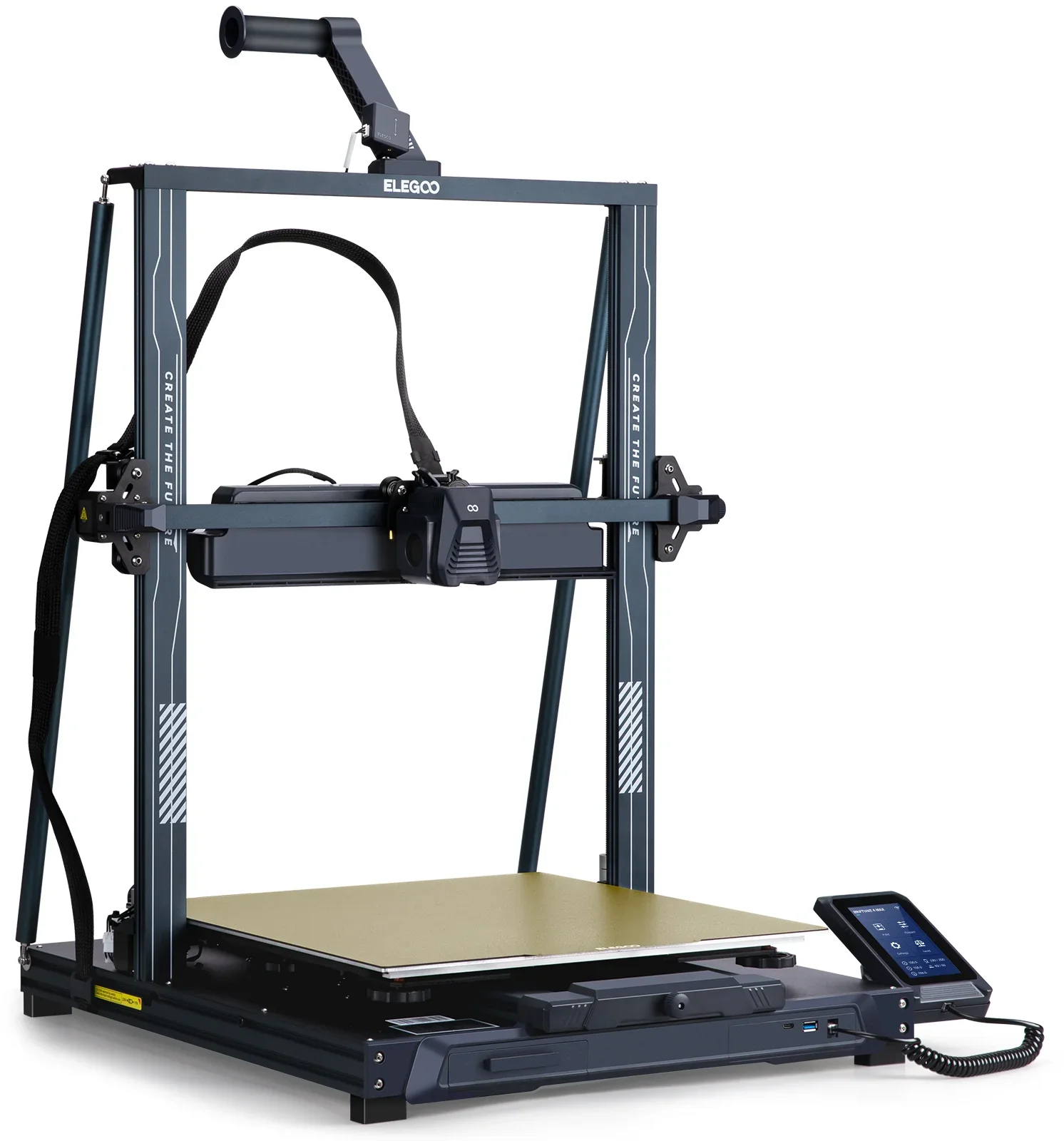
The Elegoo Neptune 4 Max is a large open-frame FDM printer in the budget class, offering a 420×420×480 mm build volume and speeds up to 500 mm/s at around €479. It runs Klipper with Input Shaper and automatic bed leveling: features usually found on far more expensive machines. If you need to print large-format objects without breaking the budget, the Neptune 4 Max is one of the most sensible choices on the market.
What it is
The Neptune 4 Max is a CoreXY open-frame machine from Elegoo aimed at users for whom print space matters more than an enclosure or automatic material switching. With a 420×420×480 mm build volume it sits firmly in the large-format desktop category, while Klipper provides Input Shaper, Pressure Advance and a convenient Moonraker interface. Without a camera or AMS, and with an open frame, the printer is optimized for bulk PLA and PETG printing, and handles TPU and ABS with some care.
Technical specifications
| Technology | FDM (CoreXY, open frame) |
|---|---|
| Build volume | 420 × 420 × 480 mm |
| Maximum speed | up to 500 mm/s |
| Firmware | Klipper (Input Shaper, Pressure Advance) |
| Bed leveling | automatic: Multi-Point ABL |
| Camera / AMS | none |
| Class / Price | Budget · ~€479 |
Who it’s for
- Large-format prototyping (Full-scale functional prototypes without splitting and assembling) the 420×420×480 mm volume covers most housing and structural parts in a single run. (Industrial Design)
- Manufacturing jigs and fixtures: Custom alignment templates, holding fixtures, and tools in low volumes (1–100 units) to streamline assembly line workflows. (Automotive & Manufacturing)
- 1:1 scale props and armor, Full-sized helmets, armor sets, and props for cosplay or film in a single print, eliminating multi-piece assembly. (Entertainment & Hobby)
Calibration step by step
- Clean the PEI magnetic build plate thoroughly with isopropyl alcohol (IPA) to remove fingerprints, oils, and dust. A completely clean surface that ensures maximum first-layer adhesion and prevents bed adhesion failure.
- Run the automated bed leveling sequence so the probe can measure multiple points across the large build platform. A high-density mesh map is saved, allowing the firmware to dynamically adjust the Z-axis and compensate for any bed warping.
- Fine-tune the Z-offset manually using a sheet of paper under the heated nozzle until a slight friction/drag is felt. Perfect nozzle-to-bed distance: guarantees optimal first-layer squish without causing an elephant's foot.
- Calibrate the extruder E-steps using the M92 command, then adjust the flow (extrusion multiplier) in the slicer. The extruder motor delivers the exact required amount of filament: no structural gaps from under-extrusion or surface blobs from over-extrusion.
Common defects and fixes
Recommended settings by material
Pick a material to see the recommended temperatures (empirical ranges from 561 OrcaSlicer/Bambu profiles) plus machine-specific tips:
Conclusion
The Elegoo Neptune 4 Max is a compelling choice for anyone who prioritizes build volume above all else while keeping costs down. Klipper with Input Shaper tames vibrations at high speeds, and automatic bed leveling makes the large platform manageable. The weak point is the open frame: ABS and ASA require extra effort. For PLA, PETG, and TPU, however, the Neptune 4 Max delivers large-format printing at a price that competitors struggle to match.
The full picture
This article is one page from The Big Book of 3D Printing: 704 illustrated pages covering every technology, material and fix in one reference.
Read it on Kindle →Engineer, author of The Big Book of 3D Printing and additive manufacturing expert
Updated on 11 September 2026
This article was written with AI assistance; the facts were checked against the sources on 11 September 2026.