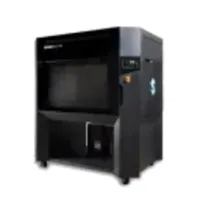
The Stratasys F770 is a large-format industrial FDM printer with a build chamber nearly 1 metre long, designed to print large parts, housings and tooling at full size, without joining sections. Replacing legacy fabrication for oversized components, the F770 delivers an enclosed regulated environment, soluble supports and the Stratasys material ecosystem for manufacturing-grade reliability.
What it is
The F770 is the largest machine in Stratasys's F-Series family: a production FDM printer with a 1000 × 610 × 610 mm build volume that can print full-length parts up to 1 metre. It operates inside a fully enclosed, temperature-regulated chamber, which is critical for dimensional stability with large ABS, ASA and carbon-filled ABS-CF10 parts. Soluble support materials (SR-35, SR-110) are dissolved away without mechanical post-processing, preserving the geometric accuracy of complex internal geometries. The F770 targets manufacturing and R&D teams in aerospace, automotive and heavy industry who need large prototypes, casting patterns or end-use production aids without outsourcing.
Technical specifications
| Technology | FDM (enclosed, temperature-regulated chamber) |
|---|---|
| Build volume | 1000 × 610 × 610 mm |
| Support material | soluble supports (SR-35, SR-110): no mechanical post-processing |
| Chamber | enclosed, regulated temperature for minimal warping |
| Connectivity | GrabCAD Print (network), Ethernet/Wi-Fi |
| Class / Price | Industrial · ~€90,000 |
Applications and industries
- Full-size large-scale prototypes: printing housings, covers and structural parts up to 1 metre long for form, fit and ergonomic verification without joining sections (Automotive and Aerospace)
- Casting patterns and production tooling: direct large casting patterns and templates replacing expensive wooden or CNC-machined tooling; soluble supports preserve complex internal geometry (Heavy industry and manufacturing)
- Large aerospace and automotive components: end-use production jigs, fixtures and covers from ABS-CF10 and ASA for environments with moderate load, UV exposure and thermal cycling (Aerospace and defense)
Production workflow
- Submit the file through GrabCAD Print and review the automatic support placement. Optimised soluble support placement without manual intervention, minimising material and dissolution time.
- Start the large-format FDM print with the chamber temperature regulated from the first layer. Even thermal conditions across the full 1-metre volume: minimal corner warping on large parts.
- Place the part in a dissolution tank (WaterWorks or appropriate solvent) to remove the supports. Clean internal geometry with no mechanical damage or support removal marks.
- Perform final dimensional inspection with a calliper or CMM and apply any required surface finishing. Verified accuracy and readiness for direct use or the next manufacturing stage.
Key considerations
Materials and applications
Pick a material/alloy this machine processes to see its properties and typical applications:
Conclusion
The F770 stands clearly apart from desktop and mid-range industrial FDM machines: its single defining argument is scale, the 1-metre chamber enables what no desktop printer can. For R&D and production teams working with large parts in aerospace, automotive and heavy industry, the F770 eliminates section joining and outsourcing, delivering manufacturing-grade reliability directly on the shop floor.
The full picture
This article is one page from The Big Book of 3D Printing: 704 illustrated pages covering every technology, material and fix in one reference.
Read it on Kindle →Engineer, author of The Big Book of 3D Printing and additive manufacturing expert
Updated on 11 September 2026
This article was written with AI assistance; the facts were checked against the sources on 11 September 2026.