

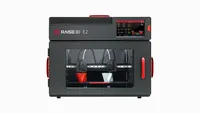
The Raise3D E2 is an enclosed prosumer FDM printer with an independent dual extrusion (IDEX) system, designed for engineers and small workshops that need reliable multi-material printing without compromise. With a 330×240×240 mm build volume, automatic leveling and a flexible magnetic build plate, the E2 makes the complex routine.
What it is
The E2 is Raise3D's second-generation prosumer mid-range machine and the only one in its price bracket with a true IDEX architecture: both print heads move completely independently along the X axis. This enables three working modes: standard dual-material printing (soluble supports plus model), duplication mode (two identical parts simultaneously) and mirror mode (symmetric parts). The enclosed chamber retains heat, making the machine suitable for ABS, ASA, PC and CF-Nylon without warping. It is aimed at R&D departments, jig-and-fixture production and short-run batches where predictability matters more than speed.
Technical specifications
| Technology | FDM (IDEX, enclosed chamber) |
|---|---|
| Build volume | 330 × 240 × 240 mm |
| Extruder system | IDEX: 2 fully independent heads on X |
| Print modes | Dual / Duplication / Mirror |
| Build plate | flexible magnetic PEI build plate |
| Class / Price | Prosumer · ~€3 500 |
Who it’s for
- Prototyping with soluble supports (IDEX): the independent heads print the model and soluble supports (PVA/HIPS) simultaneously, enabling complex overhangs beyond 45° without manual removal (Industrial design and R&D)
- Production jigs from engineering polymers: the enclosed chamber maintains a stable temperature for printing strong, dimensionally stable jigs and fixtures from ABS, ASA and PC (Automotive and manufacturing)
- Short-run production in Duplication / Mirror mode: both heads run synchronously and print two identical or mirrored parts at the same time, doubling the machine's effective throughput (Consumer goods manufacturing)
Calibration step by step
- Clean the flexible PEI build plate with isopropyl alcohol (IPA). A grease-free surface guarantees maximum adhesion and easy release once the part cools.
- Run automatic bed leveling. A precise digital mesh compensates for platform irregularities across the full build area.
- Calibrate the X/Y offset for both print heads. Perfect hardware and software alignment of the left and right extruder, preventing geometric misregistration during dual-material printing.
- Fine-tune Z-offset while printing a first-layer test. An optimally squished first layer that ensures adhesion without the "elephant's foot" defect.
Common defects and fixes
Recommended settings by material
Pick a material to see the recommended temperatures (empirical ranges from 561 OrcaSlicer/Bambu profiles) plus machine-specific tips:
Conclusion
The Raise3D E2 is the right choice when a project demands more than one material or production-grade repeatability. The IDEX architecture and enclosed chamber unlock engineering polymers and soluble supports, while Duplication and Mirror modes make short-run production efficient. If speed is not the priority but reliability and flexibility are, the E2 delivers both.
The full picture
This article is one page from The Big Book of 3D Printing: 704 illustrated pages covering every technology, material and fix in one reference.
Read it on Kindle →Engineer, author of The Big Book of 3D Printing and additive manufacturing expert