

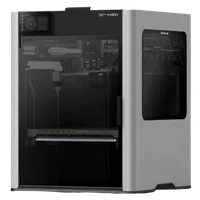
The Bambu Lab H2D is Bambu Lab's enclosed flagship: their first printer with two independent extruders (IDEX-style dual-nozzle), AMS 2 supporting up to eight spools simultaneously and an expanded 350×320×325 mm build volume. Designed for prosumer and light-production use, the H2D handles engineering polymers at elevated chamber temperatures and combines true multi-material printing with optional laser engraving and cutting modules.
What it is
The H2D is Bambu Lab's answer to the question of what comes after the X1 Carbon. The two nozzles operate independently: one prints the object while the other handles support structures or a second material, with no mid-print spool change required. AMS 2 doubles the capacity to eight spools with automatic switching, a tension sensor and humidity monitoring. The chamber is fully enclosed with active heating, which is mandatory for ASA, PC and CF-Nylon. Optional laser engraving and cutting modules turn the H2D into a hybrid workstation: engrave, cut and 3D print from a single device. It targets designers, engineers and small workshops that demand precision, material flexibility and hands-free operation.
Technical specifications
| Technology | FDM (CoreXY, enclosed chamber with active heating) |
|---|---|
| Build volume | 350 × 320 × 325 mm |
| Extruders | Dual-nozzle (IDEX-style): two independent print heads |
| Maximum speed | up to 500 mm/s |
| Nozzles | hardened steel (standard); tool-free swap |
| Calibration | automatic: LiDAR, leveling, Input Shaper, Pressure Advance |
| Multi-material | AMS 2: up to 8 spools, humidity monitoring |
| Class / Price | Prosumer · ~€899 |
Who it’s for
- Dual-material printing with soluble supports: one nozzle prints the object, the other lays down soluble supports (PVA/HIPS) for complex geometries with no manual break-away (Industrial design and R&D)
- Strong functional part production: jigs, fixtures and end-use parts from CF-Nylon, PC and PET-CF inside a stable heated chamber (Automotive and aerospace)
- Educational and STEM projects (multi-color models and demonstrations with AMS 2) from concept to finished object in a single loading (Education)
Calibration step by step
- Clean the PEI plate with isopropyl alcohol (IPA). An oil-free surface guarantees maximum first-layer adhesion.
- Run automatic leveling and the LiDAR first-layer inspection for both nozzles. Accurate Z-offset on both heads: no height mismatch between nozzle 1 and nozzle 2.
- Run the flow-rate and Pressure Advance calibration for each nozzle separately. Balanced extrusion: no blobs when switching between the two materials.
- Execute the XY-offset calibration between the two heads (dual-nozzle alignment). Precise layer alignment from both extruders: no lateral offset at the material boundary.
Common defects and fixes
Recommended settings by material
Pick a material to see the recommended temperatures (empirical ranges from 561 OrcaSlicer/Bambu profiles) plus machine-specific tips:
Conclusion
The H2D is the machine for those who have outgrown the X1 Carbon: needing two materials at once, more spools without interruption or a larger volume for real production parts. The dual-nozzle architecture removes the trade-off between switching speed and precision, AMS 2 delivers eight-spool hands-free operation, and the heated chamber makes PC and CF-Nylon as routine as PLA on a standard printer.
The full picture
This article is one page from The Big Book of 3D Printing: 704 illustrated pages covering every technology, material and fix in one reference.
Read it on Kindle →Engineer, author of The Big Book of 3D Printing and additive manufacturing expert