

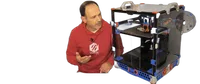
The Voron Trident KIT (LDO) is a self-assembly DIY kit for an enclosed CoreXY FDM printer in the prosumer class: a machine you do not buy ready-made but build yourself, bolt by bolt. With a 250×250×250 mm build volume, Klipper firmware and speeds exceeding 300 mm/s after Input Shaper calibration, the Trident Kit is both an educational and a technological investment.
What it is
The Trident Kit is not a printer in a box: it is a set of high-quality components from LDO Motors (motors, linear rails, frame, hotend), paired with thorough documentation from Voron Design. You assemble it yourself, configure Klipper from scratch and in the process understand every system of the machine. The result is an enclosed chamber with a three-point bed leveling (TAP probe), independent Z-motors and CoreXY kinematics capable of handling ABS, CF-Nylon, PC and any engineering polymer. Unlike the ready-built Trident 300, the KIT version requires 30–50 hours of assembly, but gives you full control and deep understanding of every component.
Technical specifications
| Technology | FDM (CoreXY, enclosed chamber) |
|---|---|
| Build volume | 250 × 250 × 250 mm |
| Maximum speed | over 300 mm/s (with Input Shaper) |
| Firmware | Klipper (Raspberry Pi / CB1) |
| Bed leveling | automatic: TAP probe + 3 independent Z-motors |
| Components | LDO Motors kit (frame, rails, motors, hotend) |
| Class / Price | Prosumer · ~€700 |
Who it’s for
- Automotive Jigs & Fixtures: in-house production of custom alignment tools and manufacturing fixtures capable of withstanding heavy mechanical stress using CF-Nylon or PC inside a stable enclosed chamber (Automotive)
- Functional Prototypes and Final Parts: small series production (1–100 units) of high-temperature resistant and durable mechanical components using ABS or ASA materials inside the enclosure (Engineering & Manufacturing)
Calibration step by step
- Tram the Z-axis and auto-level the heated bed. The build plate is perfectly parallel to the CoreXY gantry, ensuring a consistent distance across the entire X/Y plane.
- Fine-tune Z-offset for the first layer. The filament is correctly squished onto the PEI build plate without causing elephant's foot or leaving gaps between extrusion lines.
- Calibrate E-steps (rotation_distance in Klipper) via M92 commands. The extruder motor feeds the exact length of filament requested by the G-code, eliminating baseline under-extrusion or over-extrusion.
- Run Input Shaper calibration using an accelerometer (ADXL345). The Klipper firmware calculates and applies anti-vibration frequencies, allowing for high-speed printing (e.g., >300 mm/s) without ghosting artifacts.
Common defects and fixes
Recommended settings by material
Pick a material to see the recommended temperatures (empirical ranges from 561 OrcaSlicer/Bambu profiles) plus machine-specific tips:
Conclusion
The Voron Trident KIT (LDO) is not just a printer: it is a self-assembly project, an educational platform and a production machine in one. The thirty to fifty hours of assembly equip you with knowledge that no ready-to-print printer can provide. The result is an enclosed CoreXY machine running Klipper, capable of engineering materials and speeds exceeding 300 mm/s, built precisely to your requirements.
The full picture
This article is one page from The Big Book of 3D Printing: 704 illustrated pages covering every technology, material and fix in one reference.
Read it on Kindle →Engineer, author of The Big Book of 3D Printing and additive manufacturing expert