

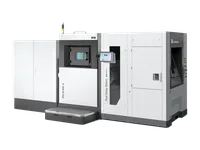
The EOS M 400-4 is an industrial DMLS/LPBF system with four 400W lasers, designed for high-throughput serial production of large metal parts. With a 400×400×400 mm build volume and four-laser parallel processing across the build area, it sets the benchmark for productivity in metal additive manufacturing.
What it is
The M 400-4 is EOS's flagship in the large-format metal additive segment. LPBF (Laser Powder Bed Fusion) technology (also known as DMLS in EOS terminology) fuses metal powder layer by layer with precise laser beams inside a sealed inert-gas atmosphere. The four independent lasers work simultaneously across different zones of the build volume, reducing build times for large parts by up to four times compared to single-laser systems. The machine targets enterprises requiring certified production of aerospace components, medical implants and complex industrial parts directly from a CAD file.
Technical specifications
| Technology | DMLS / LPBF (Laser Powder Bed Fusion) |
|---|---|
| Build volume | 400 × 400 × 400 mm |
| Laser system | 4 × 400 W Yb:YAG fibre lasers |
| Layer thickness | 20–90 μm (material-dependent) |
| Atmosphere | inert gas (nitrogen or argon), <0.1% O₂ |
| Powder handling | automated dosing and sieving via IPCM-L unit |
| Class / Price | Industrial · ~€1,500,000 |
Applications and industries
- Serial production of metal components: the four-laser architecture enables parallel processing of multiple parts in a single build, achieving cost-effective throughput comparable to conventional manufacturing methods (Industrial manufacturing and OEM suppliers)
- Large-format aerospace structures: the full 400×400×400 mm build envelope allows production of structural aviation and space components (brackets, heat exchangers, structural inserts) from certified alloys such as Ti6Al4V and Inconel 718 without welding (Aerospace industry)
- Automotive tooling and die inserts: production of conformal cooling channels in casting moulds and die inserts from tool steel (Maraging Steel / H13), reducing injection-moulding cycle times by 20–40% (Automotive and tooling industry)
Production workflow
- Prepare the CAD model: add support structures, optimize orientation and define the four-laser zone split in EOS Print software. Correct laser zone allocation prevents stitching defects at zone boundaries and ensures a homogeneous microstructure.
- Load and sieve metal powder through the IPCM-L unit; verify O₂ content in the chamber is below 0.1% before starting. The inert atmosphere prevents powder oxidation and guarantees the mechanical properties of the finished part.
- Execute the four-laser LPBF build: the four lasers fuse powder simultaneously in their respective zones, layer by layer, at 20–90 μm thickness. Parallel processing reduces total build time for large parts by up to four times compared to single-laser systems.
- Apply heat treatment (stress relief annealing or HIP) and remove supports via EDM or machining. Heat treatment relieves residual stresses, and proper support removal preserves the precise geometry of the part.
- Perform finishing as required: CNC machining of functional surfaces, polishing, coating application or HIP for full density. Final dimensional tolerances and surface roughness meeting aerospace and medical standards are achieved.
Key considerations
Materials and applications
Pick a material/alloy this machine processes to see its properties and typical applications:
Conclusion
The EOS M 400-4 is a system for enterprises where throughput and certification are not optional extras but hard requirements. The four lasers transform LPBF from a slow prototyping process into a competitive alternative to conventional manufacturing for complex metal parts. The investment is substantial, but within a properly integrated production environment (with heat treatment, automated powder management and CMM verification) the M 400-4 delivers repeatable, documented and certifiable metal additive output at industrial scale.
The full picture
This article is one page from The Big Book of 3D Printing: 704 illustrated pages covering every technology, material and fix in one reference.
Read it on Kindle →Engineer, author of The Big Book of 3D Printing and additive manufacturing expert