

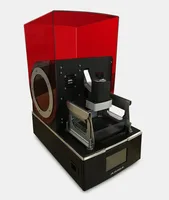
The Sinterit Lisa Rev. 2 is the most compact and affordable benchtop SLS printer on the market – an open system with a 110 × 160 × 245 mm chamber, a diode laser and a price below €10 000. It lets engineers and researchers work with true SLS technology without an industrial budget.
What it is
The Lisa Rev. 2 is the second generation of the Sinterit Lisa – the machine with which the Polish company practically created the affordable desktop SLS segment. It operates on the SLS (Selective Laser Sintering) principle: a diode laser sinters powder polymers layer by layer without support structures, enabling complex geometries and nesting of multiple parts in the chamber. The system is "open" – it accepts third-party powders, not only Sinterit materials. It targets small innovation teams, universities, medical and jewellery labs that want functional sintered parts without a six-figure investment.
Technical specifications
| Technology | SLS (Selective Laser Sintering), open system |
|---|---|
| Build volume | 110 × 160 × 245 mm |
| Laser | Diode laser, wavelength ~808 nm |
| Layer thickness | 75–175 µm |
| Powder system | Open – PA12, PA11, TPU/Flexa, TPE and third-party powders |
| Refresh Rate | Recommended ≥ 30 % fresh powder for PA12 |
| Class / Price | Entry industrial · ~€8 000 |
Applications and industries
- Small functional prototypes – Production of strong sintered parts for fit, assembly and load verification – without support structures, with multiple parts nested in the chamber (Product design and R&D)
- Flexible and elastic parts – Printing with TPU/Flexa and TPE powder for gaskets, seals, dampers and wearables requiring elasticity and repeated deformation resistance (Medical devices and sports accessories)
- Education and laboratory research – Gives universities and research labs access to real SLS technology for teaching, materials science and new powder validation at minimal capital cost (Academia and education)
Production workflow
- Prepare and check the powder blend (refresh rate). A blend of ≥ 30 % fresh and ≤ 70 % recycled powder ensures optimal sintering and mechanical properties.
- Set and wait for the chamber to reach operating temperature. A uniformly heated powder bed (around 170 °C for PA12) prevents thermal distortion and delamination.
- Start SLS sintering following the prepared profile in Sinterit Studio. The laser sinters layer by layer; the chamber maintains temperature without active cooling during printing.
- Wait for controlled cooling of the chamber after the job ends. Slow cooling (minimum 1–2 hours depending on material) prevents deformation from thermal shock.
- Remove the cake and unpack parts manually or with a brush in an unpacking station. Clean parts are ready for use or finishing – sanding, dyeing, impregnation.
Key considerations
Materials and applications
Pick a material/alloy this machine processes to see its properties and typical applications:
Conclusion
The Lisa Rev. 2 is the ideal entry point for anyone who wants to access SLS technology without an industrial budget. Its compact volume is offset by true SLS flexibility – no support structures, a broad material library from PA12 to TPU – and an open system that grows with the needs of the laboratory.
The full picture
This article is one page from The Big Book of 3D Printing: 704 illustrated pages covering every technology, material and fix in one reference.
Read it on Kindle →Engineer, author of The Big Book of 3D Printing and additive manufacturing expert