

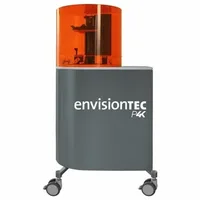
The EnvisionTEC (Desktop Health) Perfactory is a high-precision industrial DLP system designed for dental laboratories, jewelry studios and the medical industry. With a 160 × 100 × 180 mm build volume and projector-based DLP technology, it produces parts with surface quality and accuracy unattainable by standard FDM or SLA systems.
What it is
The Perfactory uses projector-based DLP (Digital Light Processing) technology, in which an entire layer is cured simultaneously by a UV projector: unlike SLA, where a laser traces point by point. The result: shorter layer cycle times, uniform accuracy across the entire build field, and remarkably smooth surfaces. The machine targets dental technicians, jewelry craftsmen and medical manufacturers, where every micrometer matters clinically or financially. EnvisionTEC's Perfactory RP software and closed material ecosystem ensure predictable, validated results.
Technical specifications
| Technology | DLP (UV projector, single-exposure per layer) |
|---|---|
| Build volume | 160 × 100 × 180 mm |
| XY resolution | down to 42 µm (optics-dependent) |
| Layer thickness | 15 – 150 µm |
| Light source | UV-DLP projector (365 / 385 nm) |
| Material system | Closed: EnvisionTEC/Desktop Health resins only |
| Class / Price | Industrial · ~€35,000 |
Applications and industries
- Dental models and copings: fabrication of precise dental models, temporary crowns, surgical guides and orthodontic devices from biocompatible and dental-grade resins (Dentistry and dental technology)
- Jewelry master patterns for casting: production of wax-like, zero-ash castable master patterns ready for direct investment casting in gold, silver and platinum (Jewelry and watchmaking)
- Hearing aids and medical prosthetics: customized hearing aid shells, in-ear monitor enclosures and small medical components with precise dimensions using biocompatible materials (Medical industry and audiology)
Production workflow
- Calibrate the UV projector: verify illumination uniformity across the full build field by printing a flat test plate. Uniform curing of each layer with no dark corners or overexposed zones, ensuring consistent XY accuracy throughout the build area.
- Load the resin and set the material parameters (exposure time, layer thickness) from the Perfactory RP material database. Layers cure with the precisely specified UV energy dose: no under-cure (weak parts) or over-cure (swollen dimensions).
- Print a control test part (e.g. a dental model) and measure critical dimensions with a micrometer or 3D scanner. Verification that deviations are within tolerances (±0.05 mm for dental); if out of spec, adjust the XY scale factor in software.
- Wash the printed part in IPA or a dedicated cleaning solution and post-cure in a UV oven following the resin protocol. Complete polymerization of the material, final mechanical strength and biocompatibility: no residual uncured monomers on the surface.
Key considerations
Materials and applications
Pick a material/alloy this machine processes to see its properties and typical applications:
Conclusion
The EnvisionTEC Perfactory is synonymous with precision in the industrial DLP segment. For dental laboratories, jewelry craftsmen and medical manufacturers where millimeter accuracy and biocompatibility are non-negotiable, the machine delivers validated results, a closed material ecosystem and an industrial-grade workflow. It is not a general-purpose printer: it is a specialized instrument, and that is exactly where its strength lies.
The full picture
This article is one page from The Big Book of 3D Printing: 704 illustrated pages covering every technology, material and fix in one reference.
Read it on Kindle →Engineer, author of The Big Book of 3D Printing and additive manufacturing expert