

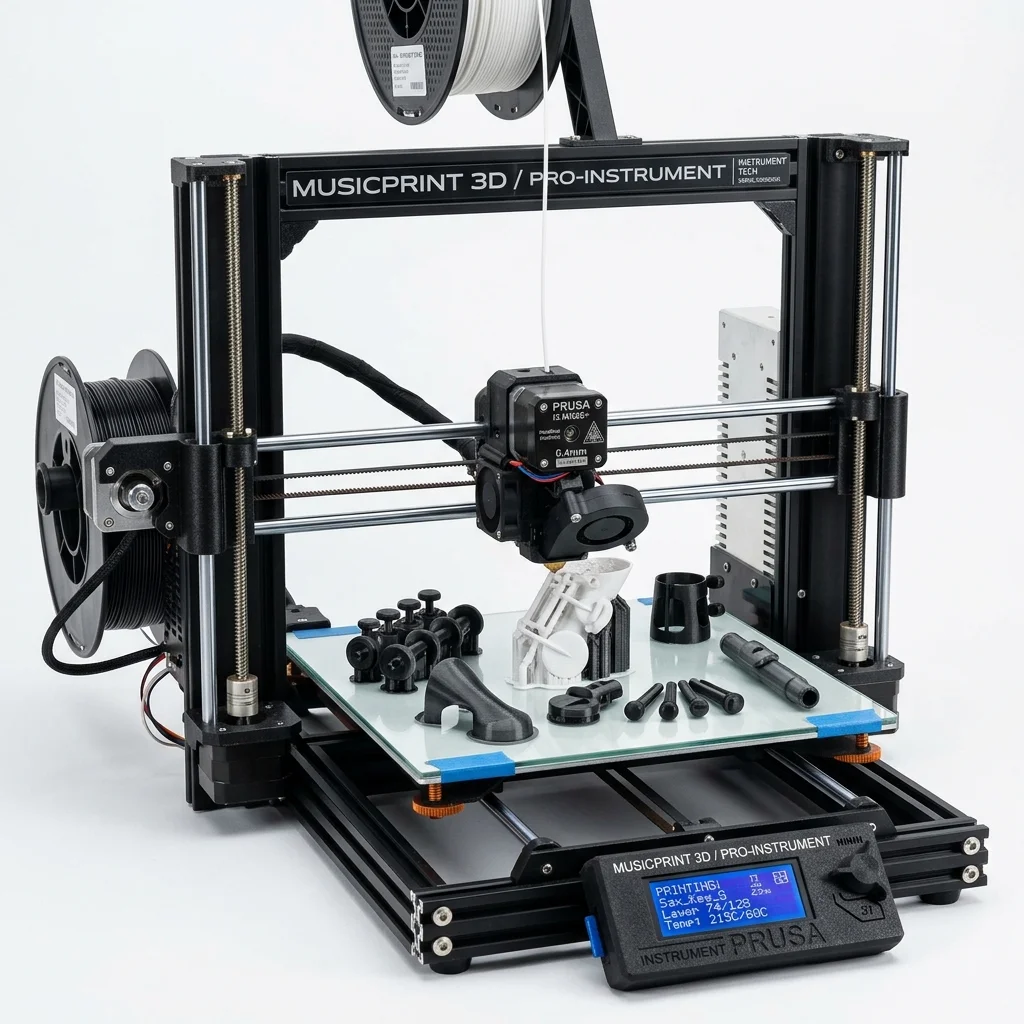
In this guide, we will explore all aspects of 3D printing for Musical Instruments Spare Parts. From choosing the right technologies and materials to cost analysis and common challenges. Whether you are a beginner or a professional, you will find valuable information here to optimize your workflow. Integrating additive manufacturing into this field offers flexibility, speed, and customization options. We will look at real-world examples and give you concrete steps to successfully realize your projects.
Advantages and Disadvantages
The application of 3D technologies for Musical Instruments Spare Parts has its specifics. Here are the main ones:
Pros:
- Rapid prototyping and design iteration
- High level of customization according to customer needs
- Waste reduction and material optimization
- Ability to create complex geometries
Cons:
- Limitations in the size of printed parts
- Print time can be long for large volumes
- Need for post-processing
- Requires specialized knowledge for file preparation
Costs and Investment
Cost analysis is key when implementing 3D printing for Musical Instruments Spare Parts. Here is a sample breakdown for initial deployment:
- Hardware investment (3D printer): 3500
- Starter pack of consumables (materials): 500
- Software licenses and initial setup: 1000
- Staff training: 1000
- Total: 6000
These costs quickly pay for themselves through the time and resources saved in manufacturing.
Workflow and Timeline
Implementing and manufacturing Musical Instruments Spare Parts follows a clear process. Here is the typical timeline for a project:
- Step 1: 3D modeling and CAD design (1-3 days)
- Step 2: File preparation (slicing) and material selection (1 day)
- Step 3: Actual 3D printing and monitoring (1-5 days)
- Step 4: Post-processing and support removal (1-2 days)
- Step 5: Testing, quality control, and finalization (1 day)
Following these steps ensures high quality of the final product.
Recommended Materials and Technologies
For Musical Instruments Spare Parts, choosing the right material is crucial. Commonly used are PLA, PETG, ABS, as well as more specialized materials like TPU for flexibility or carbon fiber composites for strength. Technologies like FDM are excellent for rapid prototypes, while SLS or SLA offer higher resolution and surface smoothness.
Real-World Examples
Many companies are already using 3D printing for Musical Instruments Spare Parts. For instance, startups are creating customized solutions that perfectly fit individual user needs. This not only improves functionality but also reduces time-to-market.
Common Challenges
When manufacturing Musical Instruments Spare Parts, you might face issues like warping, poor layer adhesion, or tolerance problems. Precise printer calibration and selecting the correct print profile are critical to avoiding these issues.
Frequently Asked Questions (FAQ)
Interactive Analyzer for 3D Printing For Musical Instruments Spare Parts – A Complete Guide
Select a profile to view detailed analysis.
The full picture
This article is one page from The Big Book of 3D Printing: 704 illustrated pages covering every technology, material and fix in one reference.
Read it on Kindle →Engineer, author of The Big Book of 3D Printing and additive manufacturing expert