

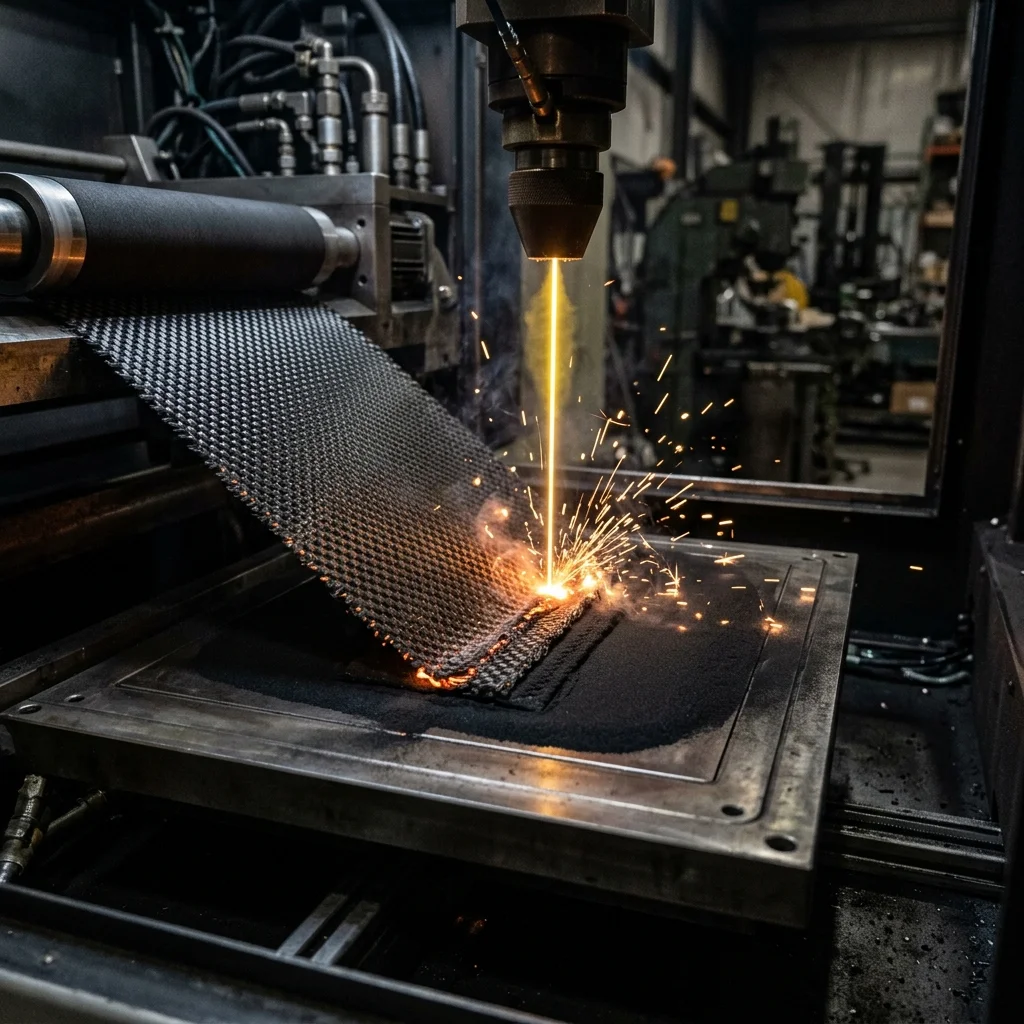
Composite Based Additive Manufacturing (CBAM) is a revolutionary 3D printing technology that combines the strength of continuous carbon fibers with thermoplastic polymers. This method allows for the creation of industrial parts with exceptional strength, often exceeding that of aluminum.
Unlike standard FDM printing, CBAM uses sheets of carbon fiber fabric and specialized thermoplastic powder (Carbon Fiber Blends). This guarantees perfect fusion and minimal internal stress within the part.
The result is a component that is incredibly lightweight but can withstand tremendous mechanical loads. This makes the technology ideal for aerospace, automotive, and drone manufacturing applications.
Why Carbon Fiber Blends are Perfect for CBAM
-
Extreme Strength: Carbon fibers provide unmatched tensile and compressive strength, which is critical for demanding industrial components.
-
Low Weight: The combination of thermoplastic and carbon is significantly lighter than metal alternatives while maintaining similar mechanical properties.
-
Fatigue Resistance: These materials can endure continuous vibrations and structural stress without deforming or cracking over time.
-
Chemical Resistance: The thermoplastic matrix often provides excellent protection against solvents, oils, and harsh industrial chemicals.
Recommended Printers and Materials
-
Impossible Objects CBAM-2: An industrial system specifically designed for the rapid production of composite parts from carbon fiber sheets and polymers.
-
EnvisionTEC SLCOM 1: A composite lamination machine that offers excellent integration of woven carbon fibers with thermoplastic matrices.
-
Fabrisonic SonicLayer 1200: While primarily known for ultrasonic additive manufacturing, it is often integrated into hybrid processes for complex prototypes.
For the best results, we recommend the following carbon-based consumables and materials:
-
ColorFabb XT-CF20: High-quality PETG with 20% carbon fiber content, excellent for highly rigid prototypes.
-
Prusament PC Blend CT: Polycarbonate infused with carbon, offering incredible temperature resistance and mechanical durability.
-
Bambu Lab Bambu PETG-CF: An accessible and easy-to-use material, ideal for visually flawless parts with enhanced structural strength.
Technical Parameters and Costs
Tensile Strength: 100 – 200 MPa (depending on the polymer matrix).
Heat Deflection (HDT): Over 150°C for polycarbonate and PEEK bases.
Part Density: Approximately 1.3 – 1.4 g/cm³.
Estimated Printer Cost: $100,000+ for industrial CBAM systems.
Material Cost (CF Blend): $50 – $120 per kilogram.
Frequently Asked Questions (FAQ)
Interactive Analyzer for Printing With Cbam And Carbon Fiber Blends
Select a profile to view detailed analysis.
The full picture
This article is one page from The Big Book of 3D Printing: 704 illustrated pages covering every technology, material and fix in one reference.
Read it on Kindle →Engineer, author of The Big Book of 3D Printing and additive manufacturing expert