

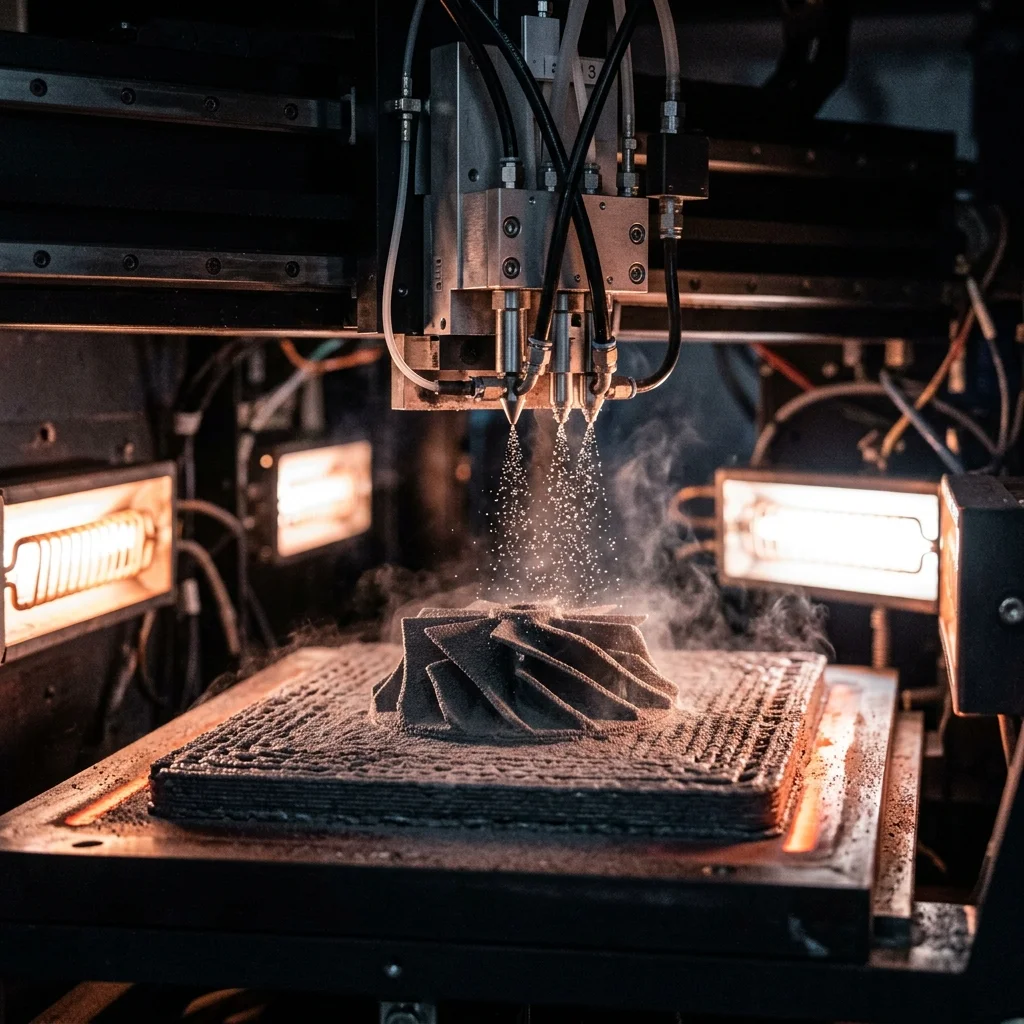
NanoParticle Jetting (NPJ) is a revolutionary 3D printing technology that uses inkjet principles for the precise deposition of ceramic nanoparticles. When this precision is combined with the exceptional properties of technical ceramics (like Alumina and Zirconia), the result is parts with unprecedented strength, thermal resistance, and smoothness. This article explores how NPJ is changing the game in the production of complex ceramic components.
Basics of NPJ Technology
NPJ is patented by XJet and differs fundamentally from traditional powder sintering. In this method, millions of liquid droplets containing ceramic nanoparticles are jetted onto a heated build tray.
The liquid carrier evaporates instantly upon contact, leaving behind densely packed ceramic particles. In this way, the part is built layer by layer with extraordinary precision.
Once the process is complete, the printed ‘green part’ must be fired (sintered) in a specialized furnace to remove residual binders and achieve its final density and strength.
Why Technical Ceramics Fit NPJ Perfectly
-
Ultra-High Resolution: Using nanoparticles instead of conventional powder allows for the printing of extremely thin layers (under 10 microns), creating parts with unprecedented geometric complexity.
-
Isotropic Properties: Unlike many other 3D technologies, parts printed with NPJ and subsequently sintered possess identical mechanical properties in all directions.
-
Surface Quality: Thanks to the minute particle size, the surface of the finished ceramic parts is so smooth that it often requires no additional mechanical post-processing.
Recommended NPJ Printers
The NanoParticle Jetting technology is exclusively offered by its creator, the company XJet.
-
XJet Carmel 1400C: The most powerful system in XJet’s portfolio, designed specifically for high-throughput ceramic printing. It features a massive build area (1,400 sq. cm) and supports industrial manufacturing.
-
XJet Carmel 1400M: This version is optimized for printing metals (e.g., stainless steel) but shares the exact same technological platform and precision as its ceramic counterpart.
-
XJet Carmel 700: A more compact system, ideal for research institutes and universities, offering the same high resolution but with a smaller build envelope.
Recommended Ceramic Materials
NPJ systems use the manufacturer’s specialized liquid cartridges, but fundamentally they contain popular technical ceramics.
-
3DCeram 3D Mix Alumina: Aluminum oxide (Alumina) is the most widely used technical ceramic. It offers exceptional hardness, electrical insulation, and high-temperature endurance.
-
Zortrax Alumina 4N: An alternative source of high-purity (99.99%) aluminum oxide, suitable for the most demanding industrial applications.
-
Tethon 3D Porcelain: This material is often used for more artistic or aesthetic applications, although zirconia and alumina dominate purely industrial needs.
Typical Applications and Use Cases
Technical ceramics combined with the precision of NPJ find a place in the most demanding sectors.
-
Medical and Dental: Manufacturing biocompatible joint implants, dental crowns, and bridges with high accuracy.
-
Aerospace Industry: Producing ultra-light insulating components that can withstand the extreme temperatures inside jet engines.
-
Electronics and 5G: Creating complex antennas and insulators requiring specific dielectric properties that only ceramics can provide.
Common Pitfalls and Best Practices
-
Fragility Before Sintering: After printing, the ‘green part’ is extremely fragile. It is mandatory to use special tools and trays to transfer it to the furnace.
-
Anticipating Shrinkage: During firing, the ceramic part shrinks uniformly by about 15-20%. This must be precisely calculated in the CAD software before printing.
-
Complexity of Support Removal: Even though the support material is soluble, washing it out of very narrow and long internal channels requires time and patience to avoid damaging the fragile structure.
Technical Specifications and Cost Estimate
Layer Thickness: Under 10 microns (ultra-thin layers)
Density after Firing: Over 99.9%
Equipment Price: XJet systems represent a major industrial investment, often exceeding 400,000 EUR.
Material Price: Closed cartridge systems are used, making the materials more expensive compared to traditional ceramic powders.
Frequently Asked Questions (FAQ)
Npj 3D Printing With Technical Ceramics: A Complete Guide Calculator
Interactive optimization calculator.
The full picture
This article is one page from The Big Book of 3D Printing: 704 illustrated pages covering every technology, material and fix in one reference.
Read it on Kindle →Engineer, author of The Big Book of 3D Printing and additive manufacturing expert