

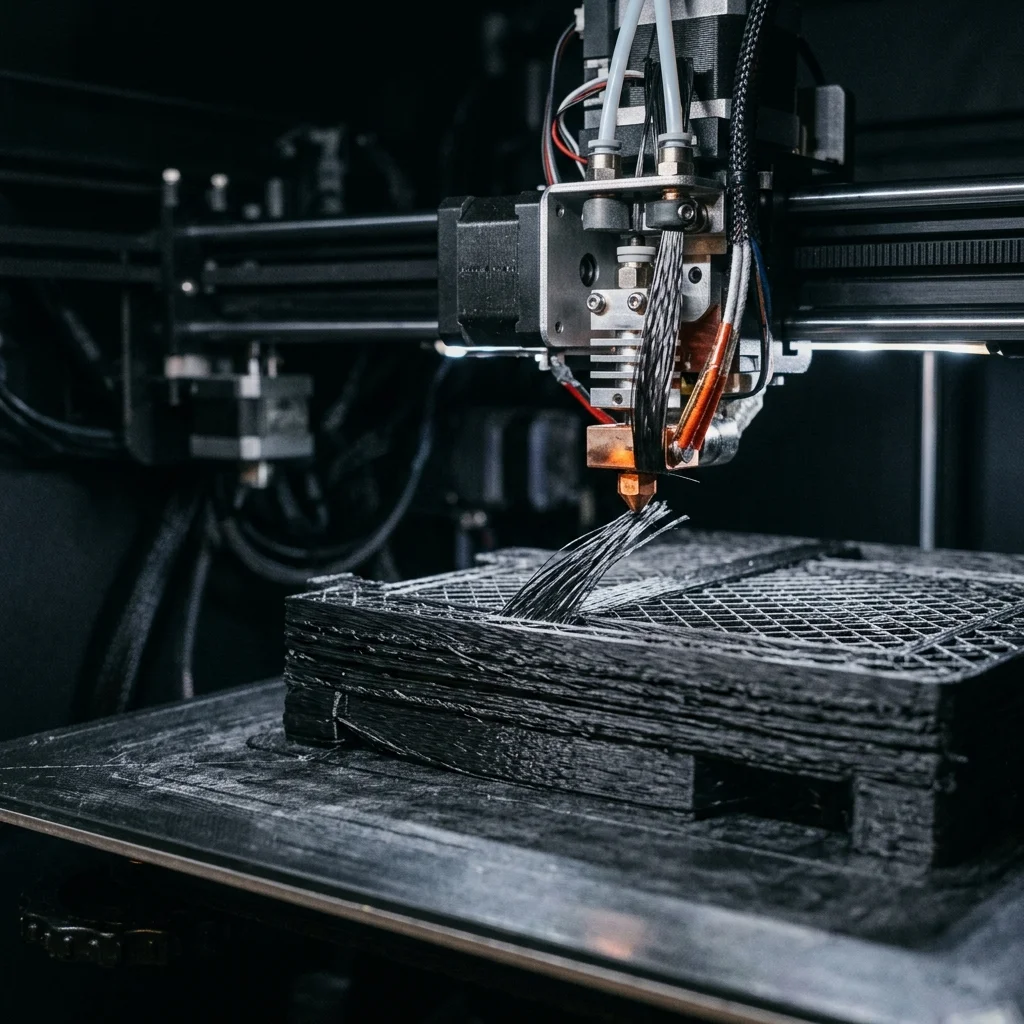
Continuous Filament Fabrication (CFF) technology represents a true revolution in the world of additive manufacturing, providing the ability to create parts with the strength of aluminum. When we combine this process with high-quality thermoplastics reinforced with chopped carbon fibers, we achieve durability and lightness.
This material has become an indispensable tool for engineers and designers seeking the optimal balance between weight and strength. Carbon fiber blends offer excellent mechanical resistance that meets the highest industrial standards.
In this guide, we will explore in depth how CFF printing works with these materials. We will discuss suitable 3D printers, recommended filament brands, typical use cases, and the most common challenges you might face.
What is CFF and Why are Carbon Blends Ideal?
CFF technology functions as an advanced upgrade to the traditional FDM (Fused Deposition Modeling) process. It utilizes two separate nozzles: one lays down the base thermoplastic material, while the other embeds a continuous reinforcing fiber directly into the part.
This method of “arming” the plastic creates composite parts that can replace metal components in many demanding applications. Carbon fiber blends are particularly suitable here because the thermoplastic matrix itself is already reinforced with chopped carbon fibers.
This dual reinforcement strategy (both within the base material and through the continuous fiber inlay) ensures exceptional rigidity and dimensional stability during printing. The result is a highly durable component that resists deformation and withstands immense loads.
-
Exceptional Strength: The combination of a carbon-infused thermoplastic matrix with continuous fiber reinforcement yields parts comparable in tensile strength to aluminum alloys.
-
Low Weight: Despite their incredible durability, these printed components are significantly lighter than their metal equivalents, which is critical for the automotive and aerospace industries.
-
High Thermal Resistance: These specialized materials maintain their mechanical properties even at elevated temperatures, making them perfect for under-the-hood applications and manufacturing tooling.
Recommended 3D Printers for CFF Technology
To achieve maximum results with CFF and carbon fiber blends, you need highly specialized equipment. The 3D printer must be able to precisely manage the dual extrusion systems and maintain the stringent thermal requirements of engineering-grade plastics.
Industrial printers designed for this purpose typically offer enclosed heated chambers and proprietary slicing software tailored for fiber routing. Here are some of the industry-leading machines available on the market today.
-
Markforged Mark Two: A highly compact and incredibly reliable desktop 3D printer. It offers flawless print quality and is the gold standard for creating strong fixtures and functional prototypes in an office environment.
-
Markforged X7: The industrial flagship of the Markforged lineup. It features a massive build volume, an integrated laser scanner for in-process quality control, and unprecedented precision in continuous fiber placement.
-
Anisoprint Composer A4: An excellent alternative that embraces an open materials ecosystem. This printer allows for greater flexibility, enabling advanced users to fine-tune printing parameters for various custom composites.
Top Materials and Brands (Carbon Fiber Blends)
Selecting the right base material is just as crucial as choosing the right printer. Different carbon fiber blends offer unique variations in tensile strength, thermal resistance, and overall ease of printing.
It is important to note that chopped carbon fibers are highly abrasive. Therefore, you must always use hardened steel or ruby-tipped nozzles to prevent rapid wear and maintain consistent extrusion quality.
Here are a few proven brands of carbon-reinforced thermoplastics that serve excellently as the primary matrix material:
-
ColorFabb XT-CF20: A PETG-based filament containing 20% specially sourced carbon fibers. It offers excellent dimensional stability, a beautiful matte finish, and is relatively easy to print without severe warping issues.
-
Prusa Research Prusament PC Blend CT: A premium polycarbonate blend that combines the exceptional temperature resistance of pure PC with the ease of printing provided by the carbon fiber additives.
-
Bambu Lab Bambu PETG-CF: An accessible and highly reliable option specifically optimized for high-speed core-XY machines. It ensures fantastic layer adhesion and a highly attractive textured surface finish.
Print Temperature (XT-CF20): 240-260°C.
Bed Temperature (XT-CF20): 60-70°C.
Print Temperature (PC Blend CT): 275-295°C.
Bed Temperature (PC Blend CT): 110-120°C.
Estimated Cost per kg: Around $50-$90 depending on the specific brand and polymer base.
Typical Use Cases and Common Pitfalls
Parts printed utilizing CFF and carbon fiber blends find their primary applications in the most demanding industrial sectors. They are the perfect candidate for replacing CNC-machined aluminum components when lower weight and rapid iteration are required.
Among the most common applications are custom manufacturing jigs and fixtures, robotic end-of-arm tooling, and highly functional prototypes for the automotive industry. These rugged parts easily endure constant mechanical stress in harsh factory environments.
Despite the numerous advantages, the CFF process does present certain unique challenges. Properly configuring the continuous fiber routing requires specific software expertise to ensure the structural loads are correctly supported by the continuous strands.
-
Abrasive Wear: Carbon fibers literally chew through standard brass nozzles in a matter of hours. The utilization of hardened steel nozzles is absolutely mandatory to preserve extrusion precision and avoid mid-print failures.
-
Material Moisture: Most engineering thermoplastics (especially Nylon and PC-based blends) are highly hygroscopic. They must be stored in dry boxes and actively dehydrated before printing, otherwise you risk brittle parts with terrible surface quality.
-
Design Complexity: To truly maximize the strength of the continuous fiber inlay, the component must be explicitly designed with load planes in mind, as CFF technology primarily reinforces along the X and Y axes.
Frequently Asked Questions (FAQ)
Interactive Analyzer for The Complete Guide To 3D Printing With Cff And Carbon Fiber Blends
Select a profile to view detailed analysis.
The full picture
This article is one page from The Big Book of 3D Printing: 704 illustrated pages covering every technology, material and fix in one reference.
Read it on Kindle →Engineer, author of The Big Book of 3D Printing and additive manufacturing expert