

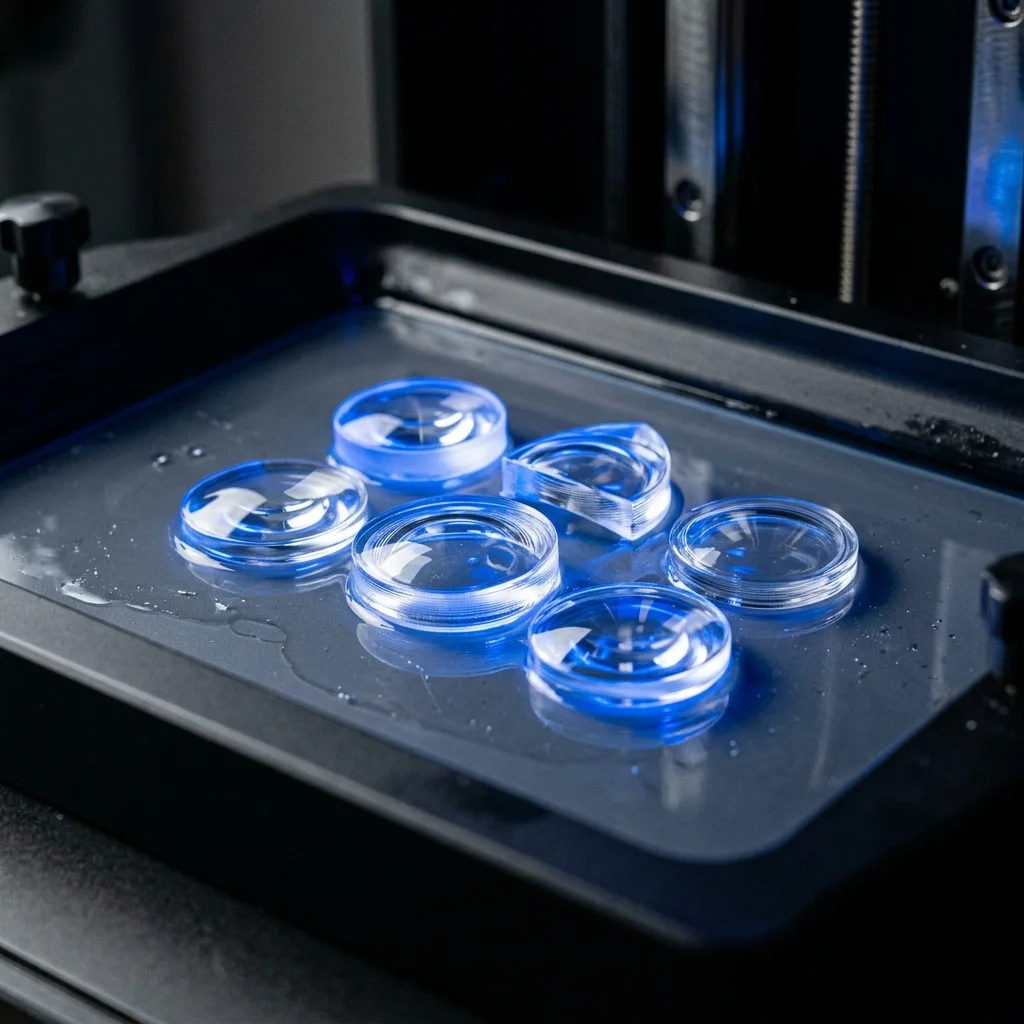
Clear (Transparent) resins are among the most visually appealing yet challenging materials in the realm of 3D printing. The ability to create optically transparent, glass-like objects opens doors to countless applications, from optical lenses and light pipes to artistic installations and architectural models. Combining these materials with DLP (Digital Light Processing) technology provides unique advantages. DLP printers can produce exceptionally smooth surfaces thanks to consistent pixel resolution, which is critically important for minimizing light scattering and achieving true transparency. In this guide, we will walk you through the fundamentals of working with clear resins on DLP machines, examine top-tier printers like the Desktop Health Einstein Pro XL and Anycubic Photon D2, discuss popular materials, and share the secrets of post-processing that transform a cloudy print into a crystal-clear masterpiece.
How DLP Technology Enhances Clear Resin Printing
DLP technology utilizes a digital projector to cure entire layers of resin simultaneously. The primary advantage of printing transparent parts with DLP lies in the surface quality. Unlike SLA, where the laser’s movement can leave microscopic traces (laser hatching), DLP pixels generate a highly uniform structural matrix. This is crucial because any micro-defect on the surface refracts light, making the part appear cloudy or frosted. Additionally, the precise light control inherent in DLP systems allows for accurate dosing of UV energy, which prevents unwanted overexposure: a common issue with transparent resins known as ‘light bleeding’. Since clear resin lacks pigments that block light, UV rays penetrate deeper, potentially curing resin in unintended areas. High-end DLP systems feature advanced anti-aliasing algorithms and dynamic intensity control that effectively minimize this light bleeding effect, ensuring crisp geometric accuracy.
Leading DLP 3D Printers for Transparent Materials
To achieve true optical transparency, you need a printer with high resolution and robust mechanics. The Desktop Health Einstein Pro XL stands at the pinnacle of the industry, offering exceptional 4K DLP projection and industrial-grade Z-axis precision, which practically eliminates visible layer lines: the primary enemy of transparency. The Flashforge Hunter is a highly reliable machine whose light engine provides a very consistent intensity of UV radiation; this is key to avoiding yellowish tints during the printing process. On the other hand, the Anycubic Photon D2 provides an affordable gateway to stunning results. Thanks to its true DLP projector, the D2 does not suffer from the ‘light diffusion’ typical of some LCD printers, allowing for extremely sharp edges even with completely transparent materials. This printer is perfect for jewelers, hobbyists, and engineers looking for high quality without a massive initial capital outlay.
Recommended Brands for Clear Resins
The quality of the resin dictates the final optical outcome. Formlabs Clear Resin is a highly popular choice among professionals due to its consistency and the ability to polish it to near-perfect transparency. It is ideal for prototyping bottles, lighting fixtures, and microfluidic devices. For those operating open material systems, Elegoo ABS-Like Clear is an exceptionally affordable alternative that offers a good balance between strength and clarity, though it may require slightly more effort during post-processing. Phrozen Crystal Clear is another outstanding resin, specifically formulated to resist aggressive yellowing under UV light: a notorious issue with many transparent photopolymers. It is perfectly suited for parts that will be exposed to sunlight or used for extended periods as functional demonstration models.
Applications, Pitfalls, and Post-Processing Techniques
Transparent resins are widely utilized for optical prototypes, clear electronics enclosures, medical models, and art pieces. The most significant challenge (pitfall) when working with them is achieving actual glass-like clarity, as parts typically emerge from the printer looking frosted and translucent due to layer lines. To overcome this, aggressive post-processing is mandatory. The part must be washed flawlessly, preferably in pure, clean isopropyl alcohol (dirty IPA will leave cloudy residue). This is followed by a wet sanding process using progressively finer grit sandpaper (from 400 up to 3000 grit) until a completely smooth surface is achieved. Finally, a clear UV-resistant acrylic clear coat is applied, or the part is machine-polished with a polishing compound. Another major trap is yellowing. All photopolymers yellow when exposed to UV light. To mitigate this, avoid over-baking the part during post-curing and opt for resins formulated with UV stabilizers.
Cost Analysis: Transparency on a Budget
The costs associated with printing transparent resins are comparable to standard and engineering resins, but you must allocate a supplementary budget for post-processing consumables. The resins themselves start at around $35-$40 per kilogram for budget brands like Elegoo, reach $60-$80 for Phrozen Crystal Clear, and can exceed $150 per liter for highly specialized materials from Formlabs. The true hidden cost here is the time and materials required for finishing. You will need sets of high-quality wet sandpaper ($15-$30), polishing compounds ($10-$20), and premium clear acrylic spray lacquer ($10-$25 per can). In a professional setting, the labor cost for manually polishing a single transparent part can significantly outweigh the cost of the material itself and machine depreciation. Nevertheless, creating such parts via traditional methods like injection molding or CNC machining acrylic would cost thousands of dollars, making 3D printing exceptionally economical for one-offs and low-volume production.
Frequently Asked Questions (FAQ)
Guide To 3D Printing With Dlp And Clear (Transparent) Resins Exposure Calculator
Calculate optimal resin print time.
The full picture
This article is one page from The Big Book of 3D Printing: 704 illustrated pages covering every technology, material and fix in one reference.
Read it on Kindle →Engineer, author of The Big Book of 3D Printing and additive manufacturing expert