

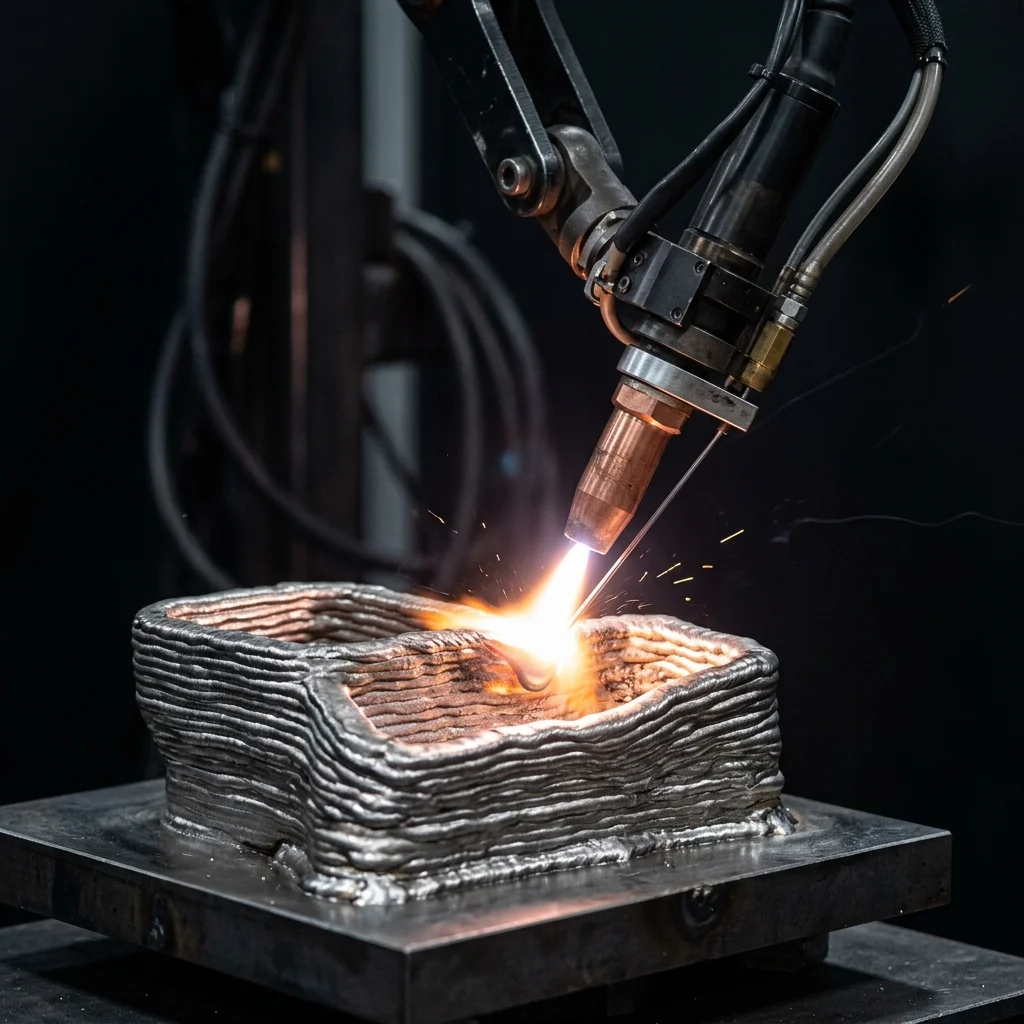
The demand for large, lightweight, and high-strength components is a primary driver in aerospace and automotive sectors. Wire Arc Additive Manufacturing (WAAM) provides a disruptive solution by merging high-speed arc welding with lightweight alloys like titanium and aluminum. This guide explores the WAAM workflow for reactive metals, detailing the necessary hardware, material equivalents, and crucial environmental controls.
Why Titanium and Aluminum are Essential for WAAM
Titanium (especially Ti6Al4V) and Aluminum alloys are prized for their high strength-to-weight ratios. Traditionally, machining large titanium components is incredibly wasteful, often milling away 90% of the expensive material.
WAAM transforms this workflow by producing ‘near-net-shape’ parts. This drastically lowers raw material waste and slashes lead times by utilizing standardized welding wire instead of massive forged billets.
Recommended Printers and Protective Systems
-
MX3D M1: A flexible robotic system that can be adapted for titanium and aluminum through the use of trailing shields or local environmental enclosures to manage oxidation.
-
AML3D Arcemy: Renowned for large-scale production, these systems integrate sophisticated localized shielding gas capabilities, which are absolutely critical when depositing reactive metals.
-
Gefertec arc605: Featuring 5-axis CNC kinematics, this machine ensures precise torch angles and consistent deposition, making it highly suitable for complex, critical aerospace geometries.
Recommended Materials and Equivalents
-
Concept Laser Ti6Al4V (Titanium): The workhorse powder of the aerospace industry, corresponding to Titanium Grade 5 wire in WAAM. It offers an unmatched combination of high strength and low weight.
-
SLM Solutions AlSi10Mg (Aluminum): A popular powder whose wire equivalents (e.g., ER4043) provide good weldability. Aluminum WAAM often requires specialized AC wave profiles to break up surface oxides continuously.
-
Renishaw Inconel 718: While a nickel superalloy rather than titanium, it is often processed on the same WAAM systems for high-temperature aerospace components.
Typical Industrial Applications
Aerospace manufacturers heavily adopt titanium WAAM to produce large structural airframe components, wing ribs, and engine mount brackets, where saving weight translates directly to fuel efficiency.
Aluminum WAAM is heavily utilized in the automotive, railway, and maritime industries to manufacture large structural frames and custom tooling where powder-bed technologies are far too slow.
Technological Pitfalls and How to Overcome Them
-
Titanium Reactivity: Titanium is highly reactive above 400°C. Exposure to oxygen creates a brittle ‘alpha-case’ layer. Printing requires flawless shielding gas coverage or an enclosed argon-purged chamber.
-
Aluminum Porosity: Aluminum presents high risks of hydrogen porosity and hot cracking. It demands perfectly clean wire and optimized pulsed arc settings.
-
Thermal Management: Both metals require advanced thermal monitoring to ensure the melt pool solidifies correctly without warping the massive structure.
Time and Cost Estimation
Titanium Wire Cost: Under €100/kg (vastly cheaper than €300/kg aerospace powder).
Aluminum Wire Cost: Very economical, around €15 – €30 per kilogram.
Deposition Rate: Can comfortably exceed 3 kilograms per hour for aluminum.
Overall Efficiency: Substantially lower total manufacturing time and material costs compared to traditional subtractive methods.
Frequently Asked Questions (FAQ)
Interactive Analyzer for Waam 3D Printing Of Titanium And Aluminum: Industrial Guide
Select a profile to view detailed analysis.
The full picture
This article is one page from The Big Book of 3D Printing: 704 illustrated pages covering every technology, material and fix in one reference.
Read it on Kindle →Engineer, author of The Big Book of 3D Printing and additive manufacturing expert