

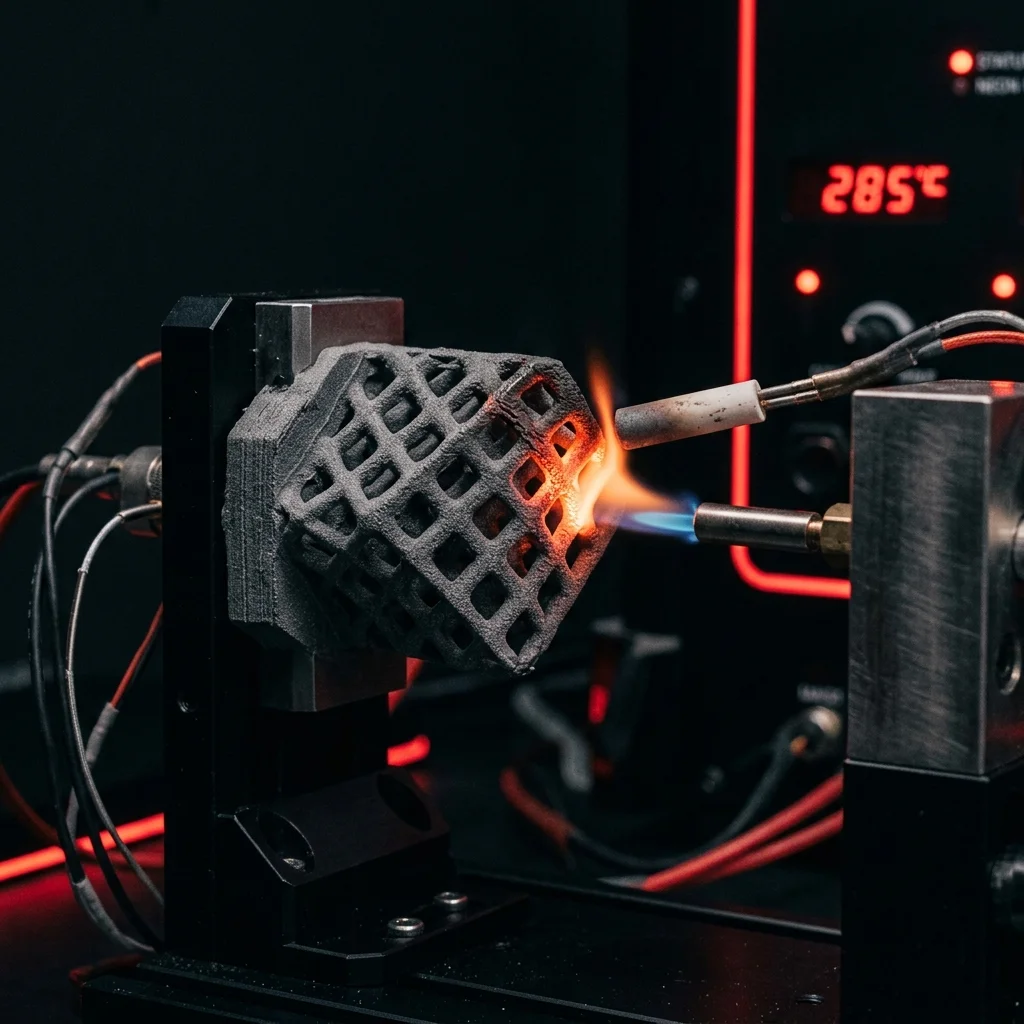
Flame retardant materials are crucial for applications requiring strict safety standards (such as UL94 V-0). Using SLS technology for their manufacturing allows the creation of lightweight yet exceptionally strong components.
These materials stop the spread of flames and are self-extinguishing. This makes them perfect for airplane, train, and automotive interiors.
SLS printing guarantees superior mechanical properties and isotropy, which are mandatory for end-product certification.
Key Advantages of SLS and Flame Retardant Materials
-
Fire Resistance: The materials often meet the UL94 V-0 standard. They self-extinguish when the fire source is removed.
-
Design Freedom: The lack of support structures in SLS allows designing complex internal channels. This is useful for ventilation systems.
-
Weight Reduction: SLS parts can be topologically optimized. This reduces the overall weight of the vehicle or machine.
-
High Durability: Parts printed with SLS are exceptionally resistant to mechanical stress.
Recommended Printers and Materials
For optimal work with flame retardant powders, here are our recommendations:
Formlabs Fuse 1+ 30W: A highly reliable system for industrial polymers. Perfect for small to medium production runs.
Sinterit Lisa Pro: Supports a wide range of specialized powders. Excellent choice for R&D.
Sintratec S2: Offers an easy transition between different materials. High process repeatability.
Stratasys Ultem 9085: Certified for aerospace applications. Possesses exceptional thermal and chemical resistance.
Polymaker Polycarbonate FR: High tensile strength. Perfect for mechanical components.
Markforged Onyx FR: Reinforced with micro-carbon fibers. Offers a perfect balance between strength and flame retardancy.
Applications, Issues, and Costs
Flame retardant materials are used for battery enclosures, electrical panels, connectors, and ventilation systems in transport. They are mandatory in any environment with a high risk of ignition.
-
High Equipment Cost: Printers and materials for such specific powders are an expensive investment.
-
Quality Control: To maintain their certification, parts must be printed under strict temperature control.
-
Moisture in Powder: Flame retardant powders are highly hygroscopic. Proper storage is critical for successful printing.
Frequently Asked Questions (FAQ)
Printing Flame Retardant Parts With Sls 3D Printers Calculator
Interactive optimization calculator.
The full picture
This article is one page from The Big Book of 3D Printing: 704 illustrated pages covering every technology, material and fix in one reference.
Read it on Kindle →Engineer, author of The Big Book of 3D Printing and additive manufacturing expert