

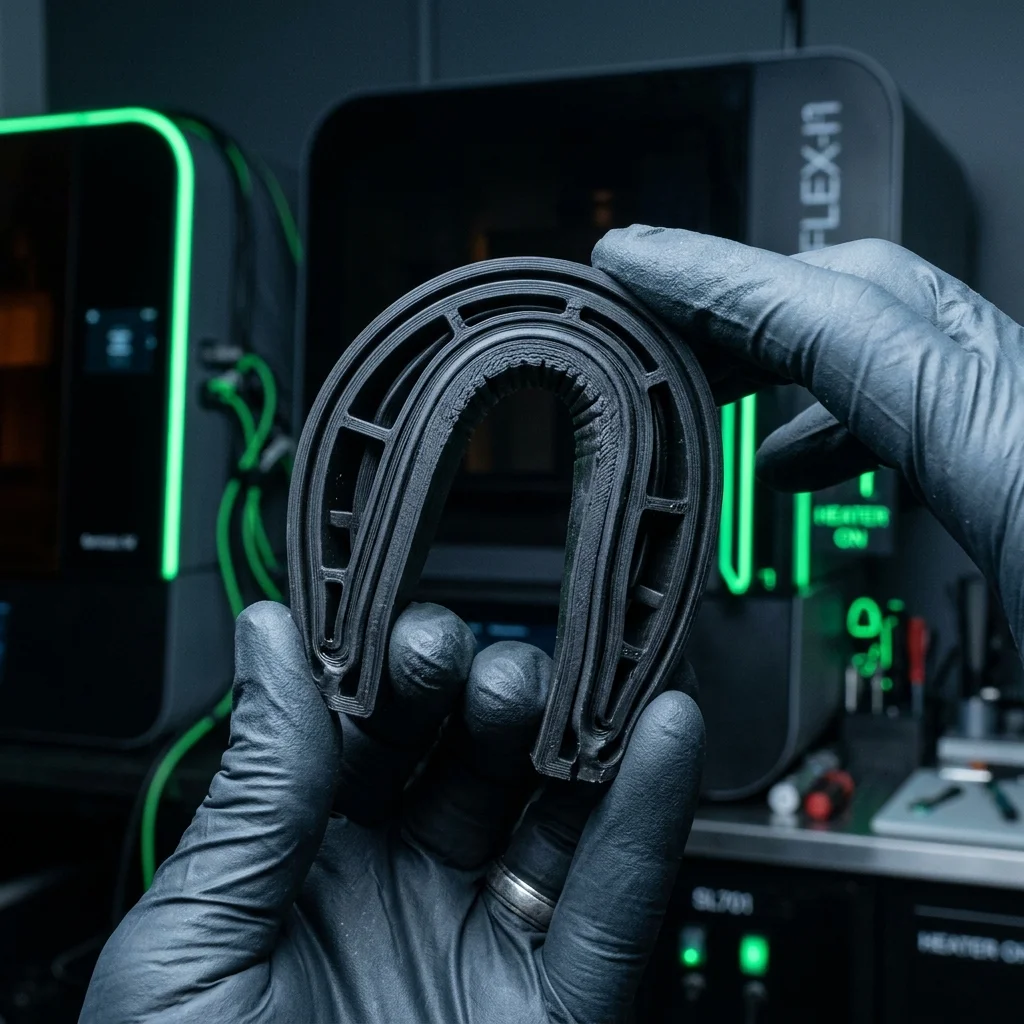
Flexible SLA resin (or ‘elastomeric resin’) solves one of SLA technology’s historical weaknesses: the hardness of standard resin. With Shore 50A-80A hardness (close to medical silicone or hard latex), flexible resin enables printing of gaskets, rubber-like prototypes, wearable objects (shoe insoles, garment grips), and medical prototypes (surgical trainers). Formlabs Elastic 50A is the standard, but the market has many MSLA-compatible alternatives. In this guide we cover flexible resin types, how they handle real applications (do they survive repeated bending?), and real engineering and medical examples.
Why flexible resin in SLA
Standard SLA resin has hardness ~80D (Shore D): almost non-bendable, brittle. For applications that need flexibility (gaskets, wearables, medical prototypes), standard SLA doesn’t work.
Flexible SLA resin has hardness:
- 50A (soft rubber, similar to medical silicone)
- 60A (medium rubber)
- 80A (hard rubber, similar to hard silicone or soft thermoplastic)
Key applications for flexible SLA resin:
- Gaskets and seals. For prototypes of functional systems (without certifications for real applications, for that silicone is better).
- Wearables. Garment grips, flexible decorative inserts.
- Medical prototypes. Surgical trainers for education, organ models for pre-operative planning.
- Flexible enclosures. For electronics that will bend (wearables, sports smart watches).
- Anti-vibration inserts. For small precision machines.
Key limitations:
- Not for long-term functional applications. SLA flexible resins gradually harden (become more brittle) over months. Real silicone gaskets last years.
- Not for loaded mechanical applications. Flexible SLA resin tensile strength: 5-12 MPa (vs 20-30 for injection-molded TPU). For real functional applications, FDM TPU printing is more sensible.
- Not for food applications. Standard flexible SLA resins aren’t food-certified.
- Not for long-term body contact. Only Formlabs BioMed Elastic is certified for long-term body contact.
Compared with FDM TPU:
- SLA flexible resin: finer resolution (25-50 µm vs 200 µm for FDM TPU). More complex to print.
- FDM TPU: more wear-resistant, more chemical-resistant, cheaper per volume. Lower resolution.
Flexible resin types
Formlabs Elastic 50A (€250/liter):
Industry standard. Hardness 50A (close to medical silicone). Impact-resistant, wearable without breaking. Recommended for Formlabs Form 3+ and Form 4.
Formlabs Elastic 50A White (€250/liter):
Same characteristics in white for visual marking.
Formlabs Flexible 80A (€280/liter):
Harder than Elastic 50A. Suitable for applications needing less flexibility (more stable enclosures).
Formlabs Silicone 40A (€350/liter):
Newer product (2023). True silicone resin for SLA printers (Form 3+ Open Mode + specialized tank). Biocompatible, medical certifications.
Anycubic Flexible Resin (€55/liter):
Hobbyist alternative to Formlabs Elastic. Similar characteristics at a quarter of the price. Works on MSLA printers.
Phrozen Rubber-like Resin (€60/liter):
Taiwanese competitor. Quality flexible resin.
Siraya Tech Flexible (€65/liter):
Professional flexible resin from Siraya. High repeatability, good long-term performance.
3DXTech HD-Flex (€95/liter):
Industrial flexible resin. More chemical-resistant, long-lasting.
eSUN Flexible (€50/liter):
Budget flexible resin. Lower quality than Siraya or Phrozen, but economically sensible for hobby applications.
Recommendation by application:
- Hobby experiments: Anycubic Flexible (€55/liter) or eSUN Flexible (€50/liter)
- Boutique prototypes: Siraya Tech Flexible (€65/liter) or Phrozen Rubber-like (€60/liter)
- Certified medical prototypes: Formlabs Elastic 50A or Formlabs Silicone 40A
- High repeatability and industrial use: 3DXTech HD-Flex
Recommended printers
For beginner experience:
- Anycubic Photon Mono M5s (€368): 12K MSLA. Works with Anycubic Flexible, Phrozen Rubber-like, Siraya Flexible.
- Elegoo Saturn 3 Ultra (€402): larger build volume.
For boutique projects:
- Phrozen Sonic Mighty 8K (€420): alternative with slightly higher resolution.
For certified medical prototypes:
- Formlabs Form 3+ (€3500): premium SLA with Elastic 50A or Silicone 40A.
- Formlabs Form 4 (€4500): 4× faster.
For industrial applications:
- EnvisionTEC Perfactory 4 (€35,000): professional DLP with high repeatability.
For a small medical prototype studio needing 5-15 flexible prototypes/month: Anycubic Photon Mono M5s (€368) + 1 liter Anycubic Flexible (€55) + Wash & Cure (€150) = €573 for a full start.
Optimal settings and processing
Layer exposure:
Flexible resins require shorter exposure than standard (to stay soft). Standard recommendations for 12K MSLA:
- Bottom layers: 25-35 seconds
- Standard layers: 1.8-2.5 seconds
- Number of bottom layers: 6-10
Supports:
Flexible resins require LESS supports than standard. Why? Because supports are of the same soft material: they’ll bend with the part and crack on removal.
- Tip size: 0.50-0.55 mm
- Density: light to medium
- Angle: 60-70°
- Always print with break-away supports (thin connection), not dense supports
Layer height:
- 0.10 mm standard
- 0.05 mm for fine details (but doubled time)
Post-processing:
Step 1: Carefully remove from platform. Flexible resins are ‘soft’, can tear with rough handling.
Step 2: Wash in IPA. 2-3 minutes (shorter than standard, flexible resins absorb IPA faster and can soften too much).
Step 3: Air dry or pat with paper towel.
Step 4: UV cure. 10-20 minutes in UV chamber. CRITICAL: flexible resins degrade if over-cured (become more brittle). Don’t leave for more than 30 minutes.
Step 5: Stabilization. 24 hours at room temperature. Flexible resins continue to cure slowly: final characteristics achieve after 48 hours.
Durability after repeated bending:
This is key for real applications. Tests show:
- Formlabs Elastic 50A: 5000-10000 cycles of 90° bending before first cracks.
- Siraya Tech Flexible: 3000-7000 cycles.
- Anycubic Flexible: 1000-3000 cycles.
For comparison: injection-molded TPU 95A: 50,000-100,000 cycles. Real silicone: 1,000,000+ cycles.
Conclusion: SLA flexible resins are suitable for prototypes and test applications. For real functional applications with many cyclic loads (pump gaskets, wearable flexible enclosures): choose FDM TPU or injection-molded silicone.
Real applications and examples
Application 1: Surgical trainer
Customer: medical university, surgery department. Need trainers for student education in specific surgical procedures (e.g. laparoscopic gallbladder surgery).
Solution: Formlabs Form 3+ with Elastic 50A. CAD design of gallbladder (anatomically correct from MRI data of a real patient), surrounding tissues, specific structures. Print 5-10 trainers per training session.
Cost: €120 material (5 trainers × 25 ml × €0.50/ml) + €200 design labor = €320 total. Alternative: plastic commercial trainers (€500-€1500 per piece). SLA is significantly cheaper and anatomically precise.
Application 2: Sealing gaskets for industrial prototypes
Customer: a measuring-instrument company. Developing a new industrial sensor model, needs gaskets for testing.
Solution: Anycubic Photon Mono M5s with Anycubic Flexible. Gaskets 30×30×3 mm with integrated conical sections for reliable seal. Print 20 gaskets in 1 build (2 hours).
Cost: €8 material + €15 labor = €23 for 20 gaskets = €1.15 per gasket. Alternative: Chinese injection-molded TPU gasket (€500 mold + €0.10 per gasket = €502 for the first 20). SLA is optimal for prototypes and small test runs.
Application 3: Flexible wearable enclosures
Customer: small SaaS firm developing a sports smart watch with a soft flexible enclosure.
Solution: Formlabs Form 4 with Elastic 50A. Enclosure 40×40×10 mm with integrated PCB and battery holder. 12 design iterations over 3 weeks of testing.
Cost: €180 material (12 versions) + €600 labor = €780 over 3 weeks. Alternative: Chinese silicone injection molding ($3000-€8000 for first run + 6-8 weeks delivery for each iteration). SLA is optimal for iterative wearable prototyping.
Application 4: Insoles for custom shoes
Customer: shoemaker making custom shoes for patients with orthopedic issues.
Solution: Phrozen Sonic Mighty 8K with Phrozen Rubber-like. Insoles (orthotic inserts) with personalized geometry from 3D scanning of the patient’s foot.
Cost: €15 material + €40 labor = €55 per pair of insoles. Alternative: external orthopedic bureau (€80-€200 per pair + 2-3 weeks delivery). SLA is cheaper and faster for personalized orthotic insoles.
Application 5: Anti-vibration inserts for precision machines
Customer: a lab service calibrating precision instruments. Old vibration inserts are degrading: needs custom replacements.
Solution: Anycubic Photon Mono M5s with Anycubic Flexible. Inserts with integrated cavities for optimal vibration distribution.
Cost: €5 material + €15 labor = €20 per insert. Alternative: specialized vibration insert from a European bureau (€80-€200 each + 2 weeks). SLA is optimal for custom anti-vibration inserts.
Economic analysis:
SLA flexible resins are optimal for:
- 1-50 pieces: always win against injection molding.
- 50-500 pieces: competitive with Chinese injection (but without 4-6 weeks delivery).
- 500+ pieces: switch to FDM TPU (Bambu Lab P1S with PolyFlex TPU), more economical at volume.
Frequently Asked Questions (FAQ)
Interactive Analyzer for Sla With Flexible Resin, For Rubber-Like Prototypes And Gaskets
Select a profile to view detailed analysis.
The full picture
This article is one page from The Big Book of 3D Printing: 704 illustrated pages covering every technology, material and fix in one reference.
Read it on Kindle →Engineer, author of The Big Book of 3D Printing and additive manufacturing expert